


How smart digital printing and packaging warehouses and intelligent 5G factories solve production pain points
Recently, the Ministry of Industry and Information Technology released the "2025 5G Factory Typical Application Practices", selecting 100 technologically advanced and benchmark-led typical application practice projects from 1,260 5G factory list projects across the country, including raw material industry, equipment industry, consumer goods industry, electronic information, energy and transportation and other important industries. This issue focuses on the printing and packaging industry in the consumer goods industry, takes you to unlock the implementation experience of the "Wine Box Digital Intelligent Printing and Packaging Vertical Warehouse Intelligent Distribution 5G Factory" project, and sees how "5G + Industrial Internet" solves the pain points of production and brings triple improvements in efficiency, cost and quality.
1. Project overview
Jiangsu Huayu Printing Co., Ltd. focuses on the digital transformation needs of the whole process of high-end liquor packaging, and builds a 5G factory for digital intelligent printing and packaging of wine boxes based on the top-level design architecture with "Kingdee Cloud" as the core. Through the deployment of 5G communication technology, we can deeply understand all aspects of production, realize intelligent upgrading and data-driven interaction of production equipment, covering the whole process from raw and auxiliary material procurement, raw material warehousing, UV printing, die-cutting, lamination, assembly, packaging and warehousing, to product sales and service. Integrate intelligent digital management applications to realize integrated management of sales orders and production plans, optimize management processes, give full play to the advantages of 5G large bandwidth and low latency technology, and comprehensively improve the overall operational efficiency and collaboration capabilities of the factory. The project promotes the deep integration of traditional printing enterprises and modern information technology, forming a benchmark for the digital transformation of the printing and packaging industry.
2. Construction needs
Jiangsu Huayu Printing Co., Ltd. is still facing the following key bottlenecks in the process of promoting the deep transformation of digitalization, networking, intelligence and new industrialization: First, on the production side, the existing system relies on the wired network, and the data transmission of offset printing, die-cutting and other equipment in the workshop is easy to interrupt during mobile operations, resulting in delays in the feedback of key process parameters such as color difference and pressure, affecting the quality stability of printed materials; Multi-equipment collaboration relies on manual scheduling, which cannot realize real-time linkage across processes and restricts production efficiency improvement. Second, on the supplier side, there is a lag in the data interaction between the SRM system and upstream raw material suppliers, and the raw material arrival progress and quality inspection information cannot be synchronized to the production scheduling link in real time, which can easily lead to frequent adjustment of production plans and increase operating costs. The third is the warehousing side, the finished products of the wine box pay attention to the integrity of the appearance, and the orders are mostly batch customization, the delivery cycle is tight, the existing three-dimensional warehouse relies on a fixed wired network to connect the stacker and conveyor line, the movement range of the equipment is limited, and it is easy to cause the stacker to stagnate due to signal interruption when the wine box is dispatched out of the warehouse across regions, affecting the efficiency of entering and exiting the warehouse. The company urgently needs to realize the full-link visualization of "procurement, production, warehousing, storage, and warehousing" through the construction of 5G factories, greatly improve the efficiency and accuracy of finished wine box products, and strengthen the delivery competitiveness of customized orders.
3. Construction plan
This construction solution is based on the "end-edge-cloud" collaborative architecture to realize device interconnection, real-time data collection, and unified business management. 20 devices (including vertical warehouse conveying equipment, system control terminals and handheld PDAs) are deployed on the end side to be responsible for finished product transportation, data collection and control; The edge is equipped with 3 sets of edge devices (including edge gateways, sensors and MEC servers) to undertake computing, storage and process instruction issuance. The cloud side integrates three systems of Kingdee Cloud, WMS, and SRM to manage core businesses such as finance, supply chain, and production in a unified manner. Through the collaboration of 5G hybrid private network, edge computing and industrial Internet platforms, the automatic collection rate of production process data exceeds 90% and the automatic control commissioning rate reaches 95%, fully supporting the intelligent operation of the factory.
5G network: Deploy a 5G hybrid private network to provide high-bandwidth, low-latency, and highly reliable in-plant data exchange capabilities to ensure real-time transmission of equipment commands and visual data. Network O&M is operated by China Mobile Operators to achieve dynamic resource allocation and typical attack protection, and improve system security and stability.
Edge computing: Relying on MEC servers and edge gateways, multi-device data is aggregated and process parameters are distributed in milliseconds on the shop floor, reducing cloud dependence. Combine edge sensors with redundant storage to improve production response speed and equipment collaboration efficiency, ensuring real-time control of critical processes.
Industrial Internet platform: With Kingdee Cloud as the core, it integrates MES, WMS, SRM and other systems, and collects and processes production data through the Huayu central control platform to realize the whole business process from order to delivery. The platform supports modules such as finance, supply chain, manufacturing, and human resource management, helping the automatic collection rate of production process data to exceed 90% and the automatic control and commissioning rate to 95%, forming an enterprise-level industrial Internet base.
4. Application scenarios
Scenario type 1: Flexible manufacturing
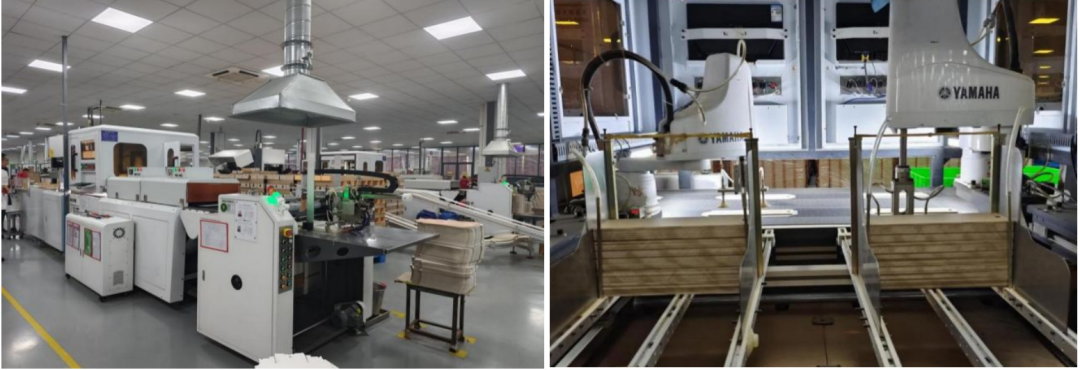
The factory's printing and packaging production line is characterized by dynamic reconfigurability, and has built an intelligent manufacturing unit with high flexibility in offset printing, box making, and assembly, and the production line adopts a modular layout design. The core equipment includes high-precision double-rotary knife web slitting machine, automatic laminating machine, automatic high-speed water-based laminating machine (800 type) and other digital equipment, all of which are connected to the 5G network and interconnected through standardized interfaces to form freely combinable "manufacturing blocks". Operators can quickly call the preset scheme according to the order needs of Kingdee Cloud system, complete the flexible adaptation of the whole process such as product material path switching, silk screen printing parameters, and hot stamping processes, and realize the mixed production of multi-variety and small-batch packaging boxes. The equipment status and process are mapped in real time through the platform, and operators can remotely verify the feasibility of the new configuration scheme, ensuring that the production line accurately responds to the diverse needs of the market while maintaining a high cycle rate, and covers multiple key processes such as printing, die-cutting, folder gluing, and assembly.
Scene Type 2: Production Site Monitoring
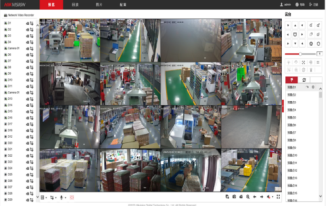
Deploy Hikvision HD intelligent cameras and other smart terminals in the workshop, and connect the monitoring data to the network, covering the production line, key equipment stations, and material flow areas of the liquor box production workshop. High-definition video is transmitted in real-time through a 5G gateway. On-site real-time monitoring of the production line operations allows for a clear view of the production rhythm at each station and personnel operations.
Scenario Type 3: Machine Vision Quality Inspection
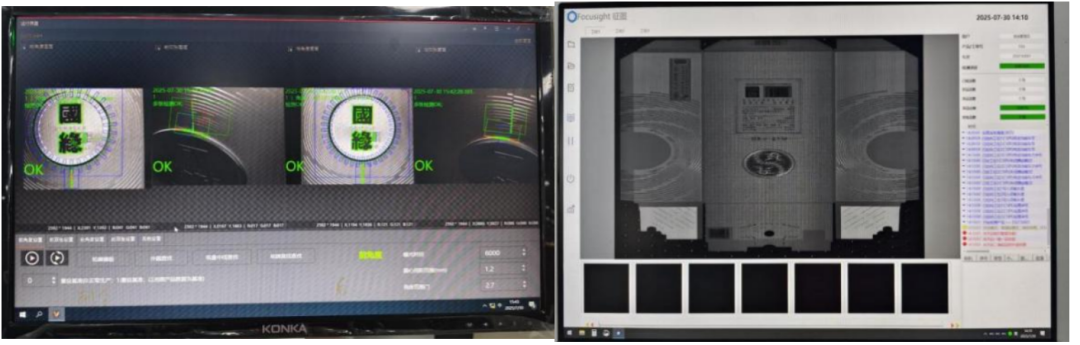
During the production of semi-finished liquor boxes, 5G devices such as product inspection machines, five-sided visual inspection machines, and double-opening visual inspection machines are used to build a full-process quality monitoring system for semi-finished liquor boxes. The system is equipped with high-precision industrial cameras to perform comprehensive inspections of the liquor box paperboards on the production line, accurately checking the correctness of text and graphics (no typos, missing characters, extra characters, or blurriness), consistency of printing colors (no obvious color differences, moderate saturation, surface dirt, ink spots, wrinkles, and other defects), secure gold stamping without smudging, dirt, and more than 20 other defects. At the same time, the system integrates intelligent rejection mechanisms to precisely intercept defective products, ensuring that lamination, embossing, screen printing, gold stamping, cross-cutting, and color differences meet quality standards.
Scenario Type 4: Industrial Compliance Verification
The finished wine box packaging relies on the quality inspection standards and process operation compliance standards provided by the company. In a production site covered by a 5G network, industrial cameras, sensors, and other equipment are used to monitor each production stage. The 5G network collects real-time parameters such as cutting dimensions and gluing flatness, as well as other appearance and dimension indicators. The collected information, including raw material characteristics and process parameters for each stage, is compared with preset process standard procedures and compliance requirements to identify non-compliance issues such as reversed operational steps or incorrect raw materials. This realizes real-time compliance verification of the wine box packaging production process, ensuring that production quality meets standards.
Scenario Type 5: Production Process Traceability
The company's wine box product production process traceability uses the pallet QR code as the core carrier and relies on the 5G network for full-process tracking. When a pallet carrying finished wine boxes enters various automated storage warehouses, the Dongjie 5G smart handheld PDA (WMS system) immediately reads the pallet QR code and simultaneously collects the material codes of the finished products. The data is transmitted to the cloud platform in real time, associated with the QR code information, integrated to form a complete traceability database, and the locations of the wine box products are tracked in real time. Through the SRM system, a 'one item, one code quality traceability system' is constructed. Each finished wine box product is assigned a unique QR code or barcode, allowing easy tracing of the production process, including details such as the manufacturer, production workshop, and production team. In the event of a quality anomaly, the traceability code can quickly locate the problem stage, query upstream raw material suppliers, and track downstream product flow within the same batch, providing data support for quality improvement and optimizing product quality.
Scenario Type 6: Precision Dynamic Operations
The WMS system manages finished product inventory uniformly and generates delivery instructions. The WCS system serves as the central hub, coordinating RGVs, shuttles, stackers, and conveyor lines through the 5G network in real time. RGVs are responsible for workshop material transfer, stackers perform warehouse pallet storage and retrieval, and high-precision positioning technology enables scheduled, fixed-point, and accurate deliveries from the warehouse to production line stations. With the linkage of WMS/WCS systems, RGVs transport wine boxes to the sorting storage, stackers automatically assign storage locations based on order priority, and WCS dispatches RGVs to precisely deliver specified batches to workstations. This enables full-process automation and intelligence in material storage, transportation, and sorting.
Scenario Type 7: Intelligent Logistics in Factory Area
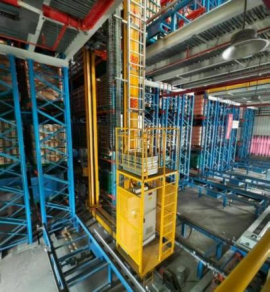
The WMS system is deeply integrated with the automated high-rise warehouse, enabling full-process management of inventory. Relying on a 5G standardized network, it achieves digital control of the entire process including inbound quality inspection, intelligent storage allocation, outbound picking, and inventory transfer. By integrating 5G intelligent equipment such as stackers, conveyors, and RGVs, and combining with a 5G private network to achieve precise equipment positioning and coordinated scheduling, it ensures fully automated circulation of finished wine boxes. During inbound, storage location information is bound via Dongjie smart handheld PDAs; during outbound, logistics orders are automatically matched to generate electronic waybills, allowing real-time tracking of shipment data. MEC edge computing nodes process sensor data in real-time, dynamically optimizing sorting paths, ensuring precise traceability and rapid flow of orders throughout the inbound, storage, and outbound processes, achieving zero-error distribution for a large volume of orders.
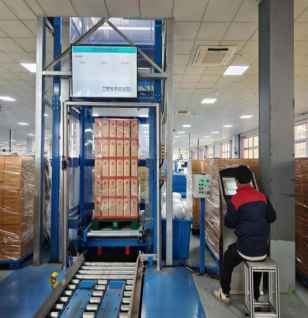
Scenario type 8: Global logistics monitoring
The system realizes global logistics monitoring through 5G network and big data technology, and internal logistics relies on 5G private network and high-precision positioning technology, and the finished products of the production line automatically scan the code to bind the pallet and upload the data to the WMS system in real time. External logistics intelligently matches the source information through the logistics scheduling platform, and the shopkeeper platform uses intelligent terminals to collect vehicle, goods and personnel data, providing real-time positioning, trajectory tracking and status monitoring, and enterprises can check the order status (such as in transit, signed) in real time. Based on the integration of 5G private network and multiple platforms, it realizes real-time collection of logistics data, full traceability and intelligent scheduling, improves warehousing and transportation efficiency, and ensures the safety and accurate monitoring of finished wine box products in warehousing, warehousing and transportation.
5. Build value
Economic value
Since the completion and application of Jiangsu Huayu Printing Co., Ltd.'s 5G factory for digital intelligent printing and packaging of wine boxes, the economic benefits have been remarkable. the cumulative reduction of comprehensive production costs by 14.5%, about 8 million yuan/year; The order delivery cycle has been shortened from 15 days to 5 days, the equipment utilization rate (OEE) has reached 89%, and the inventory turnover rate has increased by 67%. At the same time, the operation and maintenance costs of internal equipment and facilities and the comprehensive cost of enterprise operation have decreased significantly.
Social value
Due to the lagging production management methods and low capacity utilization rate adopted by the printing industry in the past, the economic efficiency of domestic printing enterprises has continued to decline, the development is slow, and it has also brought problems such as waste of social resources. This case is provided in the form of SaaS software service through the construction mode of 5G technology application, 5G big data computing center and data warehouse. Modular services such as warehousing orders and production process management, quality control, and supply chain collaboration empowered by 5G can support the customized needs of high-end liquor such as Jinshiyuan and Gujing Gongjiu.