


Prepress Waste Halved, Efficiency Doubled! How Did Chengdu Huicai Achieve This?
In the current era of rapid iteration in the label printing industry and increasingly diverse market demands, the prepress stage, as a key hub connecting design creativity and printing production, directly affects the quality and delivery cycle of the final product. However, common issues in traditional prepress processes, such as low efficiency in file preparation and a high error rate in printing plates, limit further development of enterprises. In this article, the author uses the lean implementation of the prepress process as an example to systematically outline the path from pain point resolution, implementation, to effect transformation, hoping to provide some reference methods for industry colleagues.

Pain Points in the Prepress Process
Before the company carried out lean transformation of the prepress process, it was necessary to manually conduct process reviews, single mold production, color proofing, imposition, and process plate design. This not only consumed a lot of time and effort but also made errors frequent due to human negligence, seriously hindering production quality improvement and efficiency enhancement. Specifically, this is mainly reflected in the following two aspects:
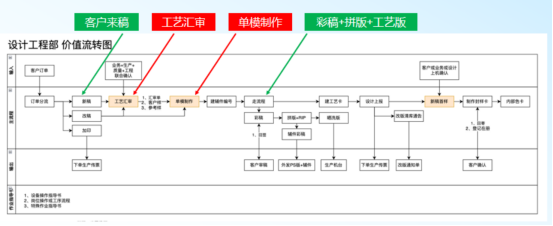
Design Engineering Department Workflow
01
Customer-submitted files have many "hidden dangers," and the error rate during machine processing remains high
Customer-submitted files are often non-standardized, such as RGB images, four-color black text, very thin lines, and designs without bleed. When prepress staff review the files or create process plates, even slight carelessness can easily miss some issues, leading to unexpected errors and posing significant challenges to prepress processing. At the same time, because each person's approach to preparing files is different, any revision often results in errors, color mismatch, or misregistration, further increasing the complexity and uncertainty of the prepress workflow.
02
Low file production efficiency and large differences in manual operation
When prepress staff conduct process review and create process plates, they rely entirely on personal experience, lacking standardized decomposition logic and unified execution standards, making it difficult to maximize process value. Single-die production lacks standardized procedures, easily causing missing graphics, missing text, forgotten text-to-curves conversion, misaligned die lines and borders, and insufficient image resolution, with no efficient self-check methods, making it hard to intercept errors in advance. Even if the customer's design files are of high quality, achieving precise reproduction is difficult; color deviations and misregistration occur frequently, seriously slowing down production schedules.
Lean Implementation of the Prepress Process
To address the above pain points, Chengdu Huicai focuses on automation, standardization, intelligence, and lean principles. It has introduced professional prepress workflow software, reconstructing the entire process operation system (as shown in Figure 2), and has implemented lean practices in five key stages.

Figure 2 Lean prepress process display
01
Pre-check the customer's manuscript and intercept the risk of documents in advance
The automatic pre-inspection mechanism of the system is introduced, which can carry out all-round intelligent verification of customer manuscripts. For example, the system will automatically detect the text conversion status of the customer's manuscript file and confirm whether the text has been converted into a curve; It will check whether the resolution of the image meets the printing standard; It will check whether the color mode of the customer's submission file is CMYK mode; It checks whether the customer submission file has the correct bleeding level, etc. One-click error reporting and automatic correction, eliminating hidden dangers from the source, replacing the traditional manual review mode one by one, greatly improving the efficiency and accuracy of incoming manuscript processing.
02
Upgrade the single-mode production tool and realize standardized processing with one click
The introduction of the system's efficient single-mode production tool can realize the automation of a number of functions: one-click automatic bleeding, one-click automatic trapping, one-click automatic whitening and establishment of independent layers, one-click generation of product renderings, etc., completely solving the problem of cumbersome manual operation and inconsistent standards. At the same time, the basic specifications for single-mode production are clarified, and standards such as size, bleeding, text, regulations, graphics, and color classification are unified to eliminate individual operation differences and ensure efficient and accurate output of single-mode files.
03
Automatically generate product confirmations to simplify the customer approval process
The system automatically generates product confirmations and directly pushes customers to complete the approval, eliminating manual sorting, verification, and sending, greatly shortening the communication cycle, improving customer confirmation efficiency, and realizing closed-loop management of order information.
04
The imposition and process plate are fully automated, improving the efficiency of plate making
Realize the full automation of imposition and RIP processes, and can automatically generate imposition lines, registration marks, cutting marks, etc. according to different machine parameters. Synchronously complete the processes of automatic color separation, auxiliary parts generation, and outgoing task push to ensure that there are no omissions in prepress materials and zero errors in plate making.
05
Intelligent self-inspection and verification ensure the quality of final documents
The automatic comparison function between customer manuscripts and production manuscripts has been added, which completes full-dimensional self-inspection and verification, intercepts detail errors, and forms a complete quality control closed loop of "manuscript verification-production-automatic verification-finalization", completely eliminating human omissions.
In addition, Chengdu Huicai is also actively exploring the implementation of AI technology in the prepress process, relying on AI generation design functions, based on selected layouts and customer manuscript requirements, automatically generating design elements, assisting creative output, further improving design efficiency, providing technical support for personalized and rapid orders, and conforming to the intelligent development trend of the industry. At the same time, the enterprise simultaneously promotes the collaborative upgrading of software and hardware, and while optimizing the software process, it improves the construction of soft power such as equipment operation instructions, post process procedures, and special operation instructions to ensure the implementation of process specifications.
Lean transformation releases multiple values
The prepress lean process has achieved remarkable results within 3 months of its launch, enabling Chengdu Huicai to achieve a triple improvement of "efficiency, quality, and management".
First, production efficiency has jumped significantly. The automated process replaces manual repetitive operations, significantly shortens the time required for single-mode production, imposition, document proofreading and other links, accelerates the order processing speed, can effectively adapt to the needs of small orders and quick turnovers, and multi-batch orders, and the delivery capacity has been comprehensively enhanced.
Second, the quality problem is almost cleared. Through automatic proofreading, standardized production, intelligent self-inspection, etc., the problems of human operation errors and inaccurate process design have been completely solved, the scrap rate of printing plates and printing defects have been greatly reduced, and the core quality indicators such as color reproduction and sleeve accuracy have been significantly improved, and customer satisfaction has continued to improve.
The third is to comprehensively upgrade the management level. At the same time, data circulation replaces manual transmission, realizing the traceability and control of the whole prepress process, and bringing the overall operational efficiency and refined management level of the enterprise to a new level.
Above, the author has systematically sorted out the prepress lean landing path of his own enterprise, hoping to give some reference to industry colleagues. All in all, the lean prepress process is not a simple technological upgrade, but an all-round reshaping of the production system of enterprises. Only by focusing on the pain points of prepress, building a foundation of standardization, improving automation and improving efficiency, and empowering with intelligence can label printing enterprises continue to enhance their core competitiveness and achieve stability and long-term progress in industry changes.