


How to achieve the localization of imported cold perm machines
In recent years, with customers' increasing demands for the quality, efficiency, and anti-counterfeiting of printing products, the use of inline cold stamping technology in printing processes has become more and more common. Cold stamping refers to the process where the previous printing unit applies a cold stamping adhesive on the paper, and immediately the following printing unit presses the cold stamping foil together with the adhesive-coated paper. The areas with adhesive then adhere to the cold stamping foil, meaning that the cold stamping foil is 'printed' onto the paper, thereby achieving inline cold stamping printing.
Currently, the cold stamping machines used domestically are mainly imported, commonly utilizing the Foilstar cold stamping machine from Germany's Heidelberg company (Figure 1) and the Optima cold stamping machine from the Netherlands' Vinfoilg company (Figure 2). Both of these machines can meet nearly all the requirements for cold stamping during printing. This article starts by analyzing the characteristics of the above two imported cold stamping machines and explores feasible approaches for the domestic production of cold stamping machines.
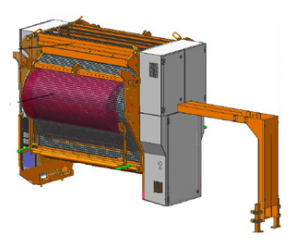
Figure 1 Foilstar Cold Stamping Machine from Heidelberg, Germany
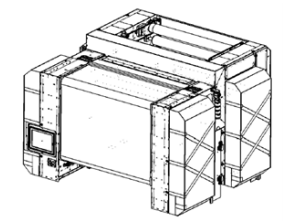
Figure 2 Optima Cold Foil Machine from Vinfoil, Netherlands
As is well known, in order to ensure the smooth transfer of cold foil, the cold foil on the cold foil machine and the paper on the printing press must operate synchronously. In other words, the cold foil and the blanket cylinder are required to have the same linear speed, meaning that within one rotation cycle of the blanket cylinder, the cold foil needs to travel a length equivalent to the circumference of the blanket cylinder. However, not all printed materials require full-face cold foiling. If the area of images and text that need cold foiling on the printed paper is small, the wastage of cold foil will be larger, and increased costs are inevitable. To reduce the waste of cold foil, the two machines adopt similar approaches to solve this problem.
Foilstar Cold Foil Machine from Heidelberg
The actual Foilstar cold foil machine is shown in Figure 3. It uses the Dancing unit step mechanism shown in Figure 4 to address the problem of cold foil waste. When the blanket cylinder rotates to the empty area of the impression cylinder, a gap exists between the surfaces of the two cylinders. Using the step mechanism (as shown in positions 1 and 2 in Figure 5), two sets of step roller mechanisms driven by servo motors at positions 1 and 2 rapidly pull the cold foil back, allowing unused cold foil to be used again for printing, thereby improving the effective utilization of cold foil.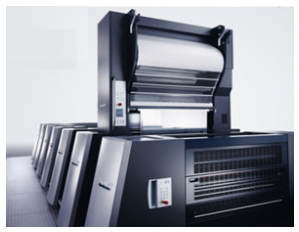
Figure 3 Actual Photo of the Foilstar Cold Perm Machine
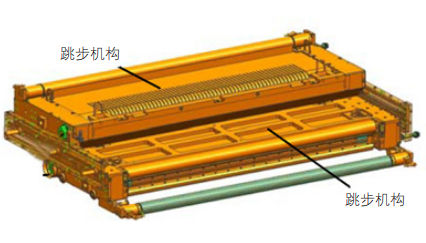
Figure 4 Dancing unit stepping mechanism
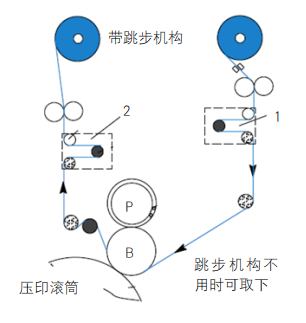
Figure 5 Stepping mechanism in the stepping device
To better understand it intuitively, the author established a simple mathematical model to illustrate the effective utilization rate of the cold stamping film. The mathematical models of cold stamping film without stepping and with stepping are shown in Figure 6.
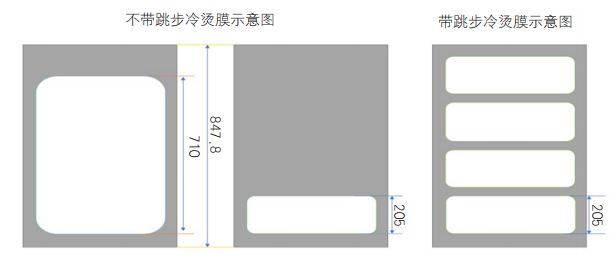
Figure 6 Mathematical model of cold stamping film with and without skipping steps (Unit: mm)
Assumption 1: Cold stamping graphics come in a variety of formats, making calculations relatively difficult. Here, a square block is selected for simulation and calculation.
Assumption 2: Since the width of the cold stamping film roll must be wider than the width of the cold stamping graphics, the waste in this direction is fixed and unavoidable. Therefore, the waste in this direction is not considered. Customers can choose cold stamping film rolls of the corresponding width according to their needs.
Assumption 3: Because the Foilstar cold stamping machine is an intermittent continuous pull cold stamping machine, it is not restricted by the circumference of the rubber roller. This size is used for calculation mainly to compare with the Optima cold stamping machine mentioned below (using CD102 as an example). According to the calculations, the effective utilization rate of the cold stamping film is shown in Table 1.
Table 1 Effective utilization rate of the cold stamping film
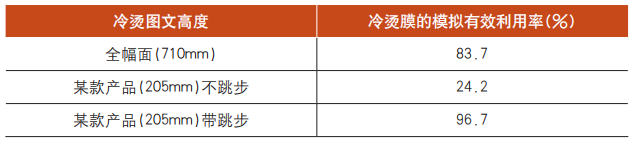
It can be seen that without using the step-skipping mechanism, the smaller the cold stamping graphics, the greater the waste of cold stamping film; whereas after using the step-skipping mechanism, the waste of cold stamping film is relatively small, which can be said to almost perfectly solve the problem of cold stamping film waste.
Vinfoil's OPtima Cold Stamping Machine
The OPtima cold stamping machine addresses cold stamping film waste in a completely different way from the Foilstar cold stamping machine. It is equipped with an MFU unit (Figure 7). The design concept is that the cold stamping film, after being printed once, does not go directly to the recycling roll but bypasses the MFU unit and goes through the rubber blanket roller for printing again. The MFU unit has two paper-turning rods controlled by a servo motor, which can change position to maintain the lateral distance required by the printed design between the cold stamping film and the previous film; another servo motor can set the overall up-and-down position of the MFU unit, thereby changing the embossing position of the cold stamping film, just allowing the previously unused portion of the film to be used again, thus improving the effective utilization rate of the cold stamping film.
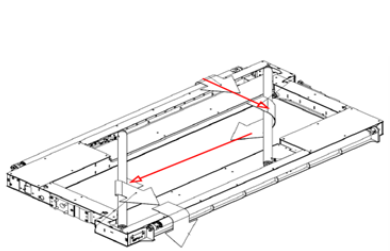
Figure 7 MFU unit of the OPtima cold stamping machine
The OPtima cold stamping machine is equipped with two MFU units, allowing flexible selection of various printing methods: single-roll cold stamping film can print one, two, or three layers, or dual-roll cold stamping films can each print one or two layers. As shown in Figure 8, a diagram illustrates single-roll printing of three layers (left) and two rolls each printing two layers (right).
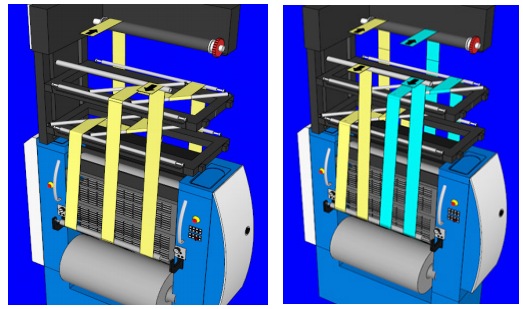
Figure 8 Single-roll printing with three films (left) and two rolls each printing two films (right)
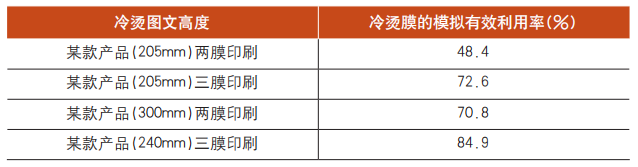
Referring to the mathematical model in Figure 9, the effective utilization rate of the cold stamping film is shown in Table 2. It can be seen that the effective utilization rate of OPtima cold stamping machine film is obviously slightly inferior to that of the Foilstar cold stamping machine with a step-jumping mechanism.
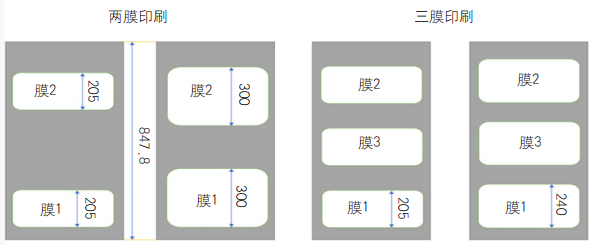
Figure 9 Mathematical models of two-film printing and three-film printing (unit: mm)
Table 2 Effective utilization rate of cold stamping film
Once you understand the key points of how imported cold foil stamping machines work, you can provide reference and direction for domestic production. Currently, the domestic cold foil stamping machine that performs relatively well is the MK1020/750CF unit from Tianjin Changrong. Its technical route is similar to that of the Foilstar cold foil stamping machine and it features a rocker-type step device. According to its official website, the maximum printing speed is 8,000 sheets per hour. The Foilstar cold foil stamping machine with the step function, as found in its manual, can reach a maximum speed of 10,000 sheets per hour when printing at the maximum format. In actual use, for small-format products, the normal printing speed can reach 12,000 sheets per hour or even 13,500 sheets per hour. Therefore, there is still room for improvement domestically in this aspect.
At present, there is no domestic cold foil stamping machine similar to the Optima design. The design concept of this machine regarding the reuse of cold foil film is to solve longitudinal issues through a horizontal approach, which is very ingenious. During printing, the speed of the cold foil film is synchronized with the press and remains constant, reaching up to 18,000 sheets per hour. This is worth studying and attempting for interested individuals and companies, and we look forward to seeing similar domestic cold foil stamping machines appear soon.