


What does the most reliable global plastic data currently look like?
In 2025, a research team from Tsinghua University published a study in the Nature-affiliated journal Communications Earth & Environment, systematically reviewing data on the production, trade, and disposal of plastic waste across the global plastic supply chain, covering the complete chain from fossil raw materials to final disposal. This is currently the largest known and most complete quantitative analysis of global plastic material flows.
[Background] About the Team Behind This Paper
The corresponding author of the paper is an assistant researcher at the School of Environment, Tsinghua University, who has long been dedicated to the field of solid waste and plastic pollution. Their research covers plastic waste trade, life cycle assessment, and circular economy policies.
The second author is a tenured professor and doctoral supervisor at the School of Environment, Tsinghua University, winner of the National Science and Technology Progress Award Second Prize (2016), and currently serves as the Executive Director of the United Nations Environment Programme (UNEP) Basel Convention Regional Centre for Asia and the Pacific and the Stockholm Convention Regional Centre for Asia and the Pacific. They have long represented the Chinese government in technical negotiations under international environmental conventions such as the Basel Convention and the Stockholm Convention, and are one of the key experts in the global waste and chemical governance field.
The team has also undertaken several international research projects, including UNEP's analysis of the impact of intergovernmental negotiations on plastic pollution and the technical guidelines on plastic waste under the Basel Convention. Their research results directly support the negotiation process of the global plastics treaty.
The benchmark year for this paper is 2022. Reading it in 2026, some might feel that the 'data is outdated.' However, two points are worth noting.
First, studies covering the entire global supply chain material flows for plastic are extremely rare. The most representative prior work was by Geyer et al., with data up to 2015. This study by Tsinghua University, published in 2025, is currently the most comprehensive and up-to-date quantitative analysis of the global plastic supply chain known.
Second, the global plastics industry has a huge baseline volume and a stable structure. Without significant external shocks (for example, the formal enforcement and implementation of a global plastic treaty), core indicators such as production patterns, trade flows, and waste disposal ratios typically change only within a limited range. Therefore, this dataset still provides strong reference value for understanding the current state of the industry.
The research team integrated multi-source trade data such as UN Comtrade (566 HS codes) to construct a material flow model covering the full chain from 'raw materials → production → trade → waste disposal.' The following are the core data and findings of the study, presented in the order of the supply chain.
Raw Materials and Production: 98% Relies on Fossil Fuels, China as the Largest Variable
In 2022, global plastic production reached 400 million tons, of which virgin resin accounted for 362 million tons, and recycled plastic from mechanical recovery amounted to approximately 38 million tons.
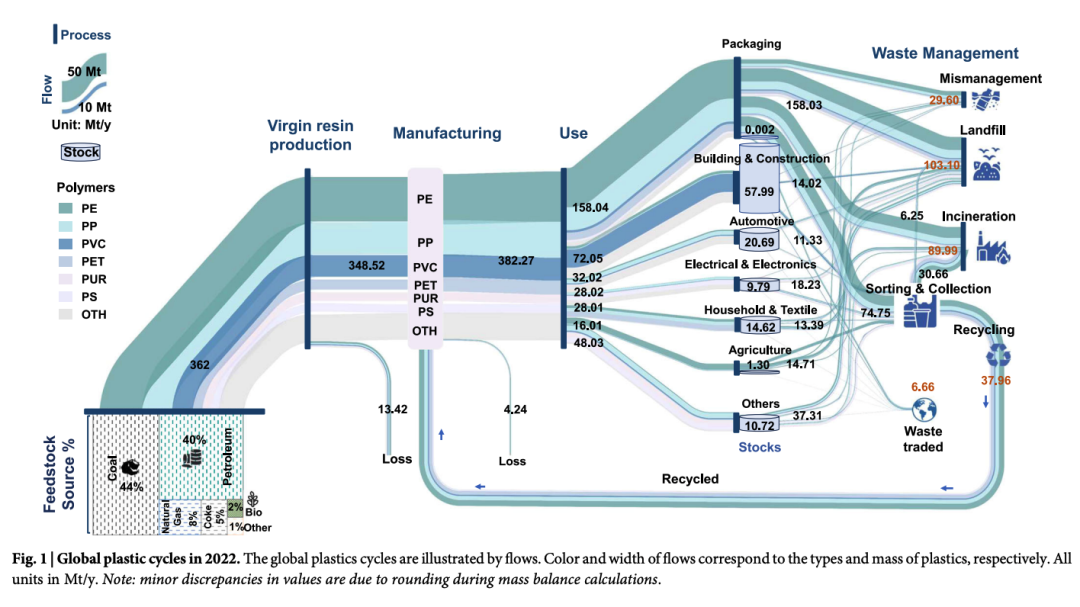
In terms of raw material sources, 98% of virgin plastics come from fossil fuels, with a breakdown of 44% coal, 40% oil, 8% natural gas, 5% coke, and 1% others. Bio-based plastics account for only 2%.
The reason coal accounts for 44% is mainly driven by China. China is the world's largest coal consumer, and the coal chemical route holds an important position in plastic production. In addition, China's chemical industry consumes about 15% of the country's total oil consumption.
In terms of production scale, China is the world's largest plastics producer, accounting for 32% of global output, followed by other Asian regions (15%), the United States (14%), the 28 EU countries (14%), the Middle East (5%), and India (5%).
By polymer type, PE (polyethylene) is the largest producer, accounting for 26% of global output, followed by PP (19%), PVC (13%), PS (5%), PUR (5%), and PET (2%).
In the manufacturing and processing stage, 348.52 million tons of virgin plastics have entered the processing stage globally. Including recycled plastics, the total manufacturing investment is about 386.41 million tons, with manufacturing losses of about 4.24 million tons.
End Applications: Packaging dominates the market, with the largest construction inventory
In 2022, a total of 382.12 million tons of plastic entered the use phase, distributed as follows:
Packaging: 158.04 million tons (44%), making it the largest application area
Construction and Construction: 72.05 million tons (18%)
Automobiles: 32.02 million tons (8%)
Electrical and Electronics: 28.02 million tons (7%)
Home & Textiles: 28.01 million tons (7%)
Agriculture: 16.01 million tons (4%)
Others: 48.03 million tons (12%)
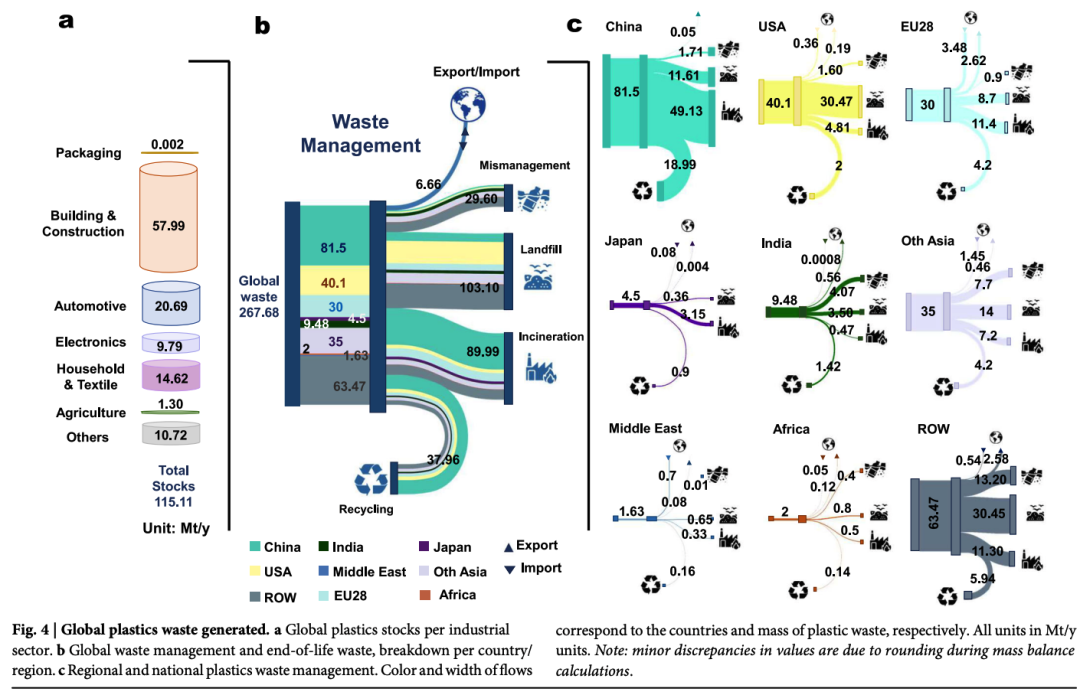
In terms of inventory, the study estimates that the global plastic inventory in use is about 115 million tons. Among them, the building and construction sector has the largest inventory, accounting for 50%, which is directly related to the long lifespan of products in this field; Next were automobiles (18%), home goods and textiles (13%), and electrical and electronics (9%). Inventory in the packaging sector is extremely small, only 2,000 tons-this is because packaging products have a very short usage cycle, usually produced and discarded within the same year, with almost no accumulation of cross-year inventory. Agricultural inventory is about 1.3 million tons, accounting for about 1%.
Global trade: total scale 437 million tons, with China and the EU as core nodes
In 2022, global plastic trade reached 436.66 million tons. The study categorizes trade according to supply chain stages
Raw material trade (71 million tons)
The EU's 28 countries are the largest raw material exporters (31%), followed by other Asian regions (26%) and the United States (14%).
The largest importers are China (31%) and the 28 EU countries (30%). The EU ranks among the top in both import and export volumes, partly due to intra-regional trade and re-export trade.
Additive trade (30 million tons)
China is the largest additive exporter (23%), followed by the European Union (22%), other Asian regions (18%), the United States (16%), and the Middle East (13%).
Primary plastics trade (152 million tons)
Other Asian regions are the largest exporters (51.55 million tons, 32%), followed by the EU (44.17 million tons) and the United States (20.34 million tons).
Intermediate goods trade (total 66 million tons)
This includes two categories: intermediate plastics (47 million tons) and intermediate products (19 million tons). The EU is the largest intermediate-form exporter (15.07 million tons), followed closely by China (14.21 million tons).
Final product trade (111 million tons)
This is the largest link in the entire supply chain with the highest trade volume. China ranked first in exports with 44.25 million tons, accounting for 45% of global final product exports, followed by other Asian regions (21%) and the European Union (18%). The largest importer is the European Union (35%), followed by the United States (20%), other Asian regions (14%), and the rest of the country (13%).
Waste Plastics Trade (6.66 million tons)
China's 2018 ban on importing "foreign waste" profoundly changed this landscape. Previously, China had been the world's largest importer of waste plastics for 25 consecutive years. After the ban was implemented, the 28 EU countries became the world's largest net importers of waste plastics in 2022, with imports totaling 3.48 million tons and exports totaling 2.62 million tons. Within the EU, the Netherlands alone accounts for 23% of the region's total imports, with Germany, Belgium, and Austria as the main importers and exporters.
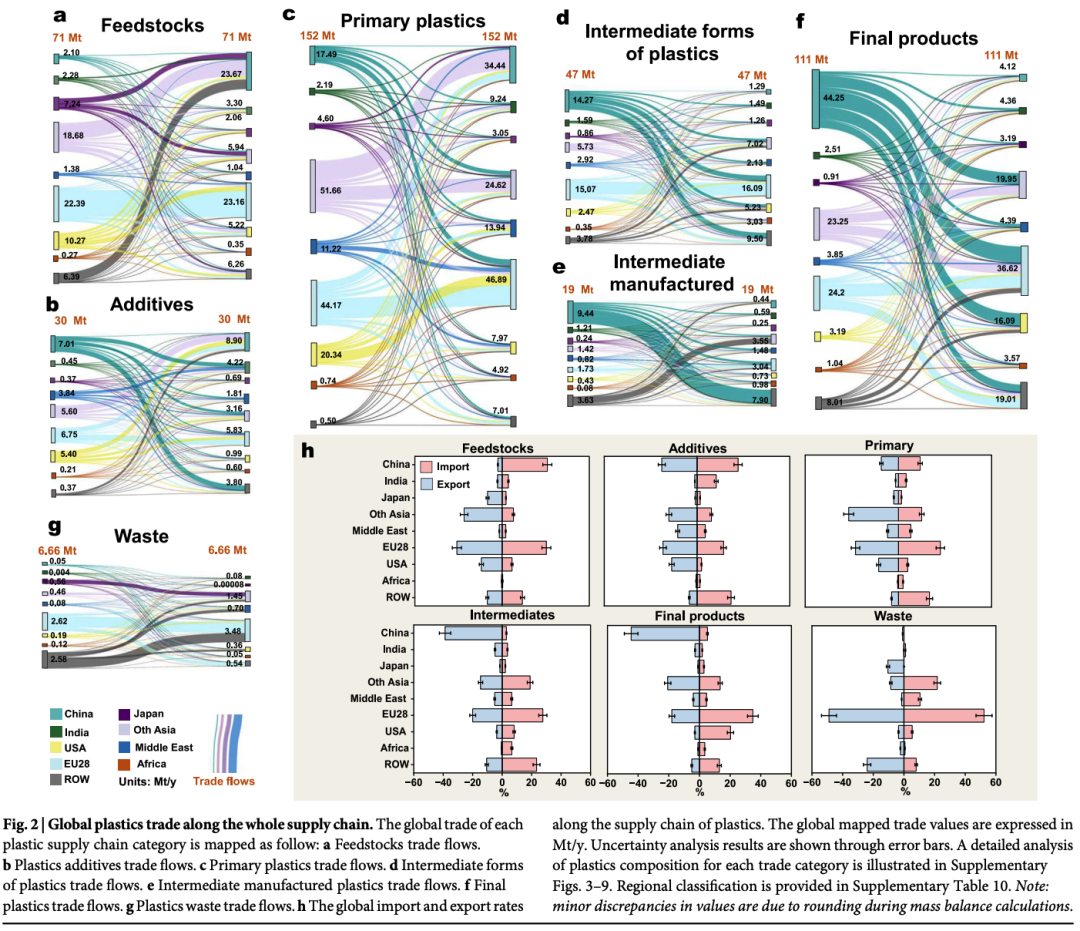
Currently, Southeast Asia has received a large influx of waste plastics, while other Asian regions (1.45 million tons) are the second largest importers after the European Union. Within Southeast Asia, Malaysia has the highest import volume (accounting for 24% of regional imports), followed by Vietnam (21%), Indonesia (13%), and Thailand (12%).
Consumption patterns: total volume and per capita show two completely different rankings.
In terms of total consumption, China is the world's largest plastic consumer (20%), followed by the United States (18%), the European Union (16%), other Asian regions (12%), the Middle East (7%), India (6%), Africa (5%), and Japan (4%).
But in terms of per capita consumption, the ranking is fundamentally reversed:
The United States is the highest, at 216 kg per person, with plastics accounting for about 12% of municipal solid waste in the U.S., and plastic containers and packaging being the main sources of waste.
Japan is 129 kg per person.
The EU is 86.6 kg per person.
Research shows that if measured by total volume, the geographic distribution of plastic production and consumption highly overlaps, indicating a clear "local production-local consumption" coupling. However, when adjusted for per capita data, this coupling is broken: regions with small populations but strong manufacturing capabilities have per capita production significantly higher than per capita consumption; densely populated regions show the opposite.
Waste management: huge global differences, recycling rates have long stagnated.
In 2022, the world generated 267.68 million tons of plastic waste.
By regional distribution: China generated 81.5 million tons (30%), the United States 40.1 million tons, other Asian regions 35 million tons, the EU 30 million tons, India 9.48 million tons, and the rest of the regions 63.47 million tons.
Global patterns of waste disposal.
|
处置方式 |
全球总量 |
占比 |
|---|---|---|
|
填埋 |
1.0337亿吨 |
40% |
|
焚烧 |
8999万吨 |
34% |
|
回收 |
3796万吨 |
9% |
|
不当处置 |
2960万吨 |
11% |
Although landfill still remains the main method, it has significantly decreased compared to historical data (estimated at 79% by Geyer et al.), largely due to China's policy shift.
Characteristics of Waste Management in Major Economies
China: Incineration rate is 60% (49.13 million tons), landfill rate is only 14% (11.61 million tons), and improper disposal rate is 2% (1.71 million tons). China's goal is to achieve "zero landfill" for urban household waste by 2023. As of September 2022, 811 waste-to-energy incineration facilities have been built nationwide.
Japan: Incineration rate is the highest in the world at 70% (3.15 million tons), landfill rate 8%, and recycling rate about 20%. This is directly related to Japan's limited land resources, strict waste disposal regulations, and advanced incineration technology.
European Union: Landfill rate is 29% (8.7 million tons), incineration rate 38%, and improper disposal rate 3%. The high incineration rate in the EU is closely related to its policies on energy recovery and waste-to-energy conversion.
United States: Landfill rate is as high as 76% (30.47 million tons), incineration rate 12%, improper disposal rate 4%, and recycling rate only 5%. Studies indicate that the U.S. recycling rate has dropped significantly from 9% in 2015. After China banned the import of waste plastics, the U.S.'s largest waste export channel was cut off, severely impacting the domestic recycling system. Predictions show that U.S. plastic waste will increase to 86 million tons by 2050.
Africa: Average recycling rate is about 7%, but if informal recycling (waste collectors) is included, the actual proportion may be higher. Insufficient waste collection infrastructure and high improper disposal rates are major problems.
Reasons for Long-term Stagnation in Global Recycling Rates
Research summarizes the following points:
First, the variety of plastics is complex, containing many different types, specifications, and additives, making sorting and processing difficult;
Second, contaminants such as food residues and labels reduce the quality of recycled materials;
Third, the price of virgin plastics, driven by oil price fluctuations, is often lower than recycled plastics, economically discouraging recycling investment;
Fourth, products lack recyclability considerations during the design stage, and some products use banned additives, making them practically impossible to recycle.