


Anker Innovations, TuoZhu Technology, and others are venturing into UV printing! Why is everyone jumping in?
UV printing is no longer a new technology. It combines UV curing technology with inkjet printing, breaking the limitations of materials and processes in traditional printing, and has been widely used in advertising, labeling, and packaging for many years. In the past couple of years, desktop UV printers have quickly gained popularity. A batch of companies with backgrounds in 3D printing, laser processing, and maker hardware have entered the field, crowdfunding hits keep emerging, and makers, cultural and creative studios, and small e-commerce businesses have become the core user groups. What exactly has triggered this consumer-driven boom? What industrial signals are new players sending? For digital printing companies, is this a disruption or a completely new external variable?
UV Printing Development History
Looking back, UV printing has gone through roughly four stages: from the 1960s to the 1990s, UV curing technology was mainly applied in traditional printing; from 2003 to 2007, UV flatbed printers achieved commercialization, but due to the limitations of print heads, inks, and equipment stability, the industry went through market adjustments; from 2008 to 2012, as core technologies matured, UV printing entered the stage of large-scale application; from 2013 to now, continuous upgrades in LED curing, industrial-grade print heads, and intelligent control technologies have pushed UV printing to expand into more application scenarios.
Since 2025, several consumer-grade UV printers have been launched and gained attention in overseas crowdfunding markets, unlocking new market potential for desktop UV printing.
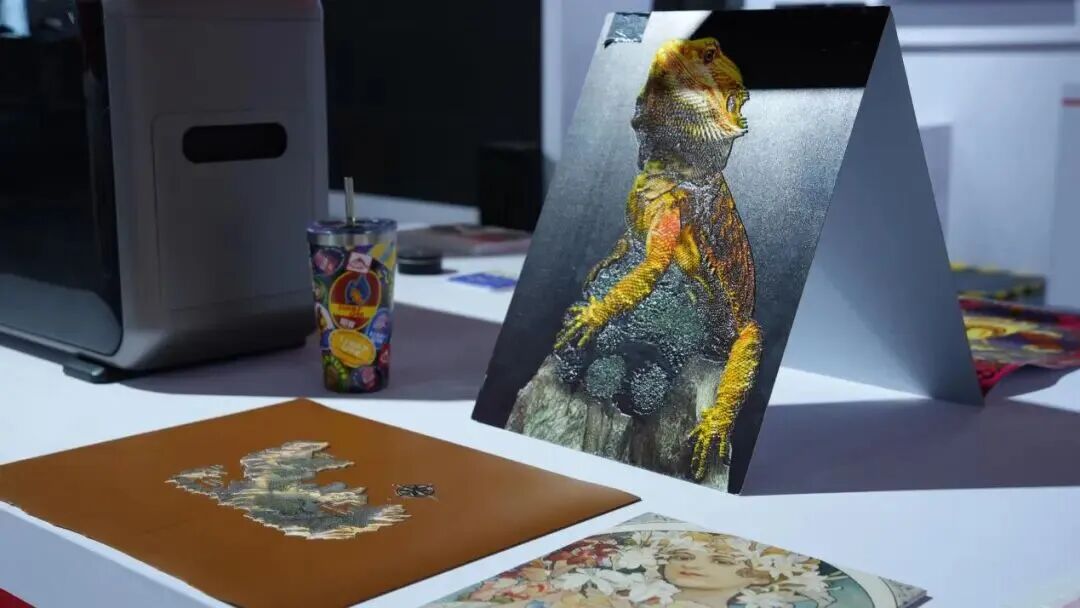
In June 2025, Anker Innovations' eufyMake E1 desktop 3D texture UV printer appeared on the overseas crowdfunding platform Kickstarter, ultimately raising $46.76 million, setting a new record for total crowdfunding in all categories on the platform. It officially launched domestically in March 2026 as a ten-thousand-yuan-level desktop device, aimed at small entrepreneurs and maker communities, becoming the benchmark mass-production model for consumer-grade UV printing. Compared with traditional UV printing, the biggest change in the E1 is that it brings printing from "flat" to "3D." With Amass3D™ technology, it can print tactile textures like bas-relief, oil painting, and leather. Combined with AI color technology and modular accessories such as rotary printing and UV-DTF, ordinary users can also create multi-material, multi-form artwork.
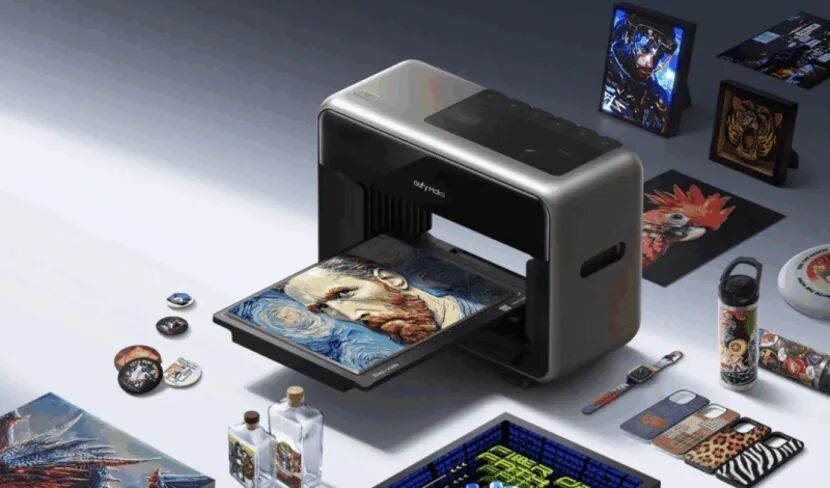
From June to July 2026, the track's popularity continued to rise. xTool released the O1 all-material integrated machine, combining UV and DTF technologies, with domestic first-day sales surpassing 100 million yuan; Hegtech's G1X 3-in-1 UV 3D printer raised over 10 million USD in overseas crowdfunding in just 5 days; after completing overseas crowdfunding, Changlang Technology's ePrint desktop UV went on domestic pre-sale, with a large number of prototype and mass-production models hitting the market, rapidly heating up the track.
Recently, Tuozhu Technology officially announced its consumer-grade UV printer R&D project, opening more than ten key R&D positions. The job descriptions clearly require engineers to have experience in Epson, Ricoh, Seer industrial printhead development, waveform debugging, and mass production of ink path systems, directly targeting industrial inkjet core technology.
Why are desktop UV printers getting popular?
01
Mature technology, industrial tech migrating downward
LED-UV curing, piezoelectric printheads, motion control, and AI visual positioning technologies have undergone years of iteration in industrial printing and are now ready for miniaturization. Manufacturers no longer pursue 7×24 hours continuous production, sacrificing some production stability to achieve smaller size, simplified operation, and lower cost, positioning products as "capable of creative, small-batch work, rather than industrial continuous production."
02
Exploding fragmented custom demand in the market
E-commerce, cultural and creative industries, and private domains are generating massive orders of 1–50 pieces. Phone cases, acrylic display stands, commemorative ornaments, and small gifts-all these orders require fast prototyping and flexible design changes. Traditional printing companies face minimum order and scheduling restrictions, while desktop UV printers perfectly fill the gap for "individuals and small studios."
03
3D Printing Has Educated the User Market
Consumer-grade 3D printing has already cultivated a large maker community, and users are highly receptive to desktop manufacturing devices. UV printing focuses on 'decorating the surface of existing objects,' which doesn't require complex modeling - images can be output directly. The barrier to entry is even lower than 3D printing, making it very easy for users to make the switch.
04
Crowdfunding Overseas Amplifies Reach
Overseas crowdfunding platforms have become important amplifiers for consumer-grade UV, with hit projects quickly creating global industry buzz, which then feeds back into the domestic market and further heats up the sector. However, the overall market for consumer-grade UV is still relatively small. By 2026, it's in the early stage of rapid growth and hasn't yet reached large-scale adoption.
Is This a Challenge or an Opportunity for Digital Printing Companies?
Under this hype, the industry can easily fall into misconceptions: will desktop UV replace industrial UV printing? Looking at device positioning and capability boundaries, there's a clear gap between the two. Simply put, desktop UV handles creative prototyping, while industrial UV printing handles commercial delivery.
01
Challenge: Fragmented Small Orders Could Be Diverted, Affecting Small UV Print Shops First
In the past, ad and print shops and small UV service providers handled many small 1–50 piece orders for creative and gift items. Now, some micro clients buy desktop UV printers to handle production themselves, causing the tail-end orders to fragment. At the same time, some design companies and brands purchase desktop UV printers for concept prototypes, slightly squeezing paid proofing business.
Large and medium packaging and commercial digital printing companies face limited direct impact. Core business like color boxes, labels, and publications have strict requirements for compliance, batch consistency, and post-processing, which are hard for desktop UV printers to meet. But new challenges arise: some clients want desktop UV output to match industrial equipment quality, while expecting lower prices, which disrupts factory pricing systems.
02
Opportunity: Desktop UV Can Serve as a Helper Tool for Digital Printing Companies
Digital printing companies can use desktop UV printers as internal support tools. For early client concept communication, they can quickly produce physical prototypes, reducing material waste and waiting times caused by frequent industrial machine test runs, improving front-end order efficiency.
Many small clients who buy desktop UV printers soon hit limits in capacity, color, compliance, and post-processing. Once orders scale up, demand returns to professional printing companies. These companies can strategically set up channels to serve small businesses, taking on this growing incremental business.
Desktop UV printing won't disrupt the mature industrial digital printing market, but the demand trend it represents - 'flexible, small-batch customization' - is real. Digital printing companies should focus not on the desktop devices themselves, but on the overall market demand changes behind this trend.