


2025 Global High-Speed Inkjet Printing Report Released
Recently, IDC released the "2025 Global High-Speed Inkjet Printing Vendor Assessment Report," which evaluates the market position of various vendors through multidimensional quantitative and qualitative indicators. As the most promising sector in the production printing field, high-speed inkjet printing technology is driving industry transformation through both technological breakthroughs and market demand. Leading companies such as Canon, through continuous innovation, have become the core drivers of this industry shift.
IDC Evaluation Standards Explained: Canon Remains at the Forefront of the Industry
The "2025 Global High-Speed Inkjet Printing Vendor Assessment Report" evaluates vendors based on their capabilities in the inkjet field, including innovation, product portfolio, service and support, customer experience, and long-term strategy. Clear inclusion criteria are also established: vendors must launch products that meet IDC's definition of "high-speed inkjet printing equipment for document printing," meaning devices with an A4 document printing speed of no less than 150 pages per minute; related solutions must be commercially available globally (in at least multiple major regions) and have a certain number of real users providing feedback on product and service satisfaction. Ultimately, a total of 12 vendors worldwide were selected for this assessment, covering the leading forces in the industry.
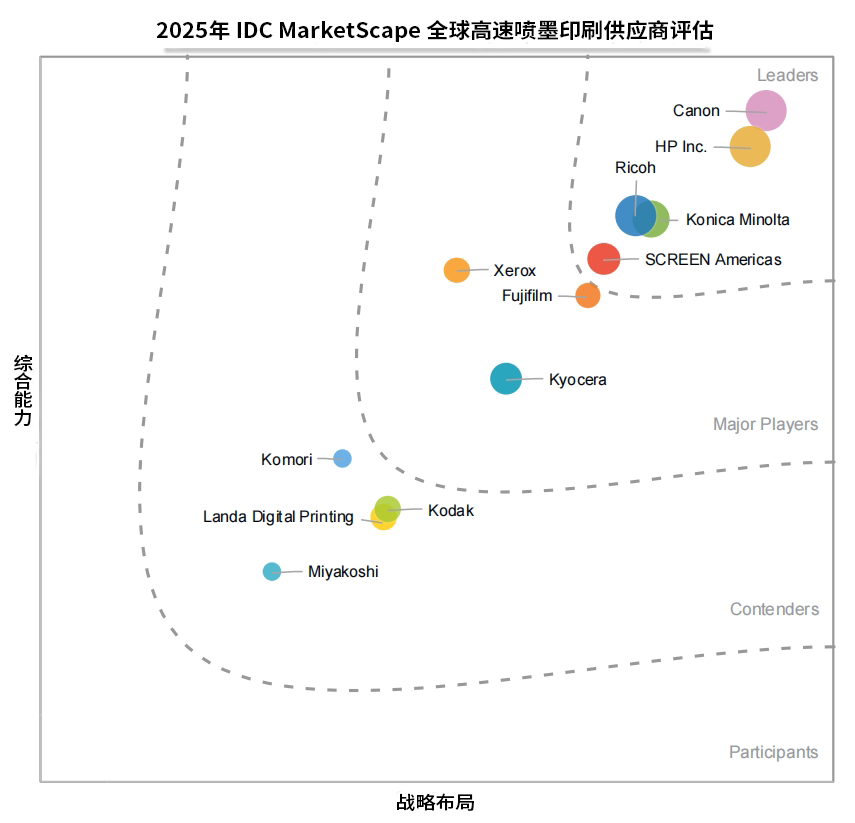
The Y-axis reflects the supplier's current product capabilities, service system, and matching with customer needs. The current capability dimension focuses on the current comprehensive strength of enterprises and products, and IDC analysts will evaluate the level of suppliers to build and deliver core capabilities, as well as the ability to support the implementation of their market strategies;
The X-axis reflects the alignment of the supplier's strategy with the customer's core needs for the next 3~5 years. The future strategic dimension focuses on the top-level decision-making and bottom-level layout of suppliers in terms of product layout, customer groups, business and channel planning in the next 3~5 years;
The size of each supplier's logo in the matrix represents the supplier's market share in the corresponding market segment.
As you can see from the graph, Canon is at the front of the leader quadrant. According to IDC's assessment, Canon maintains a strong presence in the market, with new installations and print volumes continuing to grow. Canon has proven its value and success through numerous mature installation cases.
The report further states that Canon has its own imaging technology, proprietary ink banks, proven media transfer technology, image quality control capabilities, image processing and paper-splicing technology. On the varioPRINT iX1700 press, Canon combines the company's ink, printhead, feed, drying, and fusing technologies to support a wider variety of media.
"Being named a Leader in the 2025 IDC MarketScape evaluation underscores the strength of our strategy and the momentum we are building in high-speed inkjet printing," said Kiyoshi Oka, Executive Vice President, Marketing Strategy, Canon America. Our priority is to deliver technology that can help drive real business results. By unifying innovation, application insights, and enhanced service capabilities in a cohesive product portfolio strategy, we empower our customers to achieve growth, improve performance, and stay ahead in the rapidly evolving printing landscape. "
Overall market situation: technology is ahead of demand
At present, the high-speed inkjet printing market presents the core characteristics of technological development ahead of market demand. With the continuous iteration of inkjet printhead, ink and drying technology, the printing speed of high-speed inkjet printing systems continues to increase. IDC observes that equipment suppliers are promoting technological innovation across the board, optimizing the economics of digital printing and simplifying equipment operation, while continuously improving the output quality of high-speed inkjet printers.
In addition, the market has huge commercial value and high industry activity, with more than 10 mainstream multinational suppliers around the world. This layout is well warranted: printing service providers that have deployed high-speed inkjet printing systems have achieved strong business growth, and suppliers have also observed double-digit growth in total installed equipment. In addition, with the improvement of printing quality, the high-speed inkjet printing system can undertake more high-coverage printing orders, and the revenue space for a single order is further expanded.
Rising costs force the innovation of production models
The acceleration of the transformation of the printing industry to high-speed inkjet printing is not a simple technology iteration, but an inevitable choice driven by cost pressure and demand trends, and the IDC report clearly points out two core cost drivers.
01
Raw material costs are rising
The rise in paper costs has pushed enterprises to switch to digital printing production, because the paper loss of digital printing is much lower than that of traditional offset printing; At the same time, the price increase of aluminum has pushed up the production cost of offset aluminum plates, changing the cost pattern of offset printing and digital printing. Printing service providers have noticed the industry trend of shortening, which further amplifies the cost disadvantage of offset printing and pushes companies to invest more in digital production equipment.
02
Labor costs continue to rise
According to IDC's 2025 Production Printing and Large Format Printing Survey, about 40% of printing service providers have faced employment difficulties in the past 12 months. When enterprises cannot recruit operators with adapted equipment, they often turn to digital equipment with lower operating thresholds, reducing the difficulty of personnel training and recruitment. The rise in labor costs will also promote the industry's demand for highly automated equipment, through the survey found that many printing factories used to need 4 employees to operate 1 printing machine, but now only 1~2 employees can operate 2~3 production digital printing machines.
Under the dual cost pressure, high-speed inkjet printing has become the preferred solution for the transformation of printing service providers with the advantages of low cost, high automation, and adaptation to short orders.
Four major trends in the high-speed inkjet printing market
According to the report, IDC also proposed four core trends in the high-speed inkjet printing market, which not only accurately fit the current industry development pain points, but also clarify the future industry evolution direction.
01
The range of media adaptation is wider
Many suppliers reported that customers required solutions to break through the limitations of printing materials and cover more formats and more grams of media, thereby expanding more application scenarios. The more application scenarios, the larger the total printing volume, and the shorter the return on investment cycle.
02
Sustainability
According to IDC's 2025 Production Printing and Large Format Printing Survey, 58% of printing service providers say that the demand for green and sustainable printing continues to grow. This demand is often reflected in the use of paper and film with a higher proportion of recycled materials, the adaptation of more environmentally friendly hardware and ink combinations, and the lower energy consumption of the production process. The high-speed inkjet printing solution with water-based ink and low-energy drying system is highly in line with the market demand for sustainable production.
03
Fast delivery and e-commerce
The same survey shows that as many as 40% of printing service providers have opened online order channels. End users want to be able to place orders online and deliver quickly, almost treating printing service providers as platforms such as Amazon. In fact, many online printing service providers have achieved Amazon-style fast delivery and instant fulfillment. This puts forward extremely high requirements for production equipment, prepress systems and post-press processing systems, and the whole process automation upgrade is the core path to improve equipment performance capabilities and meet customer needs.
04
Modern, upgradable system
If the business model of printed products is becoming more and more aligned with Amazon, then the business model of production-oriented digital printing systems is closer to Tesla. Printing service providers hope that solutions can be optimized and upgraded with the passage of time like cars; It is hoped that the production plan will have a modern architecture and upgradeable capabilities, and can continue to iterate with the changes in customer needs.
IDC's "2025 Global High-Speed Inkjet Printing Supplier Assessment Report" clearly confirms that high-speed inkjet printing has become the core engine of the digital transformation of the printing industry, and technology iteration, cost-driven, and demand upgrades have jointly promoted the industry to enter a new stage of high-quality development. In the future, the high-speed inkjet printing market will further release its potential, and leading companies represented by Canon will continue to inject lasting growth momentum into the global printing industry with innovative technology and ecological capabilities.