


What should be done if the label tape breaks?
Label web break refers to the phenomenon where the backing paper of labels tears during the automatic labeling process. This phenomenon is one of the most common problems in automatic labeling. Once a label web break occurs, the entire automatic labeling machine must stop and can only resume work after the labels are reconnected. Handling a label web break usually wastes 3 to 10 minutes. Occasionally experiencing this problem during labeling is acceptable, but frequent occurrences will inevitably affect labeling production efficiency. More seriously, many companies have labeling lines connected to production lines; if the labeling line stops, it can likely cause the production line to stop as well, resulting in significant economic losses for the company. So, what are the causes of label web breaks?
PART 01
Excessive die-cutting cuts through the backing paper
A reliable method to determine the cause of automatic label tearing is to observe and analyze the broken area. If the tear consistently occurs along the die-cut line, and the break is neat without delamination, this is mostly caused by excessive die-cutting that damages the backing paper.
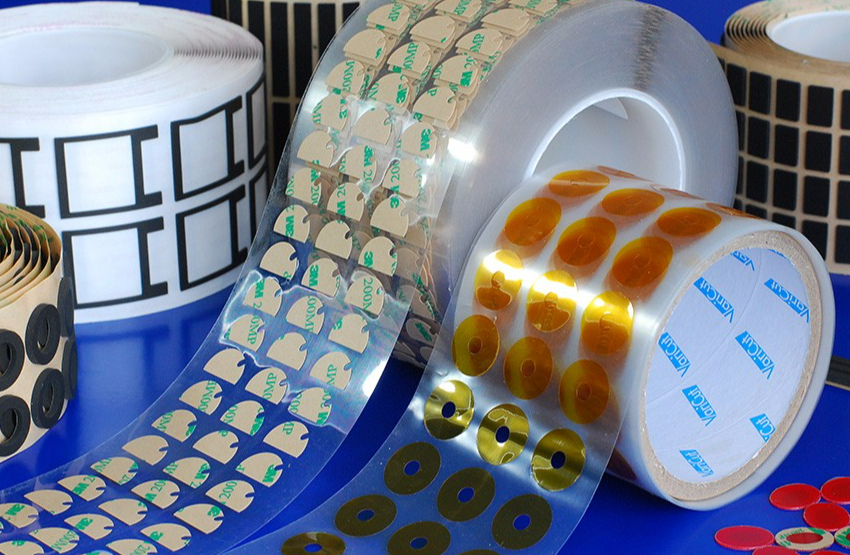
We know that finished adhesive labels need to be die-cut into shape. In principle, during the die-cutting process, the cutting plate only cuts through the face material and the adhesive layer, and the bottom layer of release paper should not be cut. However, in actual operations, due to equipment limitations, the release paper is often cut. This is because traditional die-cutting equipment usually operates in a flat-to-flat mode, where the cutting plate and the die-cut material are in surface contact. During die-cutting, the pressure may fluctuate slightly, and it is impossible to maintain complete consistency throughout. This surface-contact die-cutting equipment often cuts or even severs the release paper under these small pressure fluctuations.
Therefore, when using flat-to-flat die-cutting equipment to die-cut automatic labeling products, operators must frequently check whether the die-cutting pressure has changed. If an increase in die-cutting pressure cuts the release paper, the pressure must be adjusted promptly. To check if the release paper is cut during the die-cutting process, a staining method can be used. This involves applying color with a solvent-based marker on the die-cut line of the release paper, and then wiping it off. If the color seeps into the die-cut line, it indicates that the die-cutting pressure is too high and the release paper has been cut. At this point, the die-cutting pressure should be adjusted immediately.
Of course, if one wants to completely solve the problem of release paper being cut, the rotary die-cutting method is a better solution. This is because rotary die-cutting equipment cuts using a die roller, and adhesive material passes between the die roller and the bottom roller. When using this equipment, the die and the material are in line contact, providing high cutting accuracy. Moreover, the die roller and the bottom roller undergo dynamic balance testing before leaving the factory, with a principle of not exceeding 0.01 mm runout, also known as one silk. This ensures that the rollers have minimal runout during operation, preventing the release paper from being cut.

Due to the high cost of tool production in the circular die-cutting method, it is more suitable for larger batch orders, and if the order quantity is small, the production cost will be high. However, fortunately, most of the labels used for automatic labeling are relatively large, and some orders may not have a large number of single varieties, but the total number of multiple varieties is larger, and the specifications are the same, and the same knife can be used to die-cut. Therefore, it is best to use circular die-cutting equipment for automatic labeling orders.
PART 02
Joint quality problems
Sometimes the position of the labeling and breaking tape is very regular, basically starting from the place where there is a joint, at this time we have to see if there is a problem with the quality of the joint. Common joint problems are:
01
The tape at both ends of the joint is "one end more and one end less"
At present, most labels are bonded with scotch tape or special industrial tape. In principle, the width of the tape at both ends of the joint should be the same, the error should be less than 1mm, and the overall width of the tape should be 40~50mm. If the operator is not very conscious of quality, the width of the tape at both ends of the joint deviates greatly, which may lead to breakage at the joint during automatic labeling. For example, the overall width of the tape is 40mm, and the qualified joint requirements are 20mm of the tape width at both ends of the joint, and the two ends of the unqualified joint may be 5mm on one side and 35mm on the other side. Because the automatic labeling machine is running, it usually has to apply a few kilograms to ten kilograms of tension on the label, such a large tension coupled with the high-speed operation of the equipment, the label base paper will bear a lot of force per unit area, if the quality of the joint is not up to standard, it is easy to break.
02
The joint method is incorrect
Normally, the self-adhesive industry requires the way of the joint to be 45° miter instead of the 90° direct head, because the miter joint can disperse the force when passing through the paper guide roller and the labeling scraper of the automatic labeling machine, and the direct head force point is more concentrated, and the miter joint is more conducive to ensuring that the label will not be broken by the tension of the machine when passing through the labeling scraper.