


The direction of paper fibers is very important; 3 tips to help you identify it!
For book printing, in addition to beautiful binding design and advanced printing equipment, paper is also a factor that cannot be ignored. When we get a hardcover book, we may find that why the pages are not well flattened? Why is the ring lining wrinkled and uneven? In fact, this is all because the paper fiber direction is not considered when opening the paper.
Paper is composed of paper fibers, and in the process of papermaking, the fibers are subjected to the large traction of the running direction of the paper machine, so that most of the fibers are arranged along the running direction of the paper machine, which is usually called the fiber direction. Therefore, paper has a certain directionality, and the longitudinal paper we often say refers to the paper in which the arrangement direction of the plant fibers in the paper is parallel to the direction of the long side of the paper, while the horizontal paper refers to the paper in which the arrangement direction of the plant fibers in the paper is perpendicular to the direction of the long side of the paper.
The impact of paper fiber direction on printing and solutions
The direction of paper fibers will have a certain impact on printing, mainly manifested in inaccurate overprinting, expansion and deformation.
1. Overprinting is not accurate
In the printing process, there are two main reasons for inaccurate overprinting: first, the rules of printing machine adjustment are inaccurate; Second, the paper is deformed under the action of printing pressure and water. The printing process is inseparable from water, and paper fibers have the characteristics of water absorption and expansion. When paper fibers absorb moisture and swell, the amplitude of swelling in the diameter direction of the fiber is larger than that in the length direction, so when the paper absorbs moisture, the lateral elongation is larger than that in the longitudinal direction, which is generally 2~8 times.
Experiments have proved that when the relative humidity increases from 50% ×to 65%, the longitudinal elongation is 0.05% and the lateral elongation is 0.15%. If the paper is longitudinal paper, the elongation of the long side is 0.55mm and the elongation of the short side is 1.18mm; If it is horizontal paper, its long side elongation is 1.64mm, short side elongation is 0.40mm, although horizontal paper and longitudinal paper will be affected by humidity will produce certain deformation, but it is obvious that the horizontal paper is more seriously deformed than the longitudinal paper when affected by humidity.
Therefore, it is best to use vertical paper when printing books to reduce overprinting accuracy.
2. Telescopic deformation
Paper has high requirements for environmental humidity during use and storage, and if the moisture content of the paper itself and the relative humidity of the warehouse are not balanced, the paper will absorb or lose water. Careful observation of the deformation of paper shows that different paper fiber directions will exhibit different telescopic and deformation characteristics. Taking longitudinal paper as an example, the expansion and contraction of the long side parallel to the direction of the paper fiber is relatively small or even negligible, while the expansion and contraction of the short side perpendicular to the direction of the paper fiber is relatively obvious.
In a book, if the direction of the inner paper fibers is perpendicular to the spine, it may sometimes affect the normal reading of books and periodicals. As shown in Figure 1, you can see that the pages of the entire book are erect and cannot be completely flattened. This is mainly because when the paper is stretched and deformed, the spine is fixed by hot melt glue, and the size remains basically stable, while the other unconstrained paper parts of the book core are deformed, resulting in the size of one side of the paper remaining unchanged and the size of one side changing, resulting in this phenomenon. If the direction of the paper fiber is parallel to the spine, the paper size is stable in the direction of the spine, and the expansion and contraction of the inner page size is mainly in the direction of the width of the book, which is not limited, will not affect the shape of the book, and the reading resistance is small, and it can be better flattened, as shown in Figure 2.
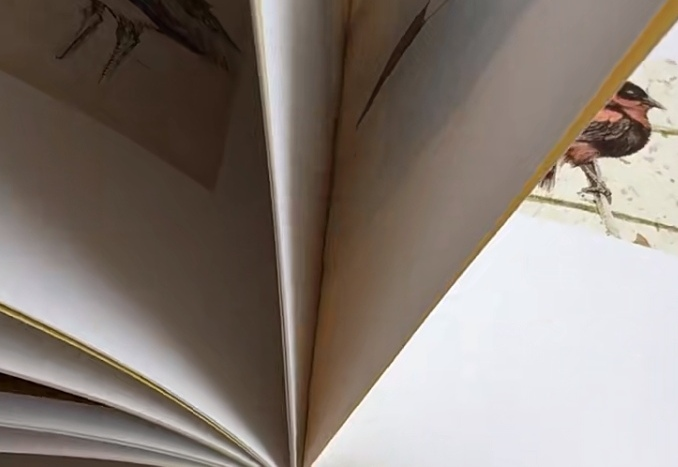
Figure 1 The paper fiber direction is perpendicular to the spine
 Figure 2 Paper fiber direction parallel to the spine
If two different types of paper fiber directions are mixed in the same book, after being placed for some time, the edges of the book, the top, and the bottom will show uneven cuts. This is also because paper with different fiber directions undergoes different expansion and contraction. That is, paper with one fiber direction expands and contracts in the width direction of the book but remains basically unchanged in the length direction of the book; paper with the other fiber direction remains basically unchanged in the width direction but expands and contracts in the length direction, resulting in uneven cuts at the edges, top, and bottom of the finished book.
To reduce quality problems caused by expansion and contraction, we can take the following measures:
(1) Reduce moisture loss, such as appropriately increasing the printing speed and lowering the drying temperature; the press pressure should not be too large to avoid excessive deformation of the paper due to stress; appropriately increase the relative temperature and humidity of the storage room to maintain the balance of paper moisture content.
(2) When cutting paper for printing, keep the spine direction parallel to the paper fiber direction so that the bound book can be flipped more easily after completion.
(3) Train relevant personnel in the printing factory to avoid using paper with different fiber directions in the same book.
Correctly determining the paper fiber direction
The arrangement of paper fibers causes differences in many properties between the machine direction (lengthwise) and cross direction (widthwise) of the paper, such as the tensile strength in the machine direction being much greater than that in the cross direction, the cross-directional expansion rate being higher than the lengthwise expansion rate, and dimensional stability being better in the machine direction than in the cross direction.
Generally, machine-direction paper can effectively reduce deformation caused by stretching during printing, avoiding problems such as wrinkling, curling corners, misregistration, and waste, while also improving printing speed and product quality.
It is clear that before printing, it is necessary to correctly distinguish between machine-direction and cross-direction paper. The main methods of distinction are as follows:
(1) Bending method: Bend the paper in both the cross and machine directions without folding, and feel the resilience of the paper. The direction with less resistance is the fiber direction, which runs parallel to that edge.
(2) Tearing method: Tear a piece of paper in both the cross and machine directions, and observe the cut surfaces. The direction with the smaller cut surface is the paper fiber direction.
(3) Water brushing method: Use a brush dipped in water to draw a line along the machine and cross directions of the paper, and observe whether the line is smooth. The smooth direction is the paper fiber direction.