


Tianjin Yihong Printing and Packaging 'Soft and Hard Integration' Intelligent Factory Construction Practice
Currently, the printing and packaging industry is at a critical stage of transformation and upgrading from 'labor-intensive' to 'technology-intensive.' Rising costs, labor shortages, and customers' increasing demands for delivery timeliness and product quality have made the traditional manual management model increasingly unsustainable. Discrepancies between accounts and actual inventory, chaotic material flow, and production line stoppages due to material shortages are common persistent problems in the industry. Reconstructing production operations and logistics management systems through digital intelligence has become a strategic must for leading printing and packaging enterprises to break through development bottlenecks.
Tianjin Yihong Intelligent Packaging Technology Co., Ltd. (hereinafter referred to as 'Tianjin Yihong') is a comprehensive printing and packaging enterprise integrating prepress design, plate making, printing, and post-press processing. It owns 9 wholly-owned subsidiaries and has established long-term cooperative relationships with well-known brands such as Mengniu, Three Squirrels, and Junlebao. Facing the pressure of digital intelligence transformation in the industry, Tianjin Yihong focuses on digital intelligence as the core driving force to build a benchmark smart factory in the printing and packaging industry.
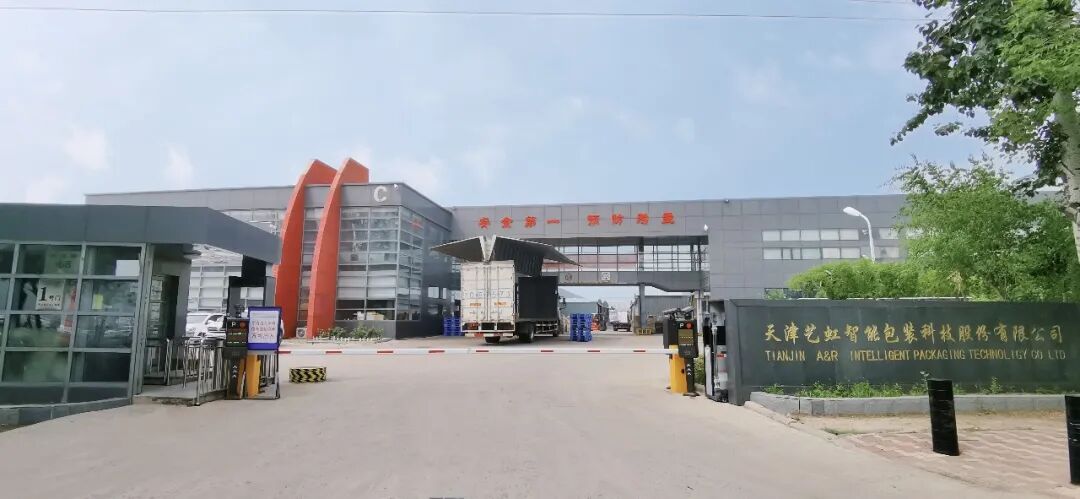
Top-level Design: Centered on the Process Route
The success or failure of building a smart factory depends on whether the top-level planning truly aligns with the factory's business processes. The Tianjin Yihong Intelligent Project centers on the process route, uses the logistics flow as its framework, is driven by data as its essence, and covers the entire lifecycle from raw material entry to finished product exit.
The main process route is as follows: Rolls of paper are cut into sheets by a paper cutting machine, then transported by AGV to the cutting machine for trimming, and then further transported to the printing machine for multicolor printing; after printing, the materials rest for 4–6 hours, then are transferred via a corridor to the surface treatment workshop where one or multiple processes such as lamination, embossing, hot stamping, and die-cutting are completed in sequence; finally, the rollers are glued together with face paper by a laminating machine, folded into boxes, and wrapped for packaging to form the finished product (corrugated cartons) or the face paper is transported upstairs by freight elevator to the premium box workshop, where greyboard is slotted and die-cut, then matched with color box face paper to form a finished premium box, processed by the top and bottom box machine into the final premium box product.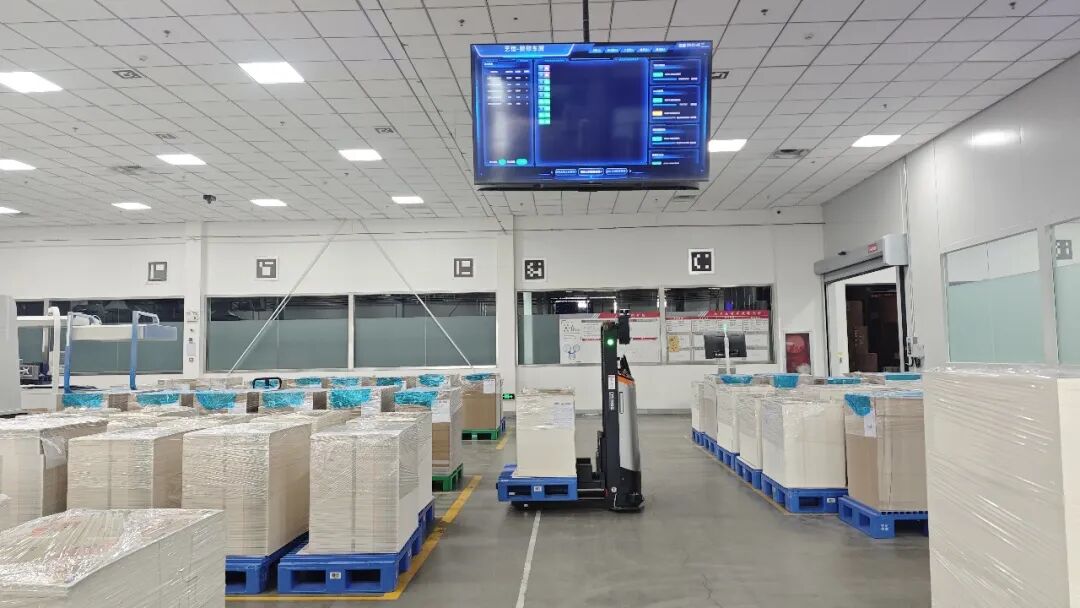
The finished glued boxes can be directly shipped from the first-floor buffer area, or transported by AGV to the freight elevator, entering the fourth-floor flat storage. They are scheduled for outbound loading once the shipping order is triggered. The entire process route spans multiple floors and functional areas, with long logistics lines and many transfer points. The project plan is centered on the core concept of 'letting data flow drive material flow, and letting system scheduling replace manual coordination,' using this as a starting point to build an integrated digital-intelligent system of 'soft and hard integration.'
Hardware Reconstruction: Full-Process Automated Handling System
01/ Printing Workshop: Core Area of Automation Transformation
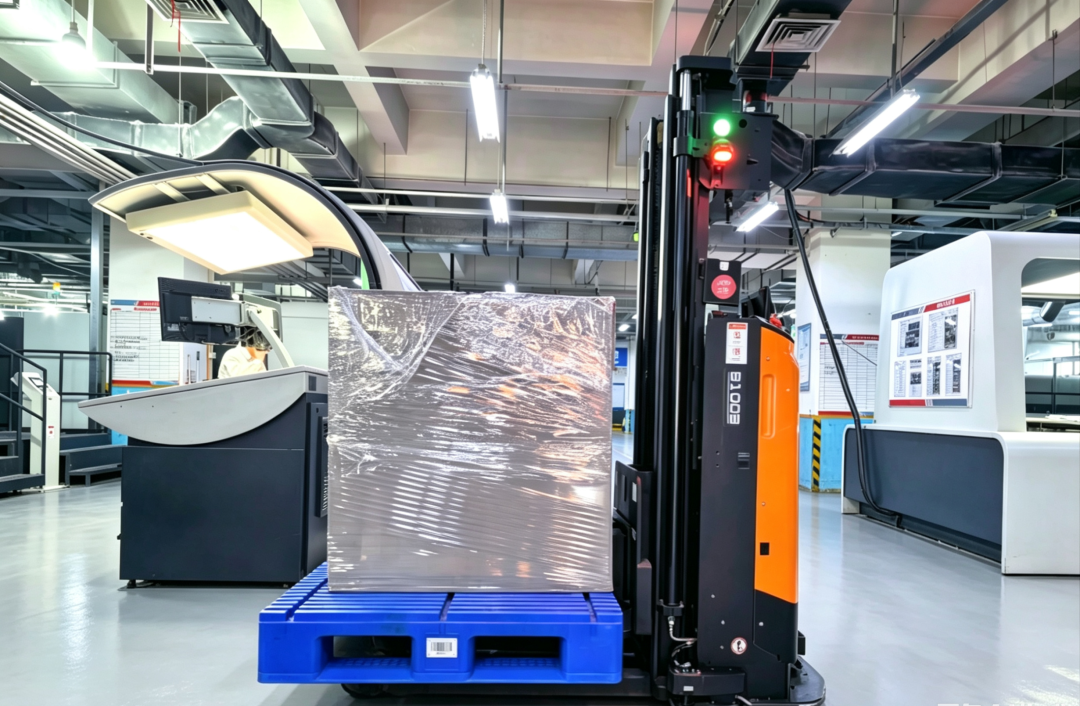
The printing workshop is the area with the most extensive transformation in this project. Through standardized upgrades of three processes-paper sheeter, cutter, and printing machines-combined with conveyor lines and forklift-type AGVs, a complete closed-loop for automatic pallet circulation has been established.
The paper sheeter adopts a U-shaped operation mode of 'upper pallet → automatic unpacking → receive full pallet → AGV transport,' with two machines symmetrically arranged north and south, achieving seamless connection from paper cutting to transfer. In the cutting process, forklift-type AGVs handle automatic material loading and unloading; empty pallets produced by cutting are centrally stacked by a pallet stacking machine and then returned via AGV to the paper sheeter or cutter feed openings, realizing automatic allocation of pallet resources.
The modification of printing machines is the most technically complex part of the project. Taking the UV printer as an example: on the loading side, forklift-type AGVs deliver pallets fully loaded with paper to the machine's loading port, where the top-lift transfer device automatically moves them to the feed position, and the feeder mechanism automatically picks the paper; on the unloading side, empty pallets circulate along the side conveyor, receiving the printed paper; full pallets automatically proceed to the end of the conveyor, where an AGV transports them to the resting area or inspection area. The entire path forms an 'S-shaped' automatic closed-loop, completely replacing the previous labor-intensive forklift operations.
02/ Cross-Floor Logistics: Vertical Transportation Automation
For the intelligent project, two freight elevators on the north and south sides were specially upgraded. Rollers were installed inside the cabins, and docking conveyor lines were set up at each floor's elevator entrance, making the freight elevator a vertical extension of the ground-level AGV system.
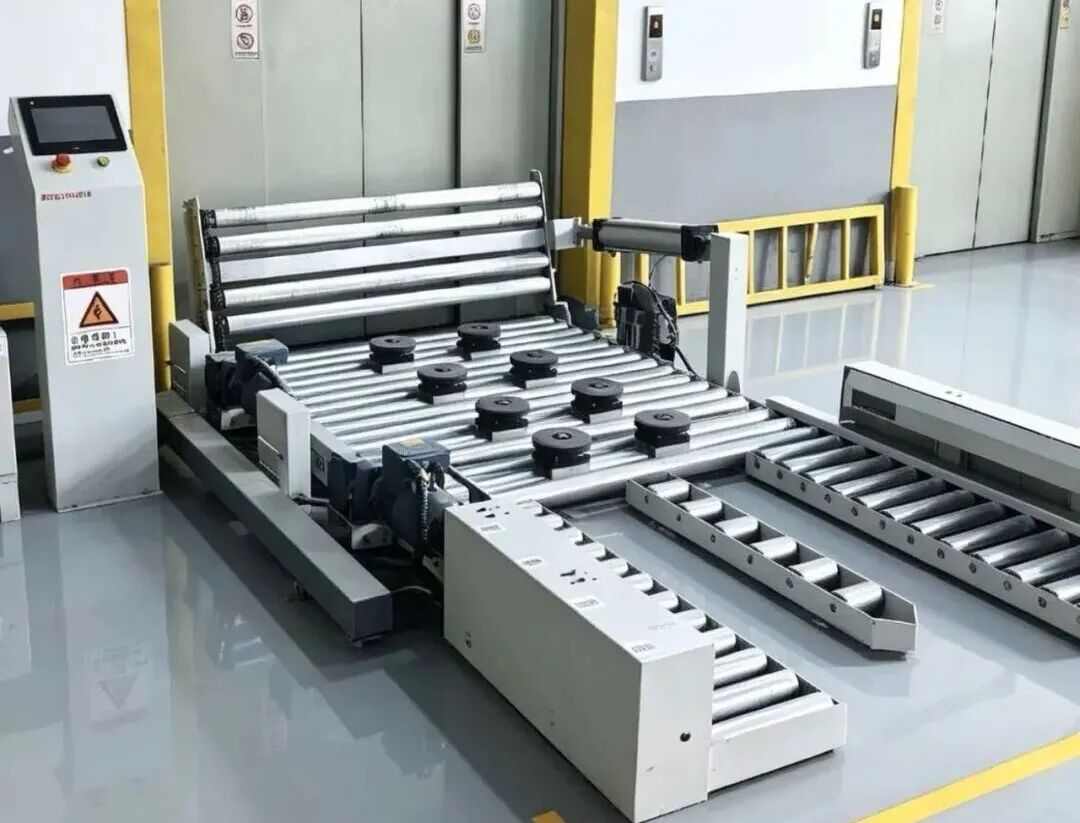
After the renovation, on the first floor, forklift-type AGVs transport materials to the freight elevator entrance. The materials are automatically conveyed into the elevator cabin, then ascend to the target floor, and are discharged onto the floor conveyor line via the cabin rollers. The subsequent transport is completed by the floor AGV or manual stacker forklift.
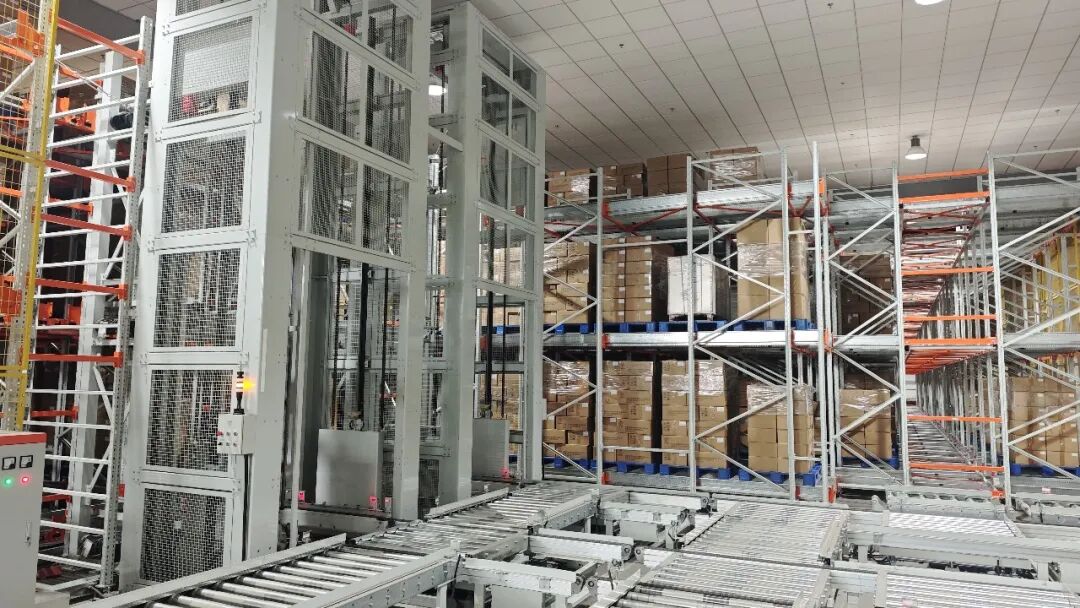
The fourth-floor flat storage area of the company can store more than 700 pallets of finished products. When storing, the finished products are lifted by the freight elevator, then picked up by the fourth-floor hidden forklift AGVs and automatically placed in storage according to the WMS-assigned locations. When retrieving, the warehouse operator issues a command in the system, and the AGV automatically transports the goods to the freight elevator entrance, descends to the first floor to wait for loading. Empty pallets generated by outbound operations are lifted back up via the freight elevator for reuse. Throughout the entire inbound and outbound process, human involvement is limited to system operation, with physical labor intensity close to zero.
03/ RFID empowerment: the digital intelligence base for material tracking
The tray adopts an integrated label of "barcode RFID chip", the appearance of the barcode is visible, and the built-in chip stores material information. Forklift AGV is equipped with RFID reader, every time the handling task is performed, the system automatically verifies whether the pallet number is consistent with the task number, realizes the accurate mapping of materials and tasks, prevents the operation risk of "taking the wrong goods, moving the wrong place" from the source, and ensures that the material ledger in the digital system and the on-site physical objects are synchronized in real time, which is also one of the key data entrances for the whole plant to achieve "digital intelligence drive".
Software empowerment: Collaborative control of the four major platforms
Hardware upgrades lay the physical foundation, and software collaboration is the real engine to unlock the value of digital intelligence. Tianjin Yihong Intelligent Project deploys four major platforms: MES, WMS, WCS, and LES, and builds a full-link digital intelligence management and control system covering production execution, warehouse management, equipment control and logistics scheduling.
01/ MES Manufacturing Execution System
Realize automatic material calling and automatic work reporting. When the machine feeding conveyor line is idle, the system automatically issues the replenishment task to the AGV. After the printing is completed, the system automatically records the number of work orders completed based on real-time data collection, and the production information flows online throughout the process, greatly reducing the manual entry time of clerks.
02/ WMS Warehouse Management System
The system is the core tool to solve the stubborn problem of "inconsistent accounts". After the system is launched, all raw materials entering and leaving the warehouse must be retained by the system operation, and each record has a clear time and responsible person. The system provides an inventory pre-alert table synchronously, automatically triggers reminders for low inventory, and procurement decisions are upgraded from "empirical estimation" to "data-driven".
03/ WCS Equipment Control System
Responsible for the unified scheduling of AGV, conveyor line, jacking and transfer and freight elevator and other automation equipment in the whole plant, it is the "nerve center" that connects the upper business logic and the execution of the underlying equipment, ensuring that every logistics instruction is accurately and timely transformed into equipment actions.
04/ LES Logistics Execution System
Carry out unified queuing and priority management of various logistics tasks such as material calling, material replenishment, transfer, and return to the warehouse to avoid resource conflicts when multiple tasks occur concurrently, and ensure the smooth and orderly logistics beat of the whole plant.
Real-time data sharing between the four platforms, and at the same time docking with the factory ERP delivery notice, realizing end-to-end data penetration from customer orders to finished product delivery, so that the concept of "digital intelligence driven" can be truly implemented at every business node.
Data collection: The machine is fully networked
The company's digital intelligence project has completed the digital acquisition transformation of 32 main production equipment in the workshop on the first floor, covering all core equipment such as paper separating machines, printing machines, laminating machines, laminating machines, embossing machines, hot stamping machines, die-cutting machines, and folder gluing lines.
The operating status, production quantity, fault alarm and other data of each machine are imported into the MES in real time to form a digital dashboard of the visual workshop. Management can grasp production capacity data, equipment utilization rate and abnormal information without relying on manual statistics, providing a solid digital intelligence foundation for the continuous promotion of lean production.
Management change: from site cleanliness to process standardization
01/ The appearance of the site has been comprehensively improved
AGV requires materials to be neatly stacked on standard pallets according to the specified storage location, which forces on-site operation specifications. In the past, the workshop environment of random stacking has been fundamentally changed, and a clean and orderly site is not only the prerequisite for system operation, but also the basic guarantee for safe production.
02/ Logistics collaboration is fully online
The use of raw materials previously relied on offline verbal communication between the captain and the warehouse manager, and information delays and unclear responsibilities were the norm. After the system is launched, all material requests are submitted online through MES, and the warehouse management performs the warehouse according to the system tasks, and each material circulation has a complete electronic voucher, realizing the fundamental transformation from "verbal agreement" to "system control".
03/ Comprehensive data-based procurement decision-making
WMS real-time inventory data and pre-warning tables allow the purchasing department to bid farewell to the history of buying paper by feeling, and the waste of repeated procurement and material backlog is effectively curbed, and the inventory turnover efficiency is improved.
Core values and industry inspiration
The value of Tianjin Yihong intelligent project can be summarized from the following four dimensions:
(1) Efficiency improvement and growth rate: the whole process is automatically upgraded, eliminating manual transfer bottlenecks, shortening the production cycle, and making the production line flow cycle more stable.
(2) Cost reduction and consumption reduction: AGV automatic transfer greatly reduces the physical labor intensity of front-line workers, effectively saves labor costs and reduces raw material waste through automatic reporting.
(3) Standardized management: The AGV system forces the site to be clean and standardized, creating a standardized and visual digital intelligence workshop.
(4) Link to the overall situation: MES, WMS, WCS, LES and ERP data are connected, opening up the whole link of production, logistics and warehousing, and comprehensively enhancing supply chain management and control capabilities.
From the perspective of industry significance, the Tianjin Yihong digital intelligence project proves that in a complex printing and packaging factory with multiple floors, multiple processes and multiple varieties, through reasonable top-level design and integrated integration of software and hardware, it is possible to realize the automatic scheduling of the whole logistics process and refined digital intelligence control of warehousing.
The intelligent factory built by Tianjin Yihong is a complete implementation of the concept of "digital intelligence-driven" in the printing and packaging industry. Intelligent manufacturing is not a simple equipment upgrade, nor is it a pure software to the cloud, but an overall digital intelligence project with process flow as the skeleton, data collection as the nerve, software platform as the brain, and automation equipment as the limbs, and organic integration and coordinated operation.
For peer enterprises that intend to promote transformation, formulating plans from pain points and implementing simultaneous design of software and hardware is the correct path to make digital intelligence move from "concept" to "value". With the continuous penetration of artificial intelligence technology in the fields of quality prediction and process optimization, the digital intelligence process of the printing and packaging industry will be further deepened.