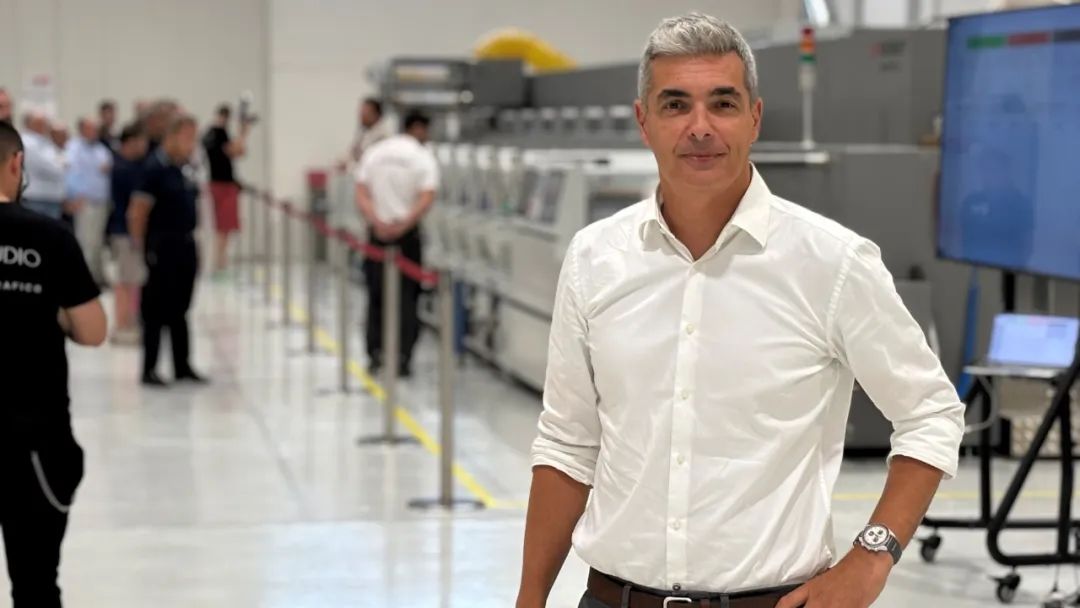
Jodi Giralt, the newly appointed Technical Sales Director of Bost: Insight into the Transformation and Future of the Label Packaging Industry!
Currently, the global labeling and packaging industry is undergoing unprecedented rapid and widespread changes, making the demand for strategic leadership by businesses unprecedentedly important. We were fortunate to interview Jodi Giralt, the newly appointed Technical Sales Director of Bost Label Business.
With rich experience accumulated in the industry, Jodi has a clear insight into the direction of market development and understands how technology partners should truly create value for customers. In this interview, he shared his unique insights on industry trends, the role of innovation, and how to establish long-term and meaningful partnerships with label processors.
Deeply cultivating the industry: Jodi's career and Bost's relationship
My career began in a family business when I was a young engineer, "Jodi said." Our family's company specializes in manufacturing narrow width wheel transfer printing brush machines. This initial experience laid a solid foundation for me in industrial technology and product development, and also gave me a deep understanding of the internal operations of professional manufacturing enterprises
With the foundation of this early experience, I began to broaden my horizons and seek development opportunities outside of my family business. In the following decades, I worked for several prestigious companies in the printing and packaging industry. In each position, I continued to hold regional or global positions, which allowed me to gain a deep understanding of international markets, complex supply chains, and strategic business development
Jodi's professional background coincides with many leaders leading the reshaping of the packaging industry today. With the packaging industry becoming increasingly complex, technology advancing rapidly, and supply chains becoming increasingly globalized, the demand for leaders who possess both practical technical experience and broad strategic vision is rapidly increasing. If enterprises want to achieve sustainability, improve speed and efficiency, they must fully utilize the digital transformation that the packaging industry is undergoing, and Jodi's composite skill set is exactly what the industry urgently needs.
Industry Changes: Insights into Major Changes in the Past Years
Jody pointed out that in the past few decades, the global labeling and packaging landscape has undergone earth shaking changes. These changes are mainly due to the continuous evolution of consumer preferences, ongoing technological advancements, and growing environmental issues.
He specifically elaborated that this undoubtedly covers a wide range of topics, such as the rise of digital printing and customization, the integrated development of smart tags and packaging represented by technologies such as RFID, NFC, and QR codes, the pursuit of high-end brands to achieve differentiation, the deepening of sustainable development concepts, the booming development of e-commerce, increasingly strict regulatory requirements, and the role of various automation technologies in improving efficiency throughout the entire supply chain. "
New technologies such as RFID, NFC, and QR codes are transforming traditional tags into interactive platforms, which not only enhance consumer engagement but also provide effective anti-counterfeiting tools for products. At the same time, sustainability plays a crucial role in this transformation process, and changes in the regulatory environment have forced businesses to re-examine label design to ensure higher clarity and compliance.
Flexographic and digital printing: integrated development is the future trend
Flexographic technology is constantly evolving, while digital printing is constantly breaking through and innovating, "Jody said." In the future, we will see flexographic printing achieve higher levels of automation, better printing quality, higher production efficiency, and more sustainable practices; while digital printing will continue to expand its boundaries in flexibility and value-added services. We can foresee that in the future, it will not be one technology replacing another, but rather flexographic printing and digital printing moving towards deep integration and mixing, combining the efficiency of flexographic printing with the flexibility of digital printing
Industry data further confirms the strong rise of digital printing. It is expected that by 2029, as printing companies gradually realize the financial and operational advantages brought by digital processes, nearly 10% of label quantity and over a quarter of label value will be realized through digital printing. Integrating digital printing machines and flexographic hybrid printing machines will enable processing enterprises to more efficiently handle small batch customized orders and large-scale production needs, thereby maximizing production flexibility and return on investment.
Automation is another key driving factor driving this development. The application of artificial intelligence (AI) and machine learning (ML) can build end-to-end ecosystems, simplify all aspects from design to production, effectively reduce waste, lower error rates, and shorten setup time. This hybrid technology and automation solution is crucial for supporting the growing trend of personalization and traceability, while also meeting the growing market demand for more sustainable and low waste operating models.
Bost's unique advantage: comprehensive integration and innovation
Jodi explained that in recent years, Bost has been committed to adapting to the industry's trend towards fully integrated and interconnected production environments. He said, "With a comprehensive technology portfolio, deep industry expertise, and strategic focus on innovation, automation, and service support, Bost occupies a unique leading position in multiple key areas of the label field. We have a very advantageous position in the flexographic printing field, and we are also at the forefront of hybrid printing machine development, which we call an 'integrated' solution because all its components come from Bost alone
Our end-to-end workflow integration enables the creation of a fully interconnected ecosystem. Coupled with our leadership position in sustainable development, this gives us a unique advantage in developing integrated solutions. By providing a one-stop solution covering hybrid, digital, and flexographic technologies, Bost not only simplifies the supply chain for processors, reduces operational complexity, but also enables them to quickly adapt to rapidly changing market demands.
The challenge of label processors and Bost's response
Jodi believes that the main challenges currently faced by label processing enterprises include rising raw material costs caused by inflation, increasingly strict regulatory compliance requirements, and the need for large-scale, rapid, and small-scale production to meet the demands of e-commerce and personalized marketing activities. In addition, the persistent labor shortage problem also poses another major challenge, and automation and intuitive machine interfaces can alleviate this problem to some extent.
Sustainability is another crucial challenge that cannot be ignored. Nowadays, processing companies must be able to demonstrate the recyclability or compostability of their labels, use responsibly sourced materials, and minimize waste throughout the entire production process.
Bost is addressing these challenges by providing highly automated and efficient solutions that can effectively reduce waste, lower energy consumption, and shorten setup time, "Jodi said." Our solution enables fast turnover and flexible production, with user-friendly interfaces, intelligent workflows, and sustainability driven innovation, all aimed at helping processing companies stay competitive in a rapidly changing market
Underestimated Future: Comprehensive Digital Transformation is the Next Frontier
Jodi emphasized that the next frontier of the labeling industry lies in fully embracing digital transformation - which requires tightly connecting every aspect from design to delivery through cloud based platforms and IoT enabled devices.
The attention of label processing enterprises to data, connectivity, and artificial intelligence is far from enough, "Jodi bluntly stated." Fully utilizing real-time production data and AI driven analysis can significantly improve production efficiency, product quality, and predictive maintenance capabilities. In addition, besides printing itself, the industry's attention to end-to-end digital transformation is also insufficient, and there is no active response to the upcoming sustainable development regulations. Adopting intelligent interconnected systems now is the key to maintaining future competitiveness. Tools like BOBST Connect can achieve wiser decision-making, predictive maintenance, and comprehensive digital integration. "
With the increasing regulatory pressure, especially in terms of transparency, traceability, and sustainability, data-driven systems have become crucial for compliance documentation and reporting. BOBST Connect is a manifestation of these features, providing processing enterprises with a clear path towards a smarter and more flexible operational model.
Win win future: Establishing long-term and stable partnerships with customers
As Jody explained, the long-term success of today's packaging industry increasingly relies on establishing collaborative strategic partnerships rather than simply transactional supplier relationships. He pointed out, "True long-term partnerships only develop when customers see Bost as a strategic ally rather than just a supplier. I believe that maintaining close contact, providing continuous support through Bost's global network, and ensuring long-term value beyond initial sales through training, data insights, and continuous innovation are key to maintaining this relationship
Bost's global influence and commitment to promoting customer success through training programs, real-time data insights, and continuous innovation reflect the industry's shift towards a partner driven business model. This approach ensures that processors can not only keep up with the pace of industry change, but also maintain a leading position in core areas such as sustainability, digital transformation, and supply chain resilience. By investing in these relationships, Bost helps clients cope with uncertainty, seize new opportunities, and establish lasting competitive advantages to achieve a win-win future.