


Grand, Shengtong, Zhejiang Printing, Yamingwei digital intelligence implementation solutions! Understand them to avoid detours~
On September 18-19, the 2025 Printing and Packaging Industry Economic Forum and the National Printing Managers Annual Conference was grandly held in Hangzhou, Zhejiang. At the meeting, numerous industry experts delivered a series of brilliant presentations, inspiring new thoughts and directions for the attendees.
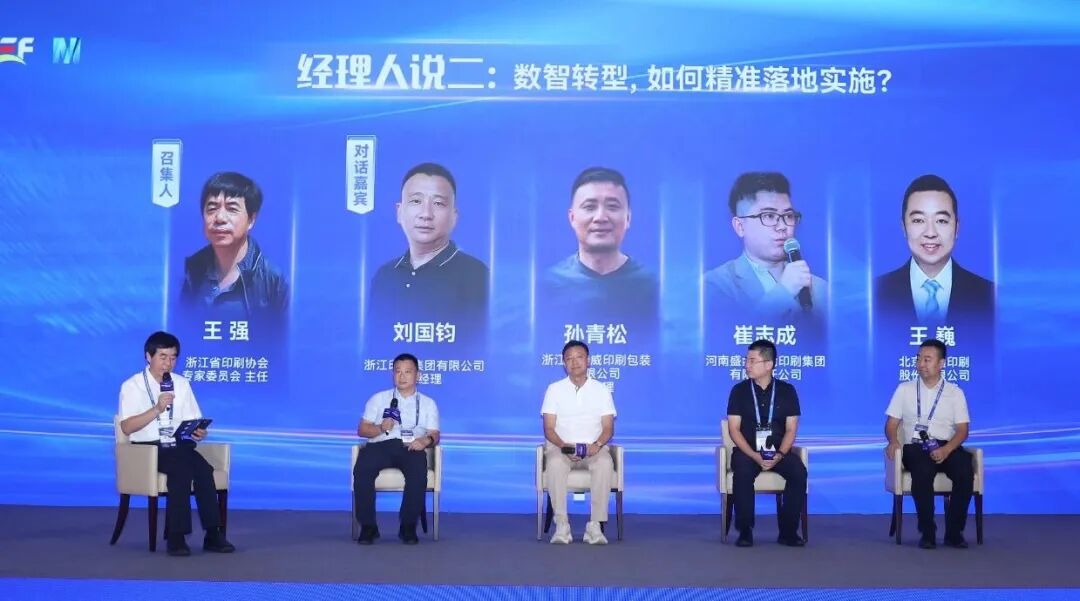
This session features the second installment of 'Manager Talks': "Digital and Intelligent Transformation – How to Implement Accurately?" The dialogue was hosted by Wang Qiang, Director of the Expert Committee of the Zhejiang Printing Association. The participating guests engaged in lively discussions, combining their insights with real company experiences.
Zhejiang Printing Group Co., Ltd
General Manager Liu Guojun
In the face of the wave of digital transformation, Zhejiang Printing Group Co., Ltd. (hereinafter referred to as Zhejiang Printing Group) has taken the method of "walking quickly in small steps, from point to surface", first consolidating the underlying capabilities, and then gradually promoting the path of digital transformation.
In the front-end document management link, Zhejiang Printing Group has built a publishing digital asset management platform to provide publishing houses with standardized document processing, secure storage and directional transmission services to ensure copyright security and traceability of document circulation. Internally, we will gradually replace traditional film libraries, strengthen prepress quality control, and improve overall service stability and delivery consistency.
At the level of production organization, we have built a full-function digital publishing center in Hangzhou Wulin 921 Digital Culture Industrial Park to realize the integration of planning, design, proofing and small-batch production; At the same time, it is combined with industrial research projects to create a "printing research classroom" and form a new service capability of "digital publishing + scene experience". Since it was put into operation in May 2024, the digital printing business has increased by more than 50% year-on-year.
In the intelligent construction of the Xiasha production base, Zhejiang Printing Group adopts a two-line parallel strategy of "digital infrastructure + equipment upgrade": on the one hand, it improves data visualization and management transparency through ERP iteration, handheld mobile quality inspection, management information optimization, etc.; on the other hand, it introduces flat plate eight-color, 16-color rotary printing machines and high-speed wireless binding machines and other equipment to optimize the production capacity structure and quality efficiency. At present, the first phase of intelligent construction has completed the expected goal, and the self-assessment has reached the third level through the maturity assessment of the second-level intelligent manufacturing capability of the Chinese Academy of Sciences.
The biggest challenge in the process of promotion is not technology, but organizational capabilities and talent structure. To complete digital transformation, traditional book printing enterprises need compound talents who understand technology, information technology, and management, as well as front-line teams that are willing to embrace change and accept challenges. Digitalization is not about "going to the system", but about making the system truly a management tool.
Our digital transformation path does not start with "growing up quickly", but with the attitude of "follower", starting from "making every link controllable, explainable and replicable".
Zhejiang Yamingwei Printing and Packaging Co., Ltd
General Manager Sun Qingsong
Zhejiang Yamingwei Printing and Packaging Co., Ltd. (hereinafter referred to as Zhejiang Yamingwei) explores and moves forward on the road of digital transformation with the attitude of a "practitioner". Our transformation process is gradual, starting with the promotion of informatization and starting with the solution of internal processes and standards in 2017. On this basis, in 2018, we cooperated with a third party to introduce a digital system in the production workshop to achieve the initial collection of equipment data. Although this system is not a complete MES system, it has always focused on the efficiency management of the workshop team, and plays an important role in two aspects: first, the efficiency evaluation and performance appraisal of the team; The second is to carry out vertical improvement for large quantities and long orders, and the core goal is to improve the utilization rate of equipment and fully tap the effective time in the production process.
With the construction of a new plant of 40,000 square meters in 2025, we plan to systematically build a truly digital factory in the next year, while strictly following two major standards: one is the capability standard, the factory must build the ability to undertake large-scale customized orders, which requires us to systematically build core modules such as process execution, intelligent scheduling, equipment monitoring, quality closed-loop and material transfer; The second is the maturity standard, we clearly build with the goal of national intelligent manufacturing maturity 3.0 to ensure that the investment direction is clear.
In the process of moving towards this goal, we are faced with a triple confusion. The first is the technical level of penetration. The digitalization of the existing main equipment is low, and there are still many problems in process execution, equipment testing, quality closed-loop, etc. For example, from the perspective of printing process execution, we cannot be completely code-driven like CNC machines, and we still need to rely on human experience.
The second is the dilemma of trade-offs between input and output. When digitalization changes from "lightweight" data display to "heavy" three-dimensional warehouses, AGVs, and intelligent sensing equipment deployment, the investment scale jumps from millions to tens of millions or even higher, making the evaluation of input-output ratio extremely challenging.
Finally, and most importantly, there is the logical dilemma of internal and external cooperation. We deeply realize that the key to digitalization does not lie in large investment, but its success depends on whether the enterprise can clearly sort out the internal lean management capabilities, production and operation logic and performance evaluation system. If we can't explain the management logic clearly, we can't effectively collaborate with technical service providers to "translate" requirements into computer language. In the final analysis, digitalization is not an end, but a means to consolidate and improve the operating capabilities of enterprises, helping them build core advantages in future cost and efficiency competition.
Henan Shanda Intelligent Printing Group Co., Ltd
Deputy General Manager Cui Zhicheng
In the process of promoting automation and digital construction, Henan Shanda Intelligent Printing Group Co., Ltd. (hereinafter referred to as Shanda Printing) has always firmly believed in a core principle: all digital and intelligent investment must be based on clear business logic and product standards, and accurate landing comes from a deep understanding of its own advantages, rather than blindly following the trend.
Regarding how to achieve accurate landing, we believe that the key lies in focus. Specifically, it is reflected in several links: first, in the warehousing link, we have invested in the construction of three-dimensional warehouses this year, replacing the traditional manual and forklift mode with intelligent management, and realizing the upgrade of warehousing efficiency; Second, in the printing process, we connect two four-color printing machines through the self-developed automatic plate loading system, so that its production capacity is equivalent to the eight-color machine, and the cost is much lower than the imported solution, and we hope to move towards the goal of "one person operating one printing machine". The basis of all this is that we highly standardize our products, and specific machines only focus on producing specific products; Third, in the post-press process, we have realized automatic box sealing, packaging and palletizing by the manipulator. The reason for the successful implementation is precisely because we lock the process into a standardized product. If a production line needs to handle complex specifications such as 8 cars, 16 cars, and 32 cars at the same time, it is not only difficult to achieve, but also extremely expensive to adapt to the system, which is contrary to our core business logic of building cost advantages and benefiting customers through the ultimate in efficiency. Therefore, the first step in accurate implementation is to sort out your own product line and business process.
Regarding the new plans for the future, our investment will focus on the field of digital printing. We see that digital printing itself comes with a digital process, and its quality is constantly improving while the cost is decreasing. We hope to build new production capacity in the field of shortcomings that are difficult to handle efficiently by introducing digital equipment such as Landa, HP, and Ricoh, so as to undertake more diversified orders and achieve a new round of intelligent upgrades on this basis.
For the majority of small and medium-sized enterprises, our experience may be difficult to fully replicate, but the ideas can be learned. Shanda Printing also started with a small piece of equipment and developed to today's scale. We believe that the most important lesson is that you must find your own strengths. Our strength lies in the large-scale and standardized "large single product" strategy, while our disadvantage lies in spot color, high differentiation and service-oriented orders. Therefore, if other companies want to compete with Shanda Printing, they should not fight our track, but focus on high value-added and customized areas, and can gain an advantage in this regard. In the end, the implementation of digital and intelligent transformation must rely on the company's own financial situation, technology accumulation and core advantages, which is the key to success.
In the process of promoting digital and intelligent transformation, Beijing Shengtong Printing Co., Ltd. (hereinafter referred to as Shengtong) has always closely focused on the business direction and actual needs of enterprises. We deeply realize that in the face of the changing of product attributes from knowledge carriers to emotional bonds, sales channels migrating from offline to online, and market patterns reversing from seller's market to buyer's market, digital transformation is no longer a multiple-choice question, but a mandatory question related to the future competitiveness of enterprises.
Based on this consensus, we have adopted a "point-line-surface" gradual strategy, not blindly pursuing one-step "unmanned", but insisting on starting from the most urgent business pain points. In the core link of quality control, we not only introduce Huaxia Sight's visual inspection equipment, but also combine the AI large model to independently develop the inspection system, which not only accurately identifies defects, but also transmits the data back in real time, completely solving the management blind spot of "whether the testing equipment is really on" and realizing refined quality control.
Similarly, in terms of efficiency improvement, we clearly judged that we must respond to the explosive order demand brought by online channels through automation and intelligence. We are not fully rolling out, but from the automatic stacking and packaging of rotary machines to the continuous motor transformation of glue binding and riding gutters, we have made breakthroughs at key nodes one by one, significantly reducing manpower dependence and improving the efficiency of the production line to a new level. In order to cope with the explosive and personalized orders brought by short video channels, Shengtong actively introduces variable data printing equipment and coated paper digital printing equipment to ensure that the market needs any products, we have the corresponding production capacity.
More importantly, the current big data and AI technology is accelerating the penetration of the printing industry, how to deeply integrate these technologies with the main printing business? The deep integration of AI must be based on real business needs, rather than blindly chasing technological hotspots. After systematic exploration, Shengtong has formed a clear strategic framework for AI applications.
First, in terms of AI technology application path, we clearly divide it into two strategic dimensions:
The first dimension is the expert advisor type. When encountering problems in daily work, we will ask AI tools such as Doubao, ChatGPT, and DeepSeek to improve problem-solving efficiency. This has become our basic ability to improve operational efficiency, but its value is more reflected in the auxiliary level.
The second dimension is to transform AI into direct productivity. This aspect can be divided into two directions, one is running inside the computer screen; The other is the ability to jump out of the computer screen and directly affect the physical world. Specifically, to improve AI productivity on the screen, we mainly promote the application of generative AI, covering Wensheng Picture, Wensheng Video, Graphic Video, Automatic Typesetting and Automatic Fusion, etc., which are the value created by AI large models for us in the virtual space.
However, we believe that the true value of AI lies in pushing the boundaries of computer screens and extending to physical production environments. This requires equipping AI with two key "tentacles": one is the "eye", that is, through visual acquisition equipment such as cameras, to input real-world data into the AI system; The second is "hands and feet", that is, through the interaction between self-developed circuit boards and machinery and equipment, so that AI decision-making can directly drive the operation of physical equipment. In this way, we build a complete closed loop, collecting data through the vision system, AI for analysis and decision-making, and finally driving machine actions through the execution system.
In recent years, with the help of AI, Shengtong has made some attempts and successfully developed data acquisition circuit boards compatible with multi-brand devices, breakthroughs in solving the protocol barriers of Heidelberg, Komori, Martini and other devices. Through IoT wireless distributed deployment, real-time monitoring of key parameters such as equipment operating status, printing machine pH, conductivity, and water tank temperature is realized, and a unified data platform is built.
In the execution process, we have achieved breakthrough innovation. Take the "double-sided graphic and textual" notebook displayed by Shengtong as an example: under the traditional method, experienced typesetting teachers take 1~2 days to complete, but AI technology can complete image segmentation and accurate layout within 1 second. In terms of technical architecture, Shengtong adopts a hybrid model. The dialog function directly relies on existing large models; image processing (such as skin whitening, face slimming, etc.) is based on existing models for targeted training and deployed to run locally; In addition, we have independently developed equipment control systems, including communication systems with cameras and stepper motor drives based on 3D printing technology.
From in-screen design layout to physical device control that pushes screen limits, AI technology is redefining the efficiency and possibilities of print production.