


Digital anti-counterfeiting? Intelligent anti-counterfeiting? You must understand these new anti-counterfeiting technologies!
How to achieve product anti-counterfeiting in QR code? How much do you know about the doorways here? In this article, the application of QR code technology in anti-counterfeiting labels was shared with everyone. In this article, the author also shares some application situations of image comparison technology and RFID/NFC intelligent technology in anti-counterfeiting labels.
Image comparison technology
Image comparison technology is a technique that combines anti-counterfeiting information printing with anti-counterfeiting management software products. It uses the shape and characteristics of the product itself, or selects materials with random structures and textures (such as intentionally adding colored fibers during paper making), encodes the anti-counterfeiting object, and combines the two anti-counterfeiting information to encode and store them together in a computer recognition system database. Consumers can request relevant image information through mobile communication tools such as smartphones and computers to verify the authenticity of their products or inspect whether they have been damaged during circulation.
Image comparison techniques include texture comparison, number comparison, symbol comparison, image comparison, and so on. These are all based on the principle of one item, one code, and an additional random variable is added to allow consumers to compare whether the logo matches the image on the query page. For example, texture comparison is the process of adding colored fibers to pulp to create clear but disordered texture anti-counterfeiting paper. The texture of anti-counterfeiting paper is randomly formed, and the colored fibers of each paper form its unique structural texture. Examples of various image comparison anti-counterfeiting labels are shown in Figure 1.
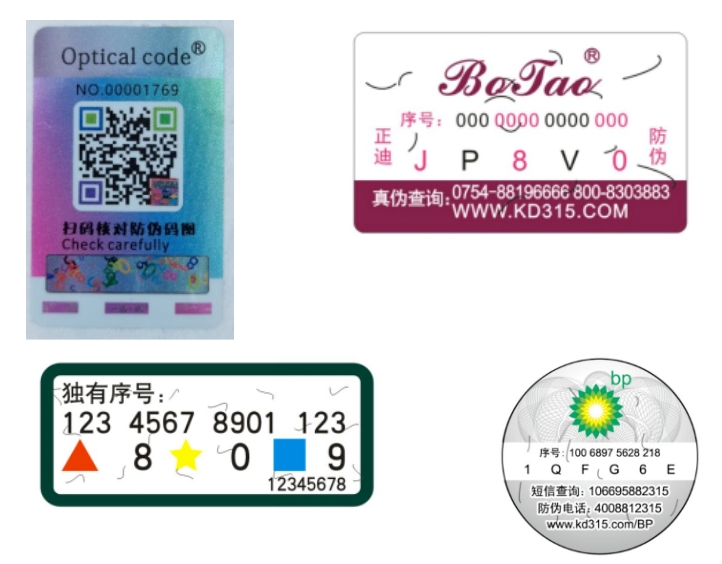
Figure 1 Example of image comparison anti-counterfeiting label
RFID/NFC intelligent technology
RFID smart tags appeared earlier, but were not widely promoted and popularized in the early stages due to cost constraints. In recent years, with the continuous reduction of RFID tag costs and the increasing application scenarios, the RFID/NFC smart tag market has developed rapidly and is widely used in product anti-counterfeiting traceability, intelligent retail, asset management and other fields. An example of an RFID smart tag is shown in Figure 2.
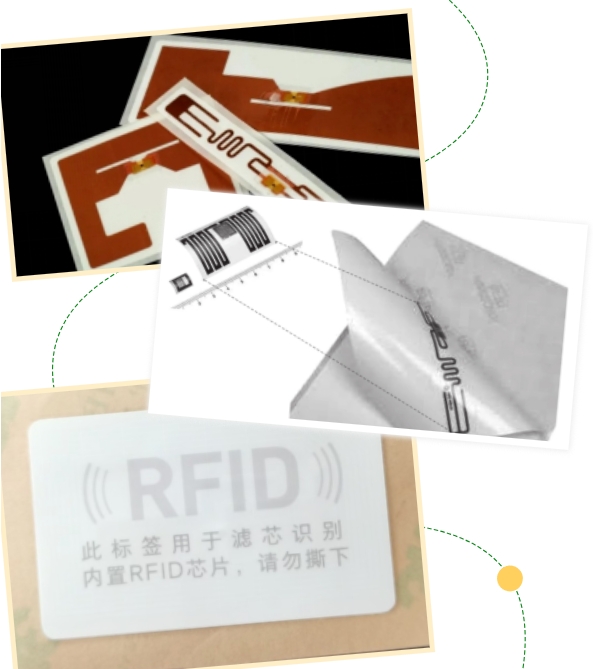
Figure 2 Example of RFID smart tag
Usually, we classify RFID and NFC together as smart tags, but in fact, they are different. NFC and RFID may appear similar on a physical level, but in reality they are completely different technological fields. RFID essentially belongs to identification technology, while NFC belongs to communication technology.
NFC is a short-range wireless communication technology based on RFID high-frequency technology, consisting of NFC devices (such as smartphones, tablets) and NFC tags. RFID must consist of specialized readers and tags. RFID can only read and determine information, while NFC technology can achieve information exchange. In other words, NFC is an evolved version of RFID. An example of NFC smart tag is shown in Figure 3.
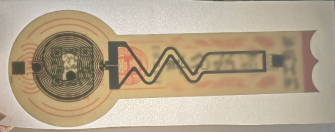
Figure 3 Example of NFC smart tag
In addition, the transmission range of NFC is smaller than that of RFID, which can reach several meters or even tens of meters. NFC, due to its unique signal attenuation technology, has the characteristics of short distance, high bandwidth, and low energy consumption compared to RFID.
At present, RFID smart tags are widely used in logistics management, warehouse management, animal identification, access control systems, retail anti-theft and other fields. NFC smart tags are widely used in fields such as mobile payments, access control systems, identity recognition, and device pairing (such as pairing Bluetooth earphones with mobile phones).
With the increasing number of application scenarios and the convenience and popularization of reading devices, it is believed that RFID/NFC smart tags will be vigorously popularized, developed, and applied in more fields.