


A seminar on the cultivation of professional doctorate talents in publishing was held in Beijing to jointly explore new pathways for nurturing high-level publishing professionals.
The 2025 Exchange Meeting on the Joint Construction of Publishing Disciplines and Majors was held at the Communication University of China. During the meeting, the seminar on the training of professional doctoral talents in publishing was held on the afternoon of October 29 at the Academic Center of the Communication University of China. The event was jointly organized by the Secretariat of the National Steering Committee for Professional Graduate Education in Publishing, the Publishing Research Institute of Nanjing University, and the School of Publishing of the Communication University of China.
Leaders from the Ministry of Education attended to provide guidance, and Duan Liping, Secretary-General of the National Steering Committee for Medical Postgraduate Education and Professor at Peking University Health Science Center, as well as Sun Jieyuan, a member of the National Steering Committee for Educational Postgraduate Education and President of Guangxi Normal University, shared their experiences in professional doctoral training. In addition, members of the National Steering Committee for Publishing Professional Education, heads of publishing doctoral degree authorization points, leaders of some publishing master's degree authorization points, as well as experts from the national publishing discipline joint construction working group and professionals from the publishing industry attended the meeting to offer suggestions for the training of publishing doctoral students. Zhang Zhiqiang, Deputy Director of the Publishing Steering Committee and Executive Deputy Director of the Publishing Research Institute of Nanjing University, presided over the meeting.
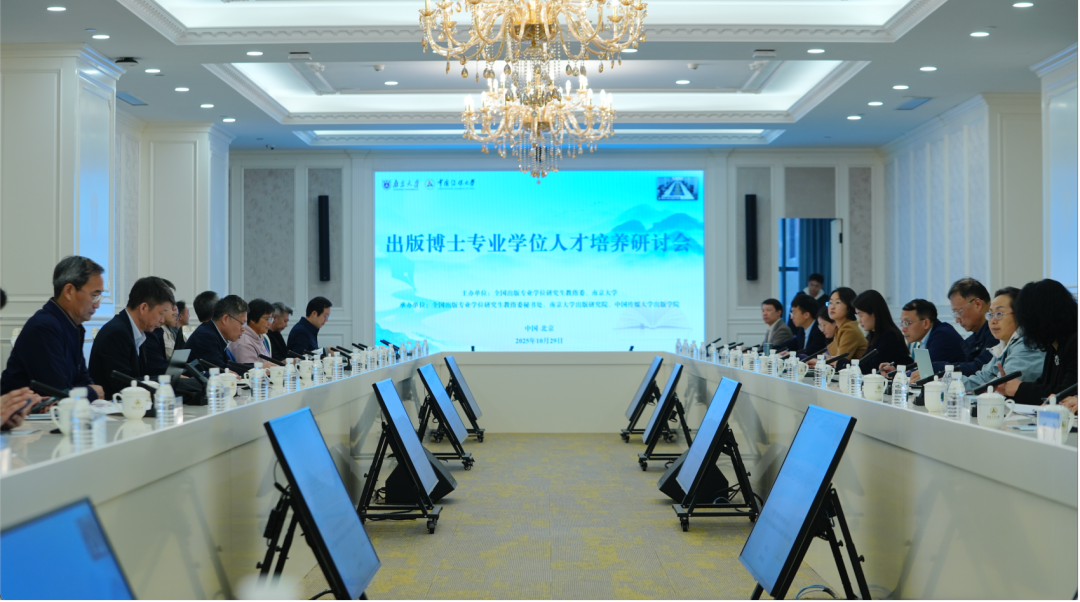 The scene of the seminar on the training of talents for the professional degree of the publishing doctoral degree
Relevant leaders of the Ministry of Education emphasized the important position of publishing in the national strategy and pointed out that the Ministry of Education attaches great importance to the training of publishing talents. For the training of publishing doctors: First, anchor "for whom to cultivate people", closely follow the major needs of national cultural prosperity, media integration, international communication capacity building, etc., deeply bind the training process with industry needs, and establish a normalized demand docking mechanism; second, focus on "what kind of people to cultivate", clarify the core competencies that publishing doctors must have, and build a high-level tutor team that is both proficient in academic research and familiar with industry practice; The third is to crack the "how to cultivate people", break down the barriers between universities and publishing units, promote in-depth cooperation between schools and communities, and build a two-wheel drive training system between academic and practical through dual tutor systems, joint research projects, and real practice scenarios. He particularly emphasized that the development of generative AI requires publishing doctors to upgrade from "physical scholars who compete with AI" to "strategists who control AI" and actively adapt to industry changes.
Duan Liping shared the training model of "medical and educational collaboration" for medical professional degrees. She introduced that the training of medical talents has built a three-stage system of "college education-post-graduation education-lifelong learning", and the clinical medicine master's degree has achieved "four certificates in one" (graduation certificate, degree certificate, licensed physician certificate, and resident standardized training certificate); The Peking University medical system ensures the quality of training through the "four examinations in one" (mid-term assessment of specialist training, the second stage assessment of standardized residency training, the clinical ability test of specialists, and the qualification examination of attending physicians) and the "trinity" (training and training coordination, assessment and personnel system coordination). She emphasized that the topics of medical doctoral studies are all derived from clinical practical problems, and practical results (such as case analysis reports and research reports) can be used as the basis for degree applications.
Sun Jieyuan focused on the training of education specialists and doctors, sharing from three aspects: training standards, processes and evaluations. He introduced that the education professional college takes political literacy, moral personality, knowledge and skills, and ability structure as the four major training standards, and implements the "4~7 year flexible learning system", which requires enough credits to strengthen practice through the "three Xi system" (internship, study, and internship); The curriculum adopts differentiated module design, and the curriculum is customized for educational leadership and management, curriculum and teaching. The evaluation system covers three types of evaluation: students (ideological and moral, course credits, practical inspections, etc.), tutors (scientific research projects, teaching evaluation, guidance level, etc.), and units (qualified evaluation, periodic evaluation). Sun Jieyuan mentioned in combination with the practical experience of Guangxi Normal University that the school has improved the quality of education and doctoral training by adding national conditions education, strengthening humanistic quality education, building a curriculum matrix, and promoting practice-driven.
In the exchange and discussion session, the heads of the publishing doctoral and master's degree authorization points across the country conducted a heated discussion on core issues such as curriculum system construction, practical teaching mode, tutor team building, and quality evaluation mechanism. They believe that the master's degree in publishing focuses on the cultivation of publishing practical ability, while the master's degree focuses more on the cultivation of systematic and compound ability. In terms of practical ability assessment, it is recommended to refer to the experience of connecting medical professional qualifications, promote the linkage between publishing and doctoral graduation and publishing qualification certificates, and strengthen the recognition of practical achievements through real publishing project signatures and fund project participation.
In terms of the construction of the mentor team, experts such as Wan Anlun, leader of the expert group of the National Publishing Discipline Co-construction Working Group and executive dean of the Institute of Digital Publishing of Beijing Normal University, believe that it is necessary to strictly select mentors with both academic skills and industry experience, encourage universities and publishing houses to build a dual mentor team, and suggest that the Ministry of Education coordinate relevant policies and absorb senior managers in the publishing industry to participate in the guidance. In addition, topics such as tuition fee setting, expansion of students in the west, construction of international practice bases, and integration of Marxist publishing concepts have also become hot topics of discussion, and some universities have shared special teaching attempts such as curriculum matrix construction and study of published classic works.
Finally, Zhang Zhiqiang emphasized that the training of publishing doctors needs to clarify three key propositions: first, distinguish between academic and professional, strengthen practical orientation, and focus on practical issues such as the construction of publishing professional teams and technological innovation; second, unify quality standards, regardless of the university level, it is necessary to take "innovative achievements" as the core requirement, avoid "water doctor", and ensure the gold content of the degree; The third is to create the characteristics of each school, rely on the university's own resources, and form differentiated training advantages. He emphasized that the training goal of publishing doctors is to cultivate leading talents in the publishing industry. Only by adhering to the deep integration of industry, education and research, strengthening the responsibility of mentors, and highlighting practical innovation can we cultivate outstanding talents with both academic and industry feelings, and provide solid support for the construction of a cultural power.
The convening of this seminar has built an exchange and cooperation platform for the national publishing doctoral training units, and the training units will combine the results of this meeting to further improve the training plan, continue to promote the improvement of the quality of publishing doctoral training, and send more high-level publishing talents with both ability and integrity to build a cultural power.