


Years of actual measurement revealed, aluminum foil inkjet printing, the key is two problems
In the traditional printing process, roll aluminum foil materials are often printed flexographically, and single sheets of aluminum foil paper are printed with offset printing. For example, in order to improve the vividness of colors and improve the adhesion between ink and aluminum foil materials, special inks with polyphthalamine or vinyl chloride acetate copolymer resin as the main components are commonly used in the industry.
With the increasing demand for personalized market and the rapid and changeable market environment, the proportion of printing orders for small batches and multiple varieties of aluminum foil materials continues to increase. Inkjet printing has become an important direction to adapt to this demand with its core advantages of small batches and personalization, but how to ensure high printing quality in aluminum foil material printing and empower enterprises has become an urgent problem to be solved by the industry.
The needs and pain points of inkjet printing in the application of aluminum foil materials
Aluminum foil is significantly different from traditional printing materials such as paper, PVC, PET, BOPP, etc., and usually faces the following two types of core problems in the inkjet printing process without special inks:
First, the tensile strength of aluminum foil is large, almost non-stretchable, and the tear strength is small and the surface is smooth.
Second, the surface energy of the aluminum foil material is low, resulting in poor adhesion after the ink layer on its surface is dry, and it is easy to cause ink loss.
Based on the above problems, the current industrial inkjet printing equipment on the market rarely tries aluminum foil printing. The author has been engaged in the research of digital inkjet printing solutions for many years, and now shares relevant practical experience with peers to provide reference for industry applications.
Aluminum foil inkjet printing pain point solution
01
Solve the problems of paper slippage, deflection and scratches on the nozzle
In view of the characteristics of smooth surface and low stretchability of aluminum foil, we need to set the tension appropriately large in production under the premise of not wrinkling or breaking, so as to avoid the material slipping on the guide roller and prevent the deflection phenomenon caused by unstable material transmission. At the same time, appropriately increasing the tension can also improve the problem of material warping to a certain extent and reduce the probability of the nozzle being scratched.
It should be noted that there is no unified standard reference for tension setting - there are differences in the servo drive system and tension optimization methods used by different equipment manufacturers, and it is recommended to increase the tension as much as possible in actual production under the premise of ensuring that the material does not slip.
02
Solve the problem of poor ink adhesion and ink loss
To solve the problem of ink adhesion, it is first necessary to clarify the core impact of surface tension: the surface tension of inkjet printing ink on the market is generally about 38dyn/cm, and only when the surface of the printing material can be greater than the surface tension of the ink can a good wetting effect be achieved to avoid ink loss. However, the surface tension of untreated aluminum foil is difficult to reach more than 38 dyn/cm; In addition, the surface of aluminum foil has no porosity, and ink cannot penetrate into its interior to form an "anchoring effect", even if the ink is transferred and dried, it is still prone to ink loss.
In response to this problem, we often use corona treatment or pre-coating processes to solve it, and the specific practice is as follows.
(1) Corona treatment process
The principle of corona treatment is to apply a high-frequency voltage between the insulating electrode and the grounded dielectric drum, breaking down and plasmizing the air between the two poles. When these plasma particles interact with the surface of aluminum foil, they can open the chemical bonds on the surface of the material, form free radicals, accelerate surface activation, and then improve the surface energy and surface wettability of the aluminum foil, and ultimately enhance the adhesion strength between the ink and the aluminum foil surface.
In actual production, a corona device can be installed on inkjet printing equipment to achieve online corona treatment, but the corona power needs to be determined by testing. Taking corona equipment with a power of 2kW as an example, the conventional test parameter is 30%~50% of the power proportion; If there is still ink accumulation and ink dropping in printing after using about 50% of the power for corona treatment, it means that the aluminum foil material can no longer improve the printing effect through corona treatment, and there is no need to continue to test other power ratios, and you can turn to the optimization of the pre-coating process.
After testing, it was found that corona treatment can significantly improve the surface energy of aluminum foil as a conductive material, but there is still room for optimization of the effect (the comparison effect is shown in Figure 1).
Figure 1 Comparison of corona effects
(2) Pre-coating process
After long-term system testing, the author found that the pre-coating process can significantly improve the ink adhesion effect, but it is necessary to focus on three core issues, namely, the selection of the number of anilox rollers (controlling the amount of pre-coating), the pre-coating method (online/offline), and the adaptability of the pre-coating solution to the ink, all of which need to be determined through actual test screening.
The selection of anilox rollers can refer to the following standards: anilox rollers with 600~1000 lines and ink load of about 3.95bcm³ commonly used for pre-coating conventional materials; For special materials such as aluminum foil, it is recommended to choose anilox rollers with about 800 lines after testing, and the coating thickness does not need to be too thick to meet the needs of ink adhesion.
The pre-coating method is divided into offline pre-coating and online pre-coating: offline pre-coating refers to pre-coating the aluminum foil on the flexo printing equipment first, and then the pre-coated aluminum foil is put on the machine for inkjet printing; Online pre-coating is equipped with a flexo printing unit on the inkjet printing machine, which realizes the online completion of pre-coating and inkjet printing, and has higher adjustment flexibility. The author also recommends using online pre-coating for aluminum foil inkjet printing.
The selection of pre-coating fluid needs to take into account two dimensions: first, the adaptability of the pre-coating solution and the aluminum foil material, according to the type of aluminum foil material, the adapted traditional flexo printing pre-coating solution can be selected; The second is the adaptability of the pre-coating solution and digital ink, which needs to be tested and verified on the basis of ensuring the adaptation of the pre-coating solution and aluminum foil, combined with the digital ink brand used.
The thickness of the pre-coating has a significant impact on the adhesion effect of ink, as shown in the left figure of Figure 2, the effect of the pre-coating is thick, and the ink still falls out during the scratching process. The picture on the right shows the effect when the pre-coating thickness is appropriate, even if there are obvious scratches, there is no ink loss.
...
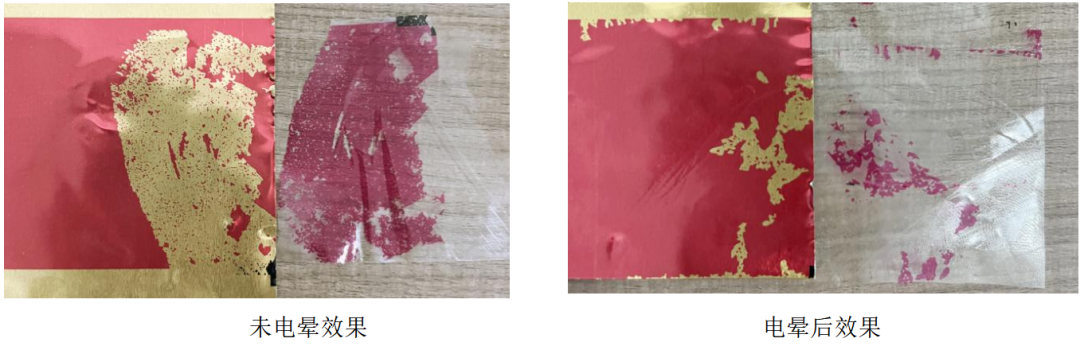 Figure 1 Comparison of corona effects
(2) Pre-coating process
After long-term system testing, the author found that the pre-coating process can significantly improve the ink adhesion effect, but it is necessary to focus on three core issues, namely, the selection of the number of anilox rollers (controlling the amount of pre-coating), the pre-coating method (online/offline), and the adaptability of the pre-coating solution to the ink, all of which need to be determined through actual test screening.
The selection of anilox rollers can refer to the following standards: anilox rollers with 600~1000 lines and ink load of about 3.95bcm³ commonly used for pre-coating conventional materials; For special materials such as aluminum foil, it is recommended to choose anilox rollers with about 800 lines after testing, and the coating thickness does not need to be too thick to meet the needs of ink adhesion.
The pre-coating method is divided into offline pre-coating and online pre-coating: offline pre-coating refers to pre-coating the aluminum foil on the flexo printing equipment first, and then the pre-coated aluminum foil is put on the machine for inkjet printing; Online pre-coating is equipped with a flexo printing unit on the inkjet printing machine, which realizes the online completion of pre-coating and inkjet printing, and has higher adjustment flexibility. The author also recommends using online pre-coating for aluminum foil inkjet printing.
The selection of pre-coating fluid needs to take into account two dimensions: first, the adaptability of the pre-coating solution and the aluminum foil material, according to the type of aluminum foil material, the adapted traditional flexo printing pre-coating solution can be selected; The second is the adaptability of the pre-coating solution and digital ink, which needs to be tested and verified on the basis of ensuring the adaptation of the pre-coating solution and aluminum foil, combined with the digital ink brand used.
The thickness of the pre-coating has a significant impact on the adhesion effect of ink, as shown in the left figure of Figure 2, the effect of the pre-coating is thick, and the ink still falls out during the scratching process. The picture on the right shows the effect when the pre-coating thickness is appropriate, even if there are obvious scratches, there is no ink loss.
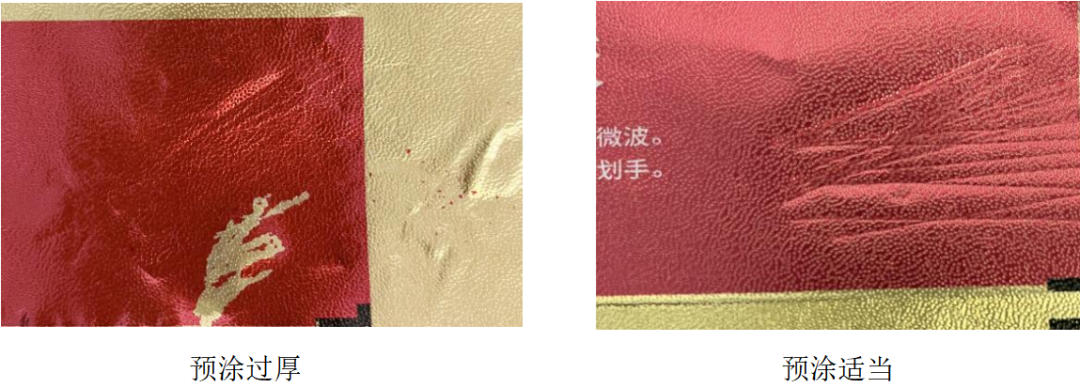
Fig.2 Effect of pre-coating thickness on ink adhesion
With its unique performance advantages, aluminum foil materials will be increasingly widely used in the field of printing and packaging. Small batches, personalization, and short delivery times have become the core demand trends in the upstream printing market, which requires practitioners in the field of digital printing to further optimize the printability of aluminum foil materials and improve related solutions. The author will continue to explore the aluminum foil inkjet printing process in depth, and will continue to exchange and share experience with peers to help the industry improve together.