


What is the phenomenon of isochromatic heteronuclear spectra?
Have you ever walked out of the house wearing two black socks, only to find at work that one of them is actually navy blue? How embarrassing, right? This is caused by metamerism.
Metamerism is the phenomenon where two colors appear to match under one lighting condition but do not match when the light changes.
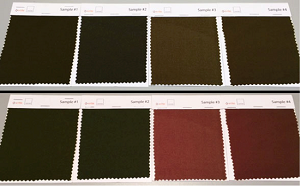
These colors appear consistent under certain lighting conditions but inconsistent under others.
The image above shows wool fabric samples dyed the same under a U30 fluorescent lamp (top) and an A incandescent lamp (bottom). Notice how the samples seem to change color? This is, of course, a situation manufacturers want to avoid.
Metamerism is quite common, especially in near-neutral colors, such as grays, whites, and similar dark shades. As colors become lighter or more saturated, the possible range for metameric matches decreases.
To manage metamerism in the color production process, it is first necessary to understand its causes.
The Science Behind Metamerism
This phenomenon occurs because the light source and the way objects reflect light influence our perception of color.
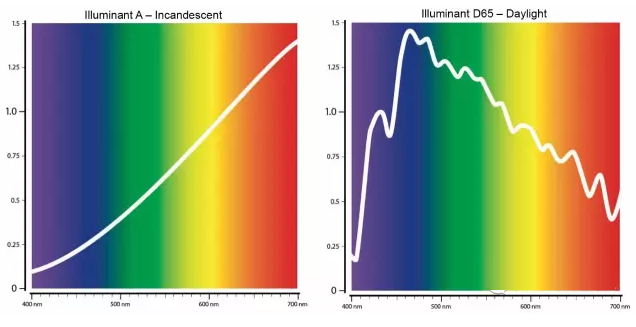
This is the reflection curve of incandescent and daylight. Note that incandescent light has a lot of energy in the red region, but not much in the blue region. Because of the increased energy in the red region, objects illuminated by incandescent light appear redder than under daylight, while daylight peaks in the blue region.
A spectrophotometer can be used to measure objects to see how much light is reflected at each point across the entire visible spectrum.
The resulting reflection data is the 'fingerprint' of the color, which can be used to create reflection curves. Metamerism occurs when colors appear the same under a specific lighting condition but actually have different 'fingerprints.'
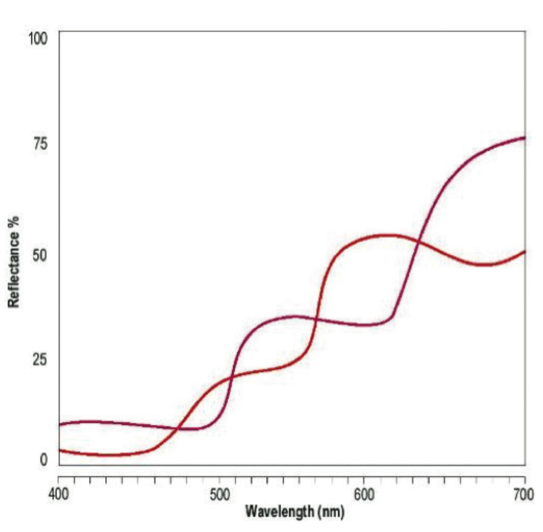
The above figure shows two red reflectance curves. Both curves strongly absorb blue, moderately absorb green, and reflect red quite strongly. Do you notice the twisting between the two curves? When there are at least three crossings between two physical samples, they are a metameric pair. If objects are a metameric pair, the metamerism phenomenon is obvious; moreover, even though they sometimes appear to be the same color, they will not match under all lighting conditions.
What causes metamerism?
Metamerism is common when products are assembled using different materials. Car manufacturers constantly battle this phenomenon. Even if the car body paint is made with pigments different from those used for bumpers and mirrors, and the dyes used for interior fabrics are completely different from the pigments used for plastic dashboards, the assembled car must match under nearly all types of lighting.
Fluorescent brighteners are also common triggers of metamerism in paper, fabrics, and liquids. In this process, a chemical is added to absorb ultraviolet energy below visible light and re-emit that energy at a longer wavelength, making the color appear whiter. OBAs can be difficult to manage and often lead to metameric pairs.
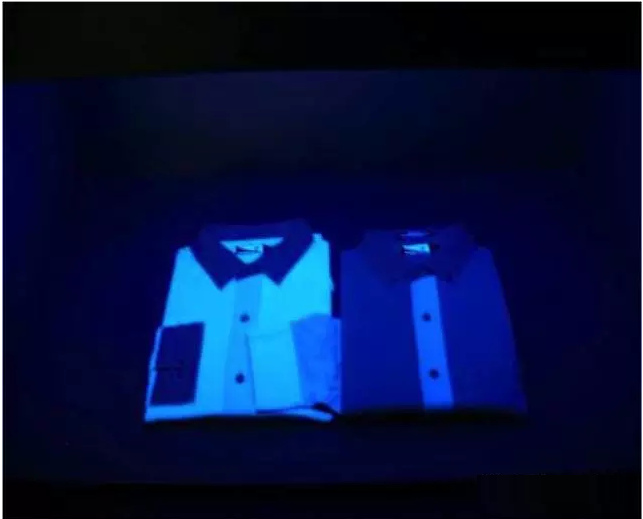
Although these shirts appear to match under sunlight, when you expose them to ultraviolet light, you can see that each shirt is actually metameric within the same color group.
When assembling parts from different suppliers, it is essential to closely monitor for metamerism, as differences in pigment formulas or dyeing processes can change the 'fingerprint.'
Some tips to avoid metamerism:
1. Use a multi-angle spectrophotometer
Spectrophotometers use three different geometries-0°/45°, integrating sphere, and multi-angle-to achieve the most accurate measurements. To evaluate metamerism on textured surfaces, you must choose the appropriate tool for this task.
The most common 0°/45° measurement involves light reflecting off the sample at a fixed angle. While this works for smooth or matte surfaces, it cannot capture and assess the details found on glossy and textured surfaces.
Integrating sphere instruments can measure light reflected from all angles, calculating color measurements that closely match what the human eye sees. They are commonly used to measure textured surfaces such as textiles, carpets, and plastics, as well as shiny or mirror-like surfaces, including metallic inks, foil printing, and other high-gloss surfaces.
Multi-angle devices allow observation of a sample's color as if it were moving back and forth, measuring it from various angles. Today's multi-angle instruments are used for pigments in special coatings and special effect colors with additives such as mica or pearlescent effects, for example, nail polish and automotive coatings.
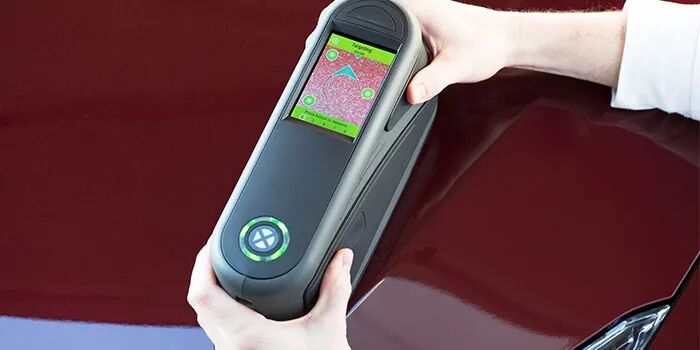
2,Visual evaluation under a lightbox
Proper evaluation can reveal how a product appears in every possible position under various types of lighting. It can simulate lighting colors that may represent its final environment. For example, carpet manufacturers can assess how their products look in a showroom as well as under daylight and home lighting. Using a lightbox, they can brush the pile in multiple directions to ensure the color is acceptable.
When the finished product consists of multiple materials, a lightbox can ensure that the harmony between components remains consistent under all lighting conditions.
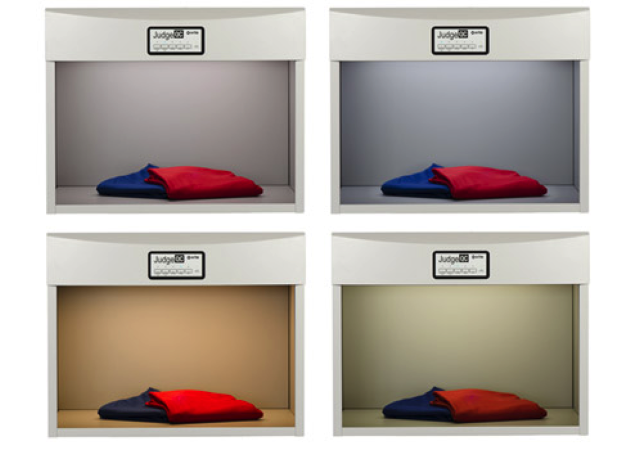
Please remember, it is not uncommon for two different people to see exactly the same two items and have disagreements about whether they match. We call this 'observer metamerism.' While color vision tests can help minimize this issue, our eyes are just human eyes. If you compare assessments at 10 a.m. and 6 p.m., you might not even trust your own judgment.