


The most comprehensive types of hot stamping processes and key processing points
Foil Stamping Process
Foil stamping should be called electrochemical foil stamping (Foil Stamping), and because gold and silver are most commonly used, it is colloquially referred to as gold stamping, foil stamping, or foil gold stamping.
Everyone has seen printed materials using the foil stamping process, such as book covers, real estate brochures, business cards, and packaging, all of which are very popular. However, if you haven't been to a printing factory, you might not be very familiar with the production process of foil stamping.
Today, Xiao Jiang specially found an animated image to help everyone better understand the principle and process of foil stamping.
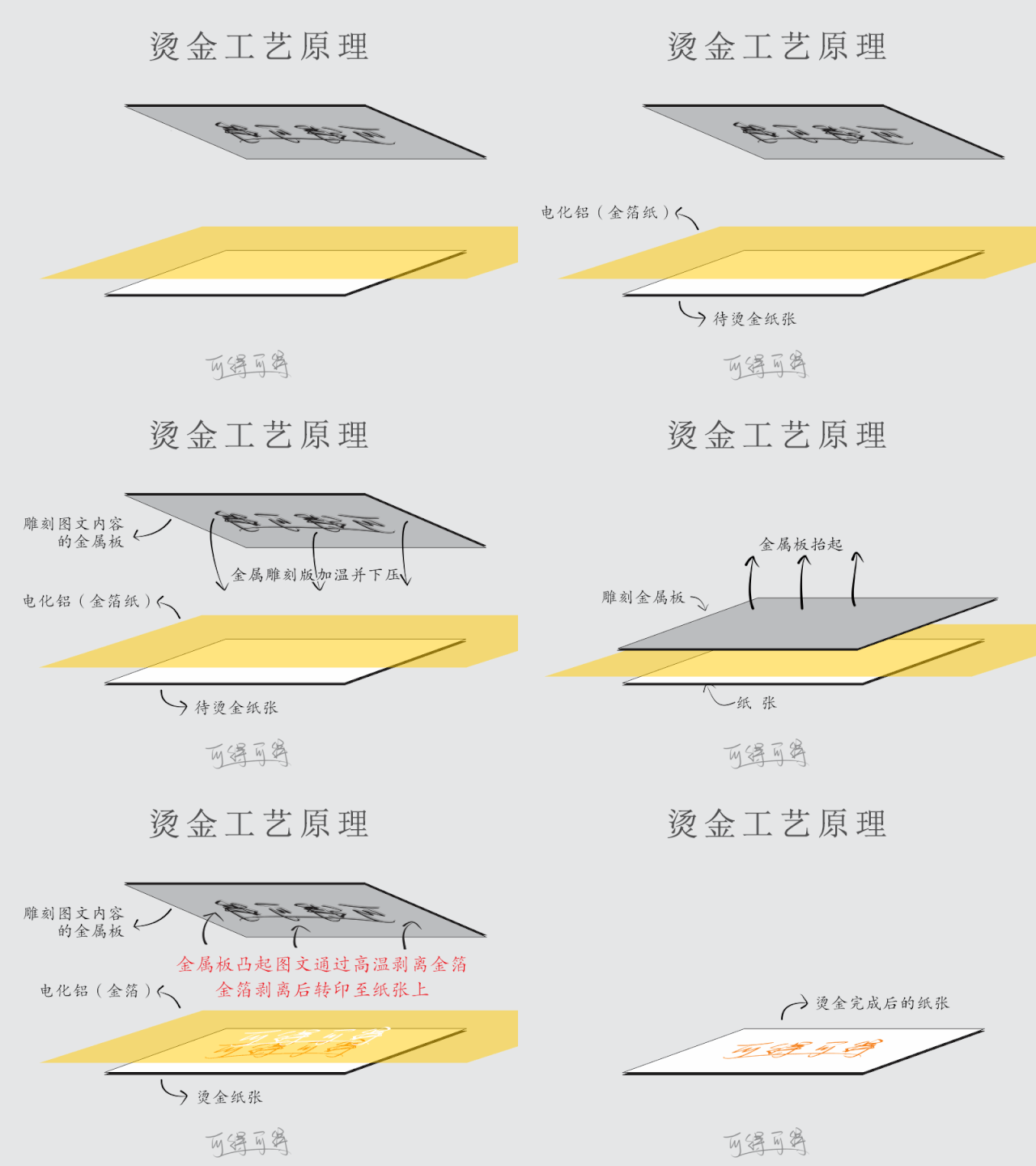
The hot stamping process is to use the principle of hot press transfer to transfer the aluminum layer in electrochemical aluminum to the surface of the substrate to form a special metal effect, which can be divided into cold hot stamping and hot stamping, of which hot stamping is divided into: ordinary flat hot stamping, three-dimensional hot stamping (commonly known as relief and convex hot stamping), holographic positioning hot stamping and other processes.
01
Plain flat hot stamping
1. The production process of printing plates (commonly known as "upper plates").
The quality of hot stamping plate production is an important factor affecting the quality of hot stamping. The production of ordinary flat hot stamping plates mainly adopts the photographic corrosion plate making process and the electronic engraving plate making process, the former has a simple production process and low cost, but the accuracy of the hot stamping plate is also relatively low, limited to hot stamping text, thick lines and patterns with low quality requirements; The hot stamping plate produced by the latter has high accuracy, can express the operation of the image level equipment richly and delicately, can reproduce fine lines and uneven thickness of pictures and texts well, the cost is relatively high, the scope of application is relatively wide, and it is suitable for cigarette packs, wine packs, medicine packs, cosmetics packaging, etc. that require high hot stamping effect.
2. Material selection of printing plates
The commonly used plates for ordinary flat hot stamping plates are copper plates or zinc plates. Copper plates have a delicate texture, smooth surface, good thermal conductivity, wear resistance and pressure resistance, and are not easy to deform, and are favored by most plate making factories. For the information of printed products manufacturers with small quantities and low quality requirements, the plate of the hot stamping plate can be zinc plate.
3. Material selection of the bottom plate (commonly known as the "lower version").
At present, most ordinary flat hot stamping plate manufacturers only make hot stamping plates, and due to the different hot stamping media, plate manufacturers can not provide suitable supporting plates, so most carton packaging companies are facing the problem of choosing what material to choose ordinary flat hot stamping plates. Comprehensive hot stamping media, print resistance, adaptability, easy operation and other factors are over-packaged. The following summary: For coated paper prints, ordinary flat hot stamping can use waste PS plates, steel scraping blades, and rough paper with a thickness of about 0.5mm as the base plate; for gold cardboard, silver cardboard, laser cardboard, and glass cardboard, 0.8~1.5mm thick insulation board and steel scraping blade can be used as the base plate; No matter what material the base plate is made of, it is indispensable to sandwich the pressure paper underneath.
4. Process requirements
✦ Electrified aluminum
Ordinary electrochemical aluminum is composed of 4~5 layers of different materials, including base film layer, peeling layer, coloring layer, aluminum plating layer, and adhesive layer. The hot stamping speed and quality are mainly affected by the peeling layer and the adhesive layer of the packaging decoration, if these two coatings are not sensitive enough to heat, the hot stamping speed will be reduced accordingly.
✦ Temperature, pressure, speed
These are the three major elements of the hot stamping process, and only by controlling the relationship between the three can we control the quality of hot stamping. The temperature of ordinary flat hot stamping is generally 70~110 °C, the temperature is too low, the adhesive layer and peeling layer of electrochemical aluminum can not be fully melted, and the electrochemical aluminum can not be completely transferred during hot stamping, resulting in hot stamping cannot be done; If the temperature is too high, the paper will be seriously deformed, which is prone to problems such as inaccurate overprinting, graphic pasting, handwriting blooming, and electrochemical aluminum discoloration. The hot stamping pressure should be adjusted to the appropriate according to the hot stamping medium and the bearing capacity of the upper and lower plates, and the hot stamping speed: manual hot stamping gold is generally controlled at 600~700 sheets/hour; The automatic hot stamping machine is generally controlled at 3500~5000 sheets/hour.
02
Three-dimensional perm
It can complete hot stamping and pressing at the same time, reducing the processing process and the amount of waste caused by inaccurate overprinting, improving production efficiency and product quality, and is mainly used in hot stamping of various high-end carton packaging such as cigarette packs, wine packs, medicine packs, and cosmetic packaging.

1. Definition (also known as concave and convex perm, three-dimensional perm, relief)
Three-dimensional hot stamping means that the pictures and texts processed by hot stamping have obvious height and three-dimensional layers, which stand out on the surface of the printed matter. Three-dimensional hot stamping technology is a compound technology that combines hot stamping technology and concave and convex technology, which can also be regarded as a combination of "hot stamping + concave and convex" combination, which is the use of corrosion or engraving technology to make the graphic text of hot stamping and concave and convex into a negative mold intaglio and male mold letterpress with upper and lower cooperation, so as to realize the process of hot stamping and stamping and convex technology completed at one time.
2. Principle
Three-dimensional hot stamping is the one-time completion of hot stamping and concave and convex printing: using hot stamping plates and bottom molds, under the action of certain pressure and temperature, the printed substrate is plastically deformed, and at the same time, the electrochemical aluminum foil is printed on the printed matter or other substrates where plastic deformation occurs, so as to carry out artistic processing on the surface of the printed material. The three-dimensional hot stamping plate of electric engraving has high accuracy and the hot stamping effect is very exquisite. Electro-engraving brass plate is widely used in post-press processing, through computer software control, the pre-scanned image is three-dimensional engraving, so the hot stamping plate made in this way can be three-dimensional hot stamping with the prefabricated letterpress. The key to this process is plate making, the graphic part of the hot stamping plate should be rounded lines, which is different from the right-angle lines of ordinary flat hot stamping plates, so the three-dimensional hot stamping plate needs to be processed twice after corrosion, and the technical difficulty is greater.
3. The production of concave and convex hot stamping plates (commonly known as "upper plates, yin plates").
The production principle of concave and convex hot stamping plates is more complex than that of ordinary flat hot stamping plates, and because it also achieves concave and convex effects, the concave and convex hot stamping plates have deep and shallow layers, and the relief depth of the graphics and texts is also deeper than that of ordinary flat hot stamping plates, and the accuracy is higher. At present, domestic plate making factories use computer-engraved brass plate making process typesetting, and the concave and convex hot stamping plates produced are rich and fine, with high print resistance.
4. The production of concave and convex hot stamping base plate (commonly known as "lower version, yang version").
The base plate used for concave and convex hot stamping must be the positive mold letterpress corresponding to the concave and convex hot stamping plate, and the base plate material usually selected by the plate making factory is glass fiber, which can be pre-made according to the model of the concave and convex hot stamping plate, and cooperate with the processed copper plate to make the positioning hole layout design, so as to facilitate replacement and positioning.
The bottom plate must correspond exactly to the concave and convex hot stamping plate, but in the process of concave and convex hot stamping, with the gradual increase of temperature, the concave and convex hot stamping plate will expand, while the temperature of the base plate remains unchanged, which will cause the concave and convex hot stamping plate to mismatch the base plate, resulting in the bottom mold being crushed or the hot stamping pattern is incomplete. Therefore, the expansion rate of the concave and convex hot stamping plate should be fully considered when making the base plate to ensure a more accurate base plate.
5. Process requirements for concave and convex hot stamping
✦ Electrified aluminum
Special electrochemical aluminum for concave and convex hot stamping should be selected, and ordinary electrochemical aluminum should not be used.
✦ Temperature, pressure, speed
Concave and convex hot stamping should be completed at one time to complete hot stamping and embossing publication, so the requirements for hot stamping temperature are very high, usually at 110~140 °C can be completed, but too high temperature will not only cause problems such as pasting plates and electrochemical aluminum discoloration, but also make the gravure hot stamping plate expand too much, and cannot accurately cooperate with the base plate, resulting in poor hot stamping. It can be said that the hot stamping temperature is the primary factor that determines the success or failure of concave and convex hot stamping.
03
Holographic positioning hot stamping
Holographic positioning hot stamping belongs to a special hot stamping process, which uses the anti-counterfeiting pattern on electrochemical aluminum, which can not only greatly improve the anti-counterfeiting performance of the product, but also improve the grade of the product, mainly used in various carton packaging that requires anti-counterfeiting functions.

1. Definitions
Hot stamping electrochemical aluminum is a holographic image, and the image needs to be accurately positioned on the printed product by the hot stamping process. There are two main types of holographic hot stamping: ordinary hot stamping and positioning hot stamping.
Holographic positioning ironing is the integration of laser holographic image anti-counterfeiting technology with good anti-counterfeiting effect and hot stamping decoration technology, so that the product can improve the decoration and increase the anti-counterfeiting performance at the same time. Laser holograms are made according to the principle of laser interference and using the method of spatial frequency coding. Due to the color spirit, obvious layers, vivid and realistic images, changeable optical transformation effects, and high information and technical content, laser holograms have been widely used at home and abroad. It is mainly used for anti-counterfeiting of various tickets, credit cards, passports, banknotes, trademarks, tobacco and alcohol packaging and important publications.
2. Principle
It is to heat and melt the hot melt adhesive layer and separation layer on the holographic hot stamping material through the heated hot stamping die head on the hot stamping equipment, and under a certain pressure, the holographic grating stripes of the information layer of the hot stamping material are separated from the PET substrate, so that the aluminum foil information layer and the hot stamping surface are bonded, integrated, and perfectly combined.
3. Production of holographic positioning hot stamping plate
The production process of holographic positioning hot stamping plate is basically the same as that of ordinary flat hot stamping plate and concave and convex hot stamping plate.
4. Process requirements for hot stamping
Holographic positioning hot stamping must use special laser electrochemical aluminum and advanced registration detection system, which determines that the requirements for the performance of hot stamping materials and hot stamping machines are stricter and higher than other hot stamping methods.
✦ Registration detection of the adjustment of the electric eye
In holographic positioning hot stamping, the adjustment of the detection electric eye (sensor) is the most important step. The more common adjustment method is: in the clear state, the indicator light is on when the cursor is encountered, and the indicator light is off when there is no cursor. However, in actual production, when using the above adjustment method, it is often encountered that the detection eye does not find the cursor and constantly alarms, resulting in downtime and a lot of waste. The correct adjustment method is to first observe the reaction state of the detection electric eye when the machine is running, and then make corresponding adjustments, so as to ensure that the response of the detection electric eye is sensitive and accurate, and the reaction state of the detection electric eye cannot be referred to the clearing state.
✦ Treatment of laser electroized aluminum plate seams
In the holographic positioning hot stamping scanning, because most of the holographic anti-counterfeiting patterns on the electrochemical aluminum are arranged independently and intermittently, a seam (plate seam) will appear every once in a while in operation. Therefore, controlling the seam jump program of holographic positioning hot stamping electrochemical aluminum is also an important factor in the success of holographic positioning hot stamping.
5. Other precautions
(1) During the hot stamping process, sometimes there is a phenomenon that the printed matter cannot be stamped due to UV varnishing, which is caused by the incompatibility of electrochemical aluminum and UV varnish. At this time, it is necessary to take the method of hot stamping and then UV varnishing.
(2) If the printed matter to be ironed still needs to be processed by laser imprinting, the method of first hot stamping and then laser imprinting transfer cannot be adopted, and the laser imprint transfer must be done first and then hot stamped.
There are two main reasons: first, the surface of the printed matter after hot stamping is often uneven, and the paper is deformed, which will seriously affect the effect of laser embossing transfer; Second, the scattered electrochemical aluminum chips, paper scraps, dust, and oil stains on the machine in the previous process not only affect the laser imprint transfer effect, but also may damage the varnishing plate used for laser imprint transfer.
04
Cold hot stamping
The electrochemical aluminum foil, working principle and process flow of cold hot stamping are different from traditional hot stamping, the back of the electrochemical aluminum foil used in the traditional hot stamping process is pre-coated with adhesive, and the pressure of the hot drum is used to melt the adhesive during hot stamping, so as to realize the transfer of aluminum foil. Cold hot stamping uses special electrochemical aluminum, which is not glued on the back, and the adhesive is directly applied to the position that needs to be decorated during printing. New technology of cold pressing is used to transfer electrified aluminum foil.

1. Principle
When printing on electrochemically coated aluminum, the aluminum comes into contact with the adhesive, and under the action of the adhesive, the aluminum foil attaches to the surface of the printed material. The process flow is:
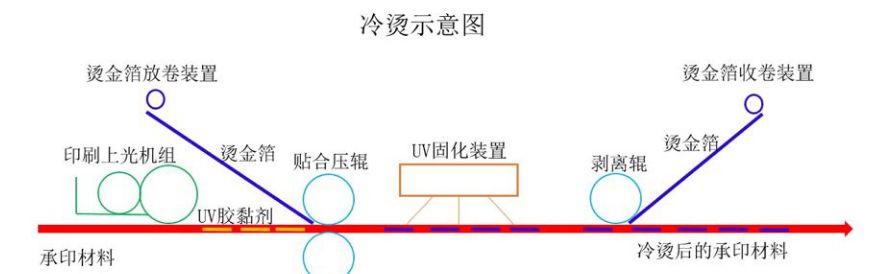
First of all, the UV ink is printed, and after drying, a special adhesive is printed on the surface of the ink that needs to be hot stamped - UV curing adhesive, and the printed adhesive is dried in the attached UV device, and the moisture in the adhesive is removed to a certain extent through the UV drying device, forming a very thin layer of high-viscosity pressure-sensitive adhesive layer, so that the surface of the printed material that needs to be hot stamped forms a high-viscosity area.
Then, start cold stamping, under the action of a pair of metal rollers, the electrochemical aluminum foil is in contact with the adhesive, and the electrochemical aluminum foil is firmly bonded to the surface of the printing pattern by applying pressure, and then the electrochemical aluminum foil is peeled off, so the part that needs to be transferred on the electrochemical aluminum foil is transferred to the surface of the printed matter to achieve cold hot stamping. Due to the large adhesion between the adhesive and the aluminum foil, the part where the electrochemical aluminum foil and the adhesive are disposed of remains on the surface of the printed matter and becomes one with the printed material, while the other parts of the electrochemical aluminum foil are disposed of like traditional hot stamping, so as to complete the front part of the hot stamping technology.
Since the electrochemical aluminum foil pattern transferred to the printed material floats on the surface of the printed material, the firmness is very poor, so it must be protected. Varnishing or laminating the surface of the printed material can protect the electrochemical aluminum foil pattern. Finally, other processes of post-press processing, such as die-cutting, waste discharge, slicing or rewinding, etc., complete the entire printing process.
2. Precautions
The cold stamping process is limited by adhesives, electrochemical aluminum foils and other conditions, and there are still some shortcomings, so attention should be paid to when applying cold stamping printing.
(1) Because the electrochemical aluminum foil pattern of cold stamping is embossed on the surface of the printed matter, its firmness is very poor, and it must be protected by the outer cover. Therefore, after cold hot stamping of the printed matter, the surface of the printed material must be glazed or wax to protect the pattern of the electrochemical aluminum foil, which increases the cost of cold stamping and the complexity of the process.
(2) Due to the poor leveling of the UV adhesive used in cold hot stamping, some of the surface after drying is not absolutely flat, resulting in poor brightness on the surface of the electroized aluminum foil transferred to it, and even diffuse reflection phenomenon will occur. In addition, cold stamping is not suitable for film materials with shrinkage characteristics (such as PVC, PE, etc.). In these two points, the effect of cold hot stamping is not as good as that of traditional hot stamping.
(3) Since the quality of cold stamping depends on the quality of the adhesive being printed, it is necessary to pay attention to the quality and printing suitability of the adhesive, and pay special attention to observing and summarizing the printing experience for better operation in the future.
(4) The requirements of cold stamping for the substrate can only be printed on the substrate with a smooth surface, and the adhesive will be absorbed on the rough substrate, resulting in not enough adhesive on the surface of the substrate for cold stamping. Therefore, cold stamping technology needs to be improved for printing on substrates with rough surfaces (such as leather, etc.), so pay attention to the smoothness of its surface when selecting the substrate.
(5) Cold hot stamping technology is currently mainly used in the printing of roll substrates.