


Is your inkjet printing unbalanced and causing a spike in defective products? The problem actually lies here!
When our company used the Heidelberg CD102 printing machine for four-color printing, it was found that 50% and 75% of the magenta dots in the text area had significant abnormalities (Fig. 1), which were mainly manifested in the uneven distribution of dots, blurred graphics, obvious color changes during printing, and significant increase in equipment water consumption. These problems lead to obvious color fading, saturation loss, loss of midtonal levels, and a significant increase in scrap rate.
Causes of failure
The staff first checked the imprint teeth and paper transfer teeth to confirm that the lubrication was normal and the tooth pads were clean and free of impurities, but when checking the pressure of the ink roller, it was found that the pressure was unstable. After systematic investigation, it was finally confirmed that the root cause of the fault was: the bearing with a diameter of 80mm on the operating side was locked due to the lack of lubricating oil, and the bearing jacket rotated synchronously with the ink roller during the operation of the machine, causing serious wear on the bearing bowl (Fig. 2). The amount of wear is significantly outside the standard range, resulting in deep wear on the housing mating surface.
When the equipment is idling, the 80mm diameter ink roller can maintain a relatively stable movement state in the shaft bowl; However, during combined production, the ink roller first contacts the ink roller in one direction, and after pressing, it is in contact with the ink roller and printing plate at the same time. Every time the machine rotates, the moment the ink roller contacts the printing plate, it will produce irregular shaking in the worn shaft bowl, which will first destroy the printing dots and form the problem of blurred deformation of the dots in Figure 1. In addition, the shaking of the ink roller when it comes into contact with the printing plate also leads to irregular changes in the pressure between it and the ink roller and the pressure between the printing plate, which is easy to cause ink bars when printing flat screens, causing ink imbalance.

Figure 1 Problematic stamp (left) and adjusted stamp (right)
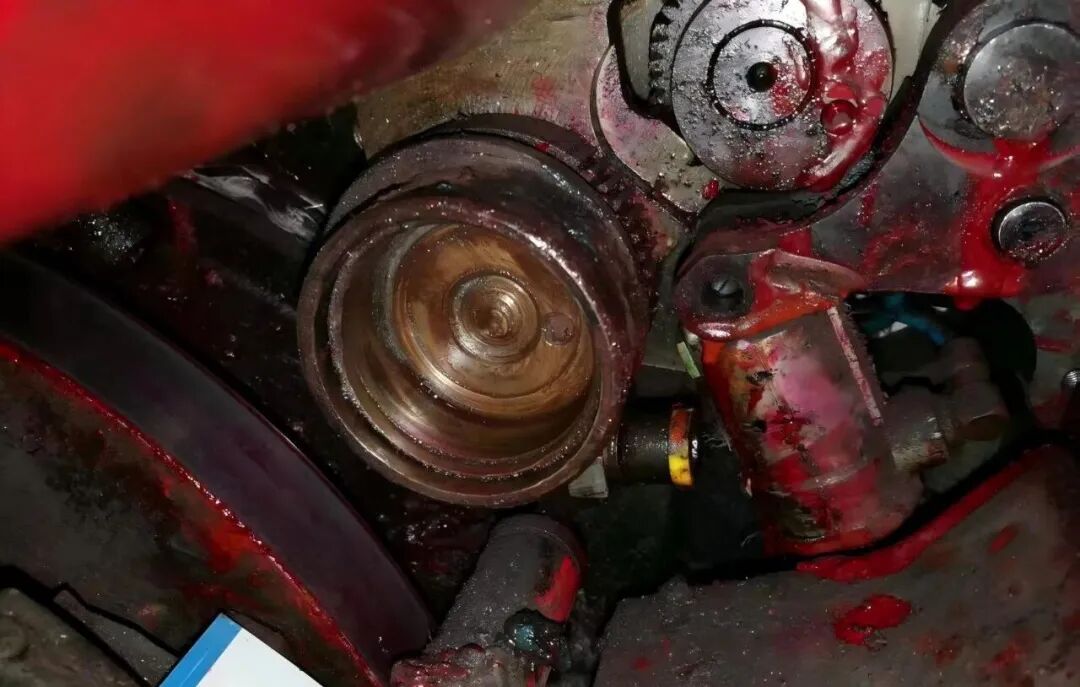 Figure 2 Wear Condition of the Anilox Roller Bowl
Standardized Maintenance Process
Since the form roller mainly relies on the movement of the ink distributor roller and only makes a regular slight deceleration when in contact with the plate, it is important to strictly follow the standard shown in Figure 3 when adjusting the printing pressure. The pressure ratio between the form roller and the ink distributor roller should be 1mm higher than the pressure on the plate. If the pressure between the form roller and the plate exceeds that between the form roller and the distributor roller, the form roller will decelerate irregularly, causing uneven ink transfer, resulting in areas of too much or too little ink and ultimately leading to color instability.
In actual production, when staff perform routine checks on the form roller pressure, they usually only pay attention to the pressure between the form roller and the plate, neglecting the pressure between the form roller and the distributor roller. The following is the standardized maintenance process:
(1) Shutdown and Cleaning: Disconnect power and post a lockout tag, then thoroughly remove the ink film on the roller surface and any metal debris inside the bearing housing using a dedicated cleaning agent.
(2) Component Replacement: Replace the original manufacturer's bearing assembly (including bearing bowl, balls, and cage). Before installation, perform ultrasonic cleaning and nitrogen blowing to ensure a contamination-free assembly.
(3) Pressure Calibration: Use Heidelberg pressure test film for calibration (as shown in Figure 3).
(4) Define Pressure Standards: The ink mark width between the form roller and the distributor roller should be 4 ± 1mm; the contact width with the plate should be set to 4–1mm.
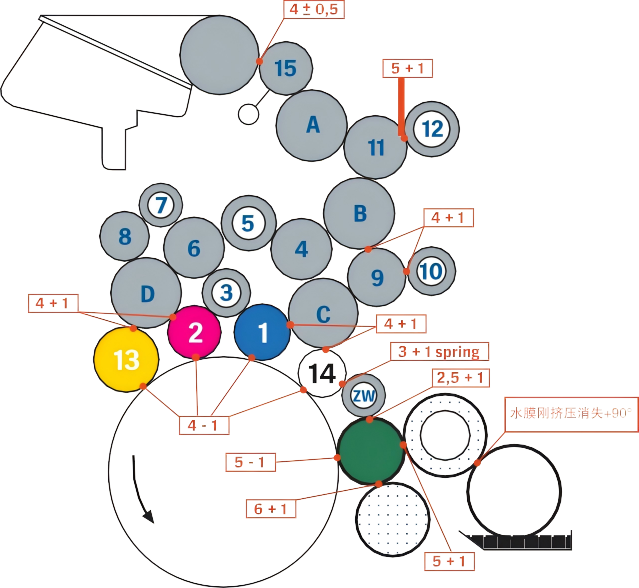
Figure 3 Printing Pressure Adjustment Standard
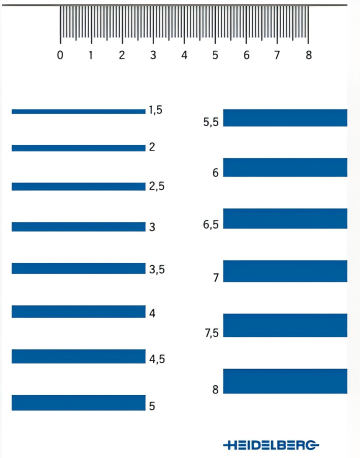
Figure 4 Heidelberg stress test film
Maintenance effect
After standardized maintenance, the quality of equipment and printed products has been significantly improved, and all indicators have returned to the normal range:
(1) The 50% outlet increase value of the magenta version fluctuates back and forth from 22%~45% before maintenance to about 18% (in line with the requirements of 17±3% outlet increase).
(2) The gradient smoothness of the gradient level of 75% dot density is increased by 40%, and there is no obvious discoloration during the printing process.
(3) The data monitoring of continuous production for 8 hours shows that the printing water consumption (after the repair of the faulty unit) is reduced by 20%, and the scrap rate is reduced from 22% to 0.2%.
(4) The equipment stability monitoring found that during 72 hours of continuous operation, the infrared thermal imager showed that the temperature of the plate roller bearing was stable in the normal range of 40±2°C, and there was no abnormal peak in the vibration spectrum analysis.
Problem analysis
01/ Defects in maintenance mechanisms
One of the core causes of this failure is that there are obvious defects in the equipment maintenance mechanism, and the relevant operations violate the requirements of the equipment maintenance manual, which stipulates that the ink roller needs to be disassembled every month, the bearing condition should be checked, lubricating oil added and the ink roller pressure should be adjusted in a standardized manner. In addition, during the previous maintenance, ordinary feeler gauges were mistakenly used instead of Heidelberg's special ink trace width detection film, resulting in a gap setting deviation of 2.2mm, and the pressure of the ink roller was mistakenly set to 6.2mm (55% exceeding the standard value), resulting in bearing overload.
When the normal indentation of the rubber roller is 4mm, the pressure is 18N; When the indentation reaches 6mm, the pressure increases to 63.5N, and when the indentation reaches 8mm, the pressure is as high as 149N. The larger the indentation, the faster the wear of the equipment, the higher the consumption of ink and dampening fluid, and the corresponding increase in electricity consumption. At the same time, excessive pressure will lead to obvious heat accumulation of the rubber roller, higher temperature and wide indentation, which will increase the actual pressure in the printing process nonlinearly, accelerating the hardening of the rubber roller. Although the hardness of the rubber roller can enhance the corrosion resistance to a certain extent, it will significantly reduce the water and ink transfer capacity, increase the ink loss of the printing equipment and the wear of the printing plate graphics. Therefore, without affecting the printing quality, the pressure of the rubber roller should be reduced as much as possible, and the minimum value specified by the manufacturer should be kept as optimal.
02/ Do a good job of rubber roller maintenance
The daily maintenance of rubber rollers needs to form a standardized process, and the pressure of the plate needs to be checked during the daily handover; During weekly maintenance, it is necessary to focus on checking the pressure of the plate roller and the ink roller, and do a good job in the maintenance of the plate ink roller to ensure that it is always maintained in a relatively stable state during production.
The surface of the new rubber roller should be uneven, and it feels a little astringent to the touch (Figure 5), so as to ensure the uniform transfer of water film and ink. In the process of long-term use, due to the constant contact with ink, dampening fluid and various solvents every day, coupled with the influence of the external environment, the hardness of the new rubber roller will usually increase after a period of use, which is a normal state. If the shrinkage and hardening of the rubber roller are light, the ink transfer characteristics can be maintained by adjusting the pressure appropriately.
The increase of the hardness of the rubber roller also means that the paper wool paper powder and the oxidized substances in the dampening solution have been deposited on the surface of the roller, forming a hardened film. This hardened film must be removed periodically (Figure 5) to prevent it from continuing to harden and glaze, which can cause instability in ink transfer and water transfer. When the surface hardens, the dirty glazing substance should be removed with calcium removal paste during maintenance.
The choice of cleaning agent is the most critical factor in determining the life of the rubber roller. Although highly volatile detergents are easy to remove hardened sediments on the surface, they will also cause the shrinkage of the rubber rollers. Improper use of cleaning agents will also lead to the expansion, contraction and deformation of the rubber rollers, affect the stability of the pressure between the rubber rollers, and even corrode the pipelines, sealing rings, machine paint and even rubber blankets. Therefore, semi-water-based, low-VOCs car wash water should be chosen. After maintenance, the rubber roller needs to be restored to the feel of the new rubber roller to be considered in place. There are no shortcuts to maintenance, and it must be persistent.
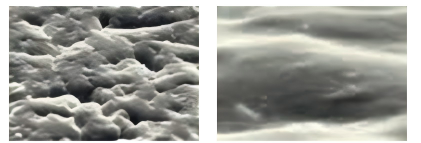
Figure 5 Surface of a new rubber roller (left) and surface of the rubber roller after glazing (right)
The key to print quality lies in ink-water balance, and the fountain roller and ink roller play a crucial role in maintaining this balance. In daily production, various quality issues caused by improper roller adjustment or roller wear are common. Therefore, it is essential to regularly inspect and check the rollers during work, and to maintain and adjust the roller surface, diameter, and pressure periodically to ensure that each roller is in proper condition. Equipment adjustment should be data-driven and standardized, contributing to the high-quality development of the industry.