


How to deal with dirty printing plates
Ink-water balance is both the foundation and the difficulty of offset printing. According to my understanding, the key to ink-water balance is the control of water. On one hand, it involves the proportion, temperature, and circulation cleaning of water; on the other hand, it requires the correct adjustment of the water system. Generally, the former is almost static and does not vary much, while the latter is dynamic, with many variables, making it difficult to master, which often results in dirty printing.
What exactly causes dirty prints?
Based on practical experience, I have made a simple analysis, roughly divided into: greasy dirty prints, dirty prints due to insufficient water, dirty prints caused by light water roller pressure, dirty prints due to water roller bouncing, and dirty prints caused by poor water distribution of the water roller. It can be said that most of these are caused by improper water roller adjustment. Therefore, I will share some of my insights in combination with two typical cases I encountered recently.
Dirty prints caused by poor water distribution of the water roller
01 Malfunction phenomena and solutions
When we were printing the cover of the "Morality and Law" textbook, we found a faint, cloth-like linear dirt pattern on the magenta plate, which was relatively evenly distributed; the entire pattern was almost consistent from start to finish.
Intentionally increasing the water slightly improved the dirt pattern, but it could not be completely eliminated. Obviously, the root cause was not related to the water amount. Since the cover design features a light blue color, with blue and magenta going full-page, printing was quite challenging. After preliminary adjustment of the ink-water rollers by the press operator, the dirt issue showed no improvement. Therefore, we began to suspect other causes:
Is the alcohol-free dampening solution unstable in quality?
Does the ink roller have pitting?
Is the ink roller calcified?
A series of question marks left us at a loss, and some colleagues grew impatient, thinking the product quality was acceptable and didn't need to be scrutinized.
As is well known, to improve operational skills, one must learn to continuously analyze and solve problems in daily work, especially difficult problems, and must never give up lightly.
Based on this belief, we re-inspected the ink rollers one by one, carefully adjusted the plate-contact roller, intermediary roller, and plate cylinder, but found no obvious abnormalities.
Later, we shifted our focus to the water system. We dismantled the metering roller and used the "ink stripe" method, discovering that the pressure from the plate water roller to the intermediary water roller was less than a 2mm ink stripe, which was clearly insufficient. We added some pressure at both ends, allowing the ink stripe to reach 7mm.
After running the press again, the malfunction disappeared. The printed magenta screen was very clean and smooth, and the ink color remained basically stable.
02 Fault analysis
From the ink path: The repeated movement and leveling of the ink via the intermediary roller cannot produce any silk-like or thread-like dirt marks.
From the water path: During printing, if insufficient water causes dirt, the manifestation is usually localized, starting from the feed area, with the trailing part almost never dirty. At this point, simply increasing the water appropriately would solve the problem.
Clearly, this malfunction was not simply due to insufficient water, but had more complex causes. To clarify, it is necessary to carefully analyze the water system transmission (as shown below).
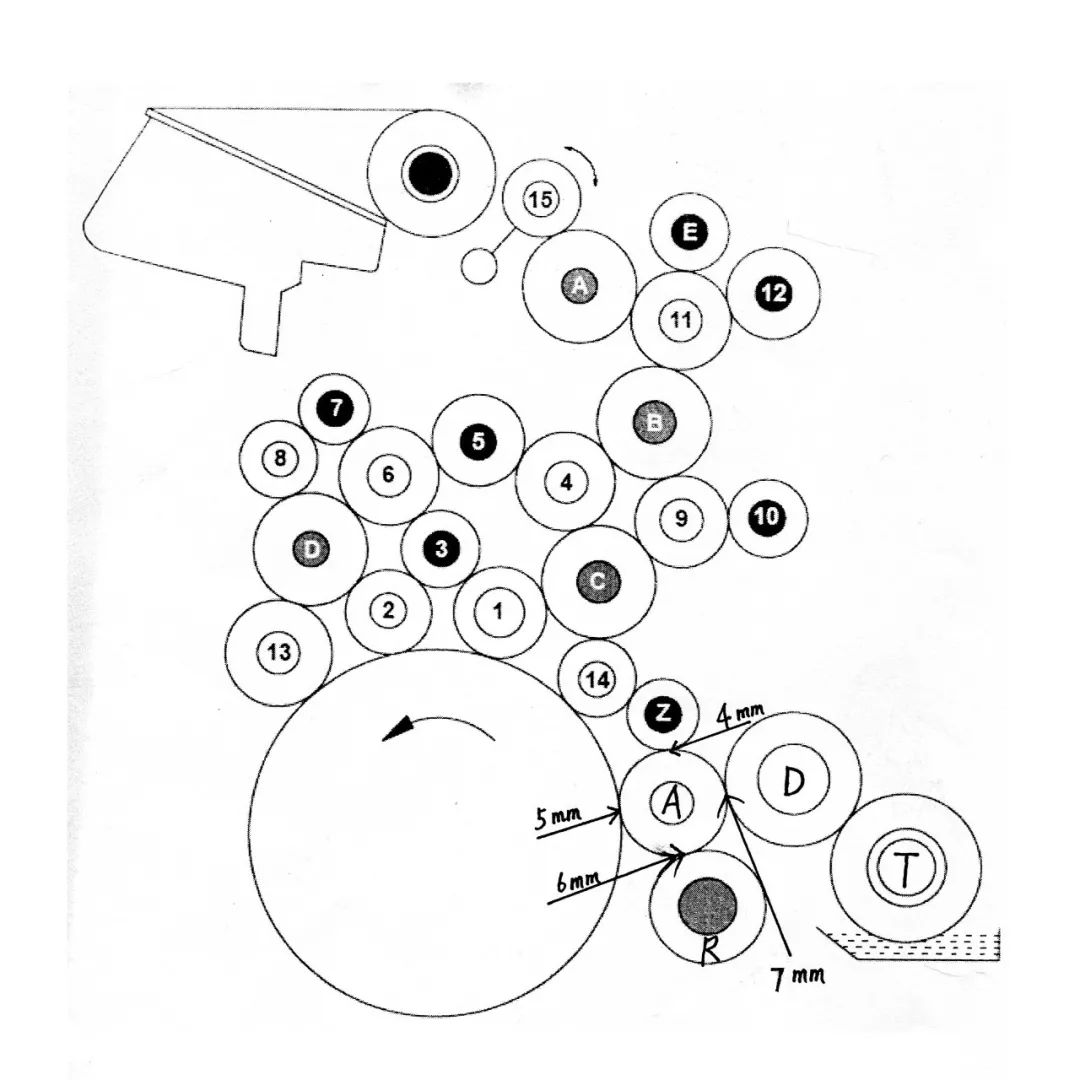
The fountain roller (T), metering roller (D), and plate-facing fountain roller (A) all supply water to the printing plate in a straight line at a uniform speed, while only the oscillating roller (R) moves back and forth in small amplitudes.
The key to the above fault is that when the pressure between the plate-facing fountain roller and the oscillating roller is significantly low, the operation of the plate-facing fountain roller almost relies on the rotation of the plate cylinder to drive it, resulting in the water film received by the plate surface not being evenly spread by the oscillating roller. Therefore, the printed dots appear very regular, showing a shallow, textured streak that is dirty from start to finish.
Dirty plate caused by roller vibration
01 Fault phenomena and solutions
During a certain printing process, it was found that the magenta group often inexplicably had dirt marks about 10 centimeters from the gripper edge, as shown in the figure below.
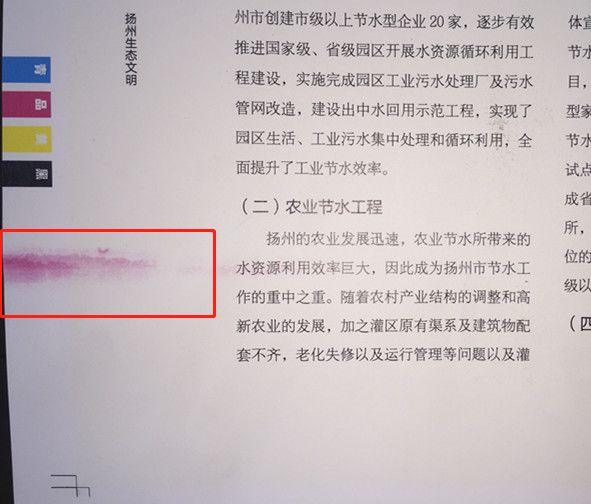
After investigation, it was understood that this situation had been occurring for several days. We deliberately slowed down the machine and increased the water flow, which made the effect barely acceptable. However, running the machine in such a precarious state is not a long-term solution, and it is necessary to find the cause as soon as possible.
Upon careful observation, we found that the roller shaft bearing of this color group's dampening roller had obvious vibration, and we initially suspected that the roller might be applying excessive pressure to the plate. We then stopped the machine for inspection, which showed everything was normal.
Could a fastening screw have come loose somewhere?
After checking, everything was normal.
Could the hydraulic cylinder prop rod have loosened?
By manually pushing the cylinder prop rod, we found the rod was loose. Because when the cylinder is in normal working condition, it is impossible to easily move the rod back and forth by hand. From this, we concluded that the cylinder seal was leaking air, preventing the dampening roller shaft bearing from working stably. Therefore, we immediately replaced the cylinder, and the problem was solved.
02 Fault Analysis
In the above fault, the dirty plate position was at the top of the gripper edge. When the machine speed was slowed, the vibration of the roller gradually decreased, and the dirty plate phenomenon improved. This is entirely different from the dirty plates we often encounter caused by insufficient water.
The causes of roller vibration, besides cylinder air leakage, include many factors:
(1) Excessive pressure of the roller on the plate;
(2) Roller bearing wear, causing wobble;
(3) Poor fit between the roller shaft end and the bearing seat, causing wobble;
(4) Loose or fallen fastening screws;
(5) Poor machining accuracy of the roller, causing out-of-roundness.
In actual production, there are many other reasons for dirty plates, and it is not necessarily caused by insufficient water. If the operator incorrectly increases the water supply, it will inevitably cause an imbalance between ink and water, leading to a series of problems. Therefore, only by truly mastering the correct adjustment and use of the offset press water system can one truly control the key to ink-water balance and achieve better printed products.