


How important is it to check the appearance quality of adhesive materials before printing and to store them properly? Find out in this article!
As is well known, adhesive labels are used in a wide range of industries, and they are also one of the most convenient functional labeling packaging materials. In order to minimize faults during the printing process, it is very necessary to carefully inspect the appearance quality of adhesive materials and properly store them before printing. In this article, the author, based on work experience, shares a few views for the readers.
Appearance Inspection
01
Check for frayed edges
Currently, the adhesive materials commonly used by label printing companies are mostly roll adhesive materials. Smooth, undamaged edges are the foundation for ensuring printing quality. Therefore, before printing, it is necessary to carefully check whether the edges of the roll adhesive materials are frayed or damaged due to improper storage and transportation.
02
Check for cracks
When cutting adhesive materials, if the cutting tool is not properly adjusted or the blade is not sharp enough, cracks can appear on the face paper or backing paper of the adhesive material, and the fibers pulled out at the crack will stick to the adhesive.
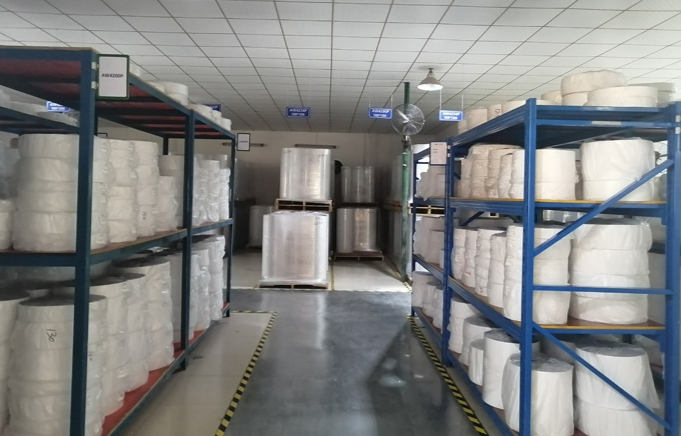
The occurrence of cracks may be continuous or random, and they may appear on one side of the roll of self-adhesive material, or on both sides. Therefore, before printing, it is essential to carefully check the backing paper and the face paper for small cracks. A piece of sample paper that has undergone the above inspection can be taken, the backing paper peeled off, and the face paper and backing paper checked again for cracks, because some cracks are very small and can only be detected after separating the backing and face paper.
It is worth noting that ink and adhesive will gradually accumulate on the guide rollers of the printing machine during the printing process, which can also cause edge cracking of self-adhesive materials. Therefore, even after printing has begun, the above issues should not be ignored.
03
Check whether the edges are sticking together and whether the backing paper is oozing silicone oil
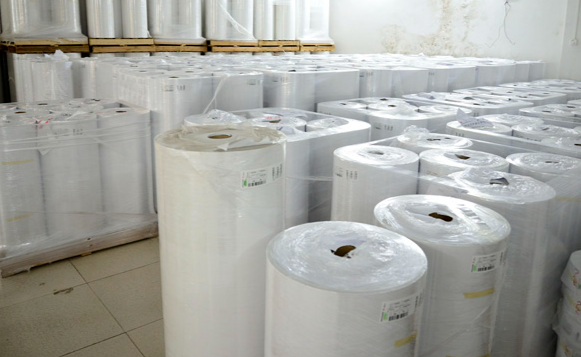
If the edges of the self-adhesive material stick together or if certain areas leak silicone oil onto the backing paper, it can cause waste paper to break during die-cutting, affecting normal production. Generally speaking, edge adhesion between the face paper and backing paper usually occurs on slit rolls coated with self-adhesive material, typically only occurring in the outer 7–10 meters. Therefore, if the edges of the self-adhesive material on the slit roll are sticking together, it does not immediately indicate that the entire roll has a problem.
It should be noted that peeling lightweight face paper requires more force than peeling heavier face paper. The lighter the face paper, the tighter it feels when peeling. Therefore, when die-cutting self-adhesive materials chosen by the customer according to their required shape, it is sometimes necessary not to proceed at the conventional printing speed.
04
Check whether the cut end face is flat and whether the rewinding elasticity is consistent
If the cut end face of the roll of self-adhesive material is uneven, it will not only affect printing accuracy but also make it difficult to eliminate waste due to changes in the die cutting position. In addition, inconsistent elasticity during rewinding can lead to changes in paper tension during printing, and uneven tension can also cause printing quality issues.
Storage Environment
01
Temperature and Humidity Control
The temperature of the warehouse storing self-adhesive materials should preferably not exceed 25°C, with around 21°C being optimal. Special attention should be paid to keeping the humidity in the warehouse not too high, ideally below 60%. If conditions do not allow, a dehumidifier can be temporarily placed in the warehouse to lower humidity. Of course, having a thermostatic and humidity-controlled system is an effective long-term measure.
02
Inventory Time Control
The storage time for self-adhesive materials should be kept as short as possible. Follow the principle of first in, first out; last in, last out. Special attention should be paid to avoid seasonal misuse: materials intended for summer should be used up in summer, and winter materials should be used up in winter.
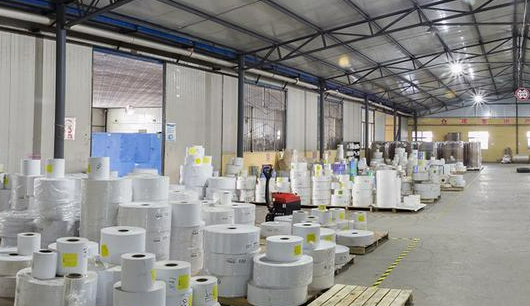
Do not open the outer sealed packaging of materials that are not yet processed on the machine; open it only when it is time to use them on the machine. Materials that have not been used up and materials that require further processing after printing should be promptly repackaged and sealed for storage.
03
Safety Control
Many adhesive materials and adhesives for self-adhesive products are flammable. In the warehouse, materials should not be piled up too densely, and safety aisles should be kept clear. Generally, in warehouses storing self-adhesive materials, one set of fire extinguishers should be placed for every 10 square meters to address fire risks.