


Paper easily curls when glued over a large area? The solution is here!
For some highly absorbent paper substrates, large-scale gluing can cause the paper to curl and deform, seriously affecting subsequent lamination operations. In this paper, the author designs a dot matrix pattern and produces it as a screen printing screen for adhesive coating. It performs well in water-based adhesive screen printing and effectively solves the problem of paper curling and deformation caused by large-area screen printing with water-based adhesives.
There are issues with large-scale adhesive application on the paper
For large-area full-sheet glue application of paper, printing and packaging factories generally use roller laminating machines, which can control the thickness of the glue by adjusting the adhesive amount on the coating roller. This method is convenient, simple, and widely applied. For large-area localized glue application, especially when bonding with specific pattern positions, local screen printing is generally used, adjusting the amount of glue applied by changing the mesh count. For paper substrates with strong water absorption, such as double-coated paper and uncoated white cards, especially those with a dosage below 220g/m², large-area gluing methods can easily cause paper curling and deformation, seriously affecting the subsequent gluing process.
To mitigate this phenomenon, the current solution is as follows: on the equipment, add a negative pressure suction device to the substrate; In terms of materials, consider using high-solidity adhesives with low moisture content or hot-melt adhesives, or reduce the amount of adhesive applied to lessen the impact of moisture on paper deformation. But the downside of these actions is obvious:
(1) Higher requirements are placed on the performance of materials and adhesives;
(2) Reducing the adhesive thickness can lower the moisture content per unit area in the coating area, but excessive reduction causes the coating layer to dry quickly, increasing the risk of false adhesive peeling and making precise control difficult during the manufacturing process. Even combining the above two methods still makes it difficult to effectively solve the problem in some cases.
Apply dot matrix screen printing screens
Recently, I encountered a non-coated white card product with a base material of 165g/m². This product uses a large-area gluing process. Since the bonding position is localized with a specific pattern, it uses full-plate screen printing and glue coating. In sample testing, whether using 100-mesh, 150-mesh, or 180-mesh screens, the paper after printing adhesive exhibits varying degrees of deformation and curling, resulting in low efficiency in the subsequent lamination process and a high defect rate.
Based on the quality requirements of this product and the characteristics of the screen printing and gluing process, combined with actual effect testing, a dot-matrix pattern screen printing screen was finally designed for adhesive screen printing, effectively solving the problem of paper curling and deformation caused by large-area adhesive screen printing, and successfully introduced in mass production.
Principle of dot matrix design
As is well known, paper is a porous heterogeneous material. Its main components, cellulose and hemicellulose, contain a large amount of hydrophilic groups (OH), and there are countless capillary pores about 20~50μm in diameter between the fibers. When exposed to water, these pores form capillary phenomena. Therefore, whether coated or uncoated paper, it has certain water absorption properties.
For example, after full-plate screen printing with water-based adhesive on paper, the paper is coated with a single-sided adhesive. The fibers on the glued side and the water molecules in the adhesive combine to quickly swell, increasing in volume, whereas the reverse side does not experience this swelling. Inconsistent shrinkage rates between the front and back fibers cause inconsistent internal stress in the paper. When this stress exceeds the structural rigidity of the paper itself, its equilibrium is disrupted, resulting in bending deformation.
Under stable environmental conditions, paper is a material with a certain strength and relative stability. In areas where the paper has not experienced swelling, or when the swelling deformation stress is less than its internal stress, the paper will appear in a state of "no deformation" or "slight deformation." Based on this phenomenon, this "deformation" and "no deformation" can alternate. As long as the two reach a state of mutual checks and balances, the paper can be kept in a stable overall state. Following this idea, we designed a dot matrix pattern to replace the full-screen mesh. Leave a certain spacing between dots, set as μ, and set the dot diameter as Ф.
By printing the adhesive in a dot-like matrix on the paper substrate, this intermittent design can effectively disperse stress from local deformation of the paper, and the amount of glue can be controlled by changing the number of mesh sizes and dot size distribution in the design. Compared with previous full-print screen printing designs, the specific differences are shown in Figures 1 and 2.
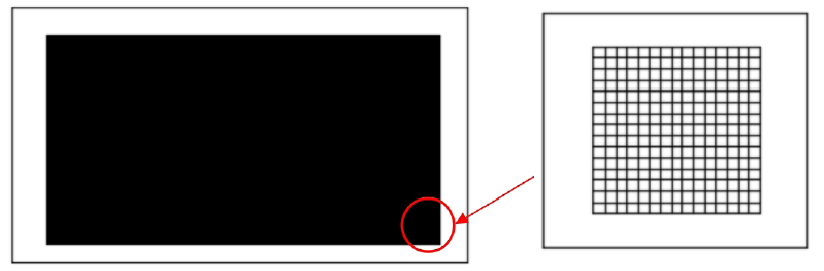
Figure 1 Design of a standard full-page layout and a partial enlarged view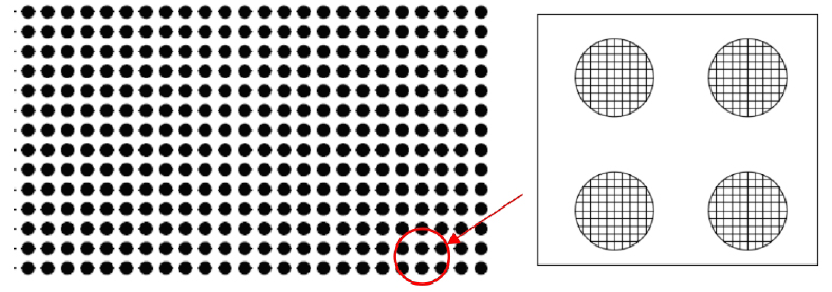
Figure 2 Dot Matrix Design and Local Magnified View
According to Figure 2, after adhesive printing, the adhesive appears alternately on the paper substrate. Within a certain period, the blank areas do not swell due to moisture and remain relatively stable, allowing the deformation stress caused by swelling in the adhesive-covered regions to be dispersed and counteracted. Deformation in the adhesive-covered area only occurs in very small local spots. As the open time of the coating process increases, 20% to 30% of the moisture in the adhesive area will evaporate into the air, while a small portion will diffuse into the blank areas. In this way, the alternating presence of adhesive and non-adhesive areas is equivalent to alternating 'stable zones' and 'deformation zones.' Once the internal stress equilibrium point is found, the overall curling deformation of the paper can be significantly alleviated.
Therefore, to address the large-area adhesive application process issue on our company's 165 g/m² uncoated special white card, considering four variables-adhesive type (solid content), dot diameter Ф, dot spacing µ, and mesh count x-a full-factorial experiment was designed as shown in Table 1.
Table 1 Full-Factorial Experiment Parameters and Test Results
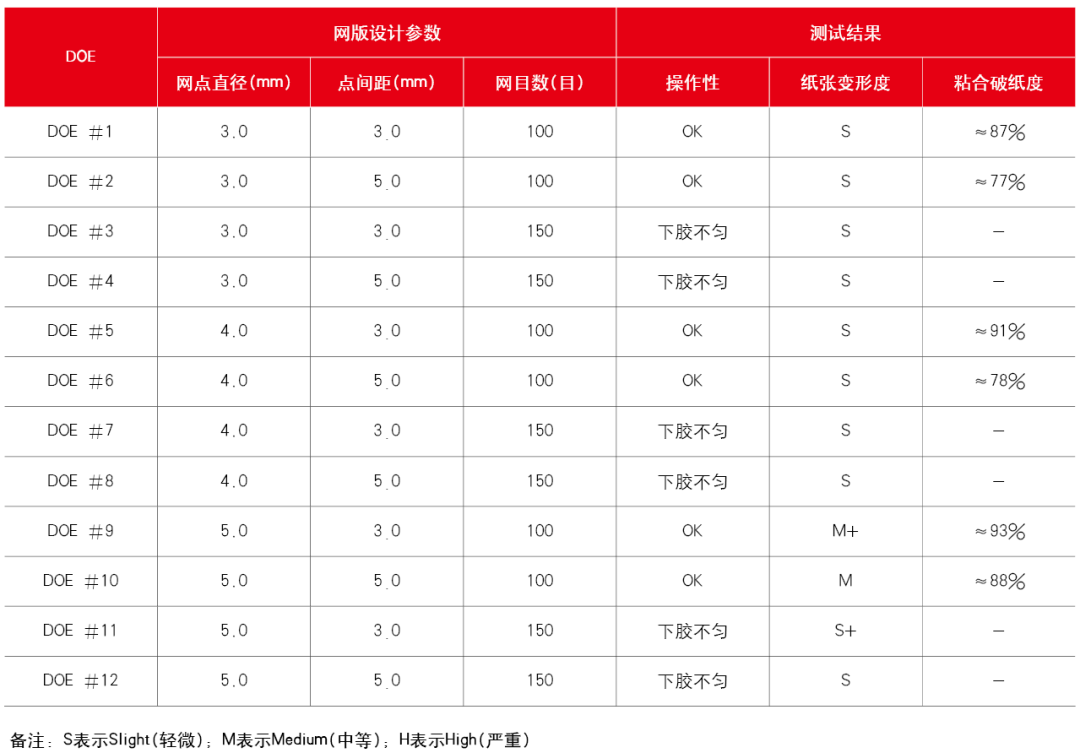
According to the results shown in Table 1, DOE #5 used Henkel's B-type glue, matched with the following screen printing parameters: dot diameter 4.0 mm, dot spacing 3.0 mm, and mesh count 100. For the company's 165 g/m² uncoated white cardboard, this provides the best gluing and printing effect. As shown in Figure 3, a screen was made based on these parameters and tested in actual production. After applying the glue, the paper remained generally flat with almost no curling or deformation, allowing subsequent processes to carry out lamination smoothly. The finished product exhibited good adhesion, with an average adhesive tear strength greater than 80%, while also reducing the glue usage by approximately 30%.
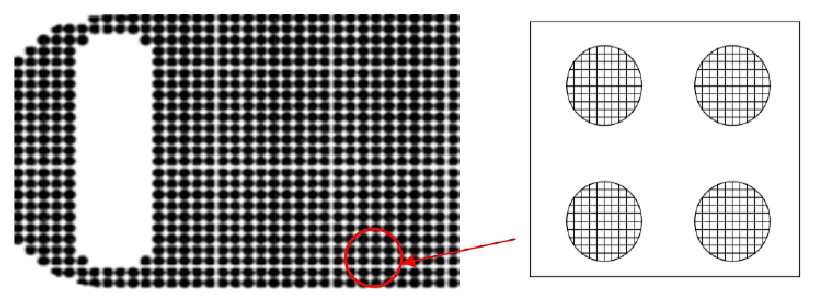
Figure 3 Case Pattern Design and Enlarged Detail View
The above approach provides a practical method to address the problem of deformation occurring after large-area gluing of low-grammage gift box surface paper. Different types of paper materials have varying characteristics and absorbency. When designing screen printing patterns, it is necessary to comprehensively consider the paper's absorbency, the mesh count of the screen printing stencil, the size and spacing of the dots, as well as the adhesive suitable for the material. This is especially important for automated folding and gluing lines, which feature high speed and precision, making screen printing application of glue widely used. Applying this method not only partially resolves the issue of surface paper curling and deformation but also facilitates subsequent die-cutting and forming processes, while also offering considerable savings in adhesives and other materials.