


Yield rate over 99.5%, a quick guide to solving digital efficiency UV varnish brushing issues
With the digital transformation and upgrading of the packaging and printing industry, digital efficiency-enhancing processes are widely used in the production of high-end FMCG products like alcoholic beverages and pharmaceuticals due to their advantages such as no plate-making, quick response, adaptability to small batches of multiple categories, and high fidelity in image and text reproduction. UV inkjet varnishing, as a key post-printing finishing process for labels, can effectively enhance surface gloss, scratch and wear resistance, and three-dimensional texture, making it a core technique for increasing the added value of label products.
In actual mass production, the stringing issue in digital UV varnish is a common and recurring defect, often occurring in large solid coating areas, gradient transition zones, and along the edges of fine lines or small text. The problem mainly appears as stringy trailing, fine horizontal streaks, frayed edges, or intermittent dragging. In mild cases, it affects the consistency of the product batch appearance; in severe cases, it can directly cause batch rejection, resulting in material waste and production delays.
Currently, domestic printing industry research mainly focuses on analyzing UV varnishing issues in screen printing and offset printing, with relatively little systematic study on the stringing mechanism, causal coupling, and standardized correction processes for dedicated digital efficiency-enhancing varnishes. Workshop production largely depends on the operator's experience for adjustments, lacking theoretical support and standardized procedures, leading to high recurrence rates and poor process stability.
Therefore, this article, based on digital efficiency-enhancing technology and UV curing principles, combined with extensive on-site experimental data, systematically analyzes the formation mechanism of stringing problems and the patterns caused by multiple factors, building a full-chain solution from emergency handling, process optimization, equipment adjustment to source prevention, providing technical support for quality improvement, cost reduction, and standardized production of digital efficiency-enhancing processes.
UV Varnish Stringing Problems
Typical Forms and Causes
01
Typical Forms
Through long-term on-site tracking and statistics, there are three typical forms of digital UV varnish stringing issues, each corresponding to different causes.
(1) Edge Stringing Type: Concentrated at the edges of graphic contours and the ends of gradients, appearing as fine intermittent stringy trails, mainly caused by incomplete varnish flow interruption and lag in leveling.
(2) Full-Page Fine Line Type: Irregular fine stripes distributed across the entire page with uneven gloss, mostly caused by mismatches between varnish viscosity, curing parameters, and substrate speed, as shown in Figure 1.
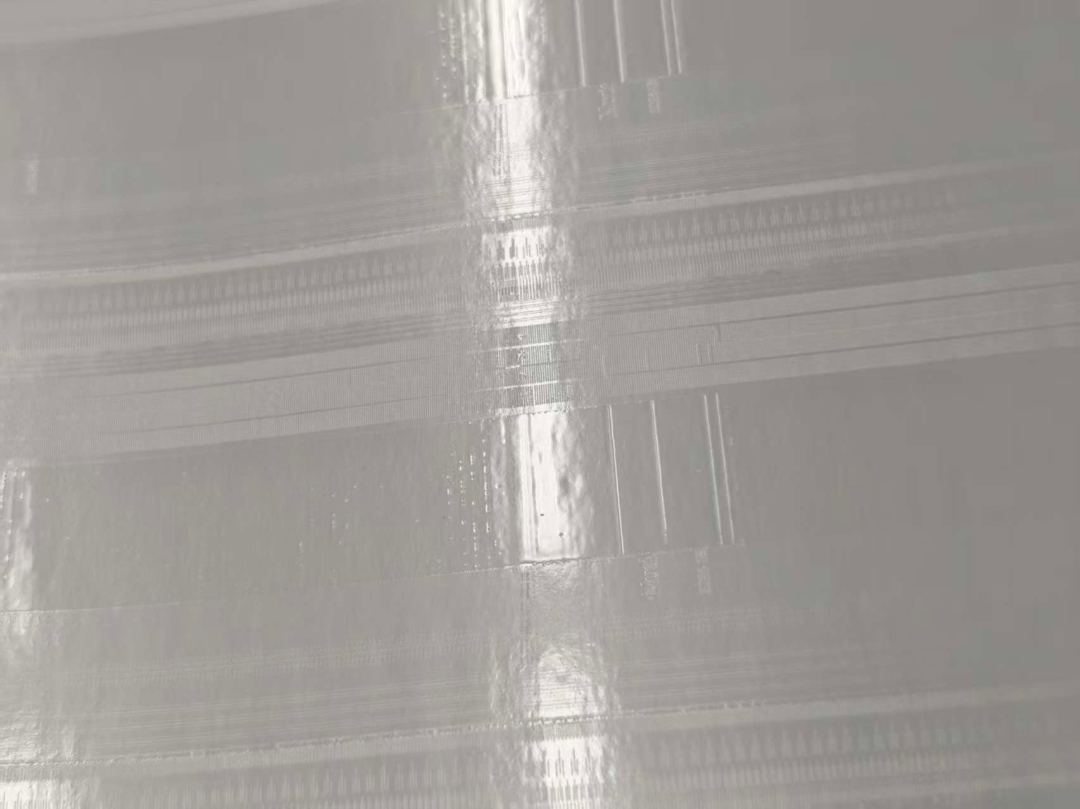
Figure 1 Full-page fine texture type
(3) Regular coarse brushing type: Thick brushing and local oil accumulation appear at fixed intervals, which is a structural issue caused by equipment precision or oil supply system abnormalities, as shown in Figure 2.
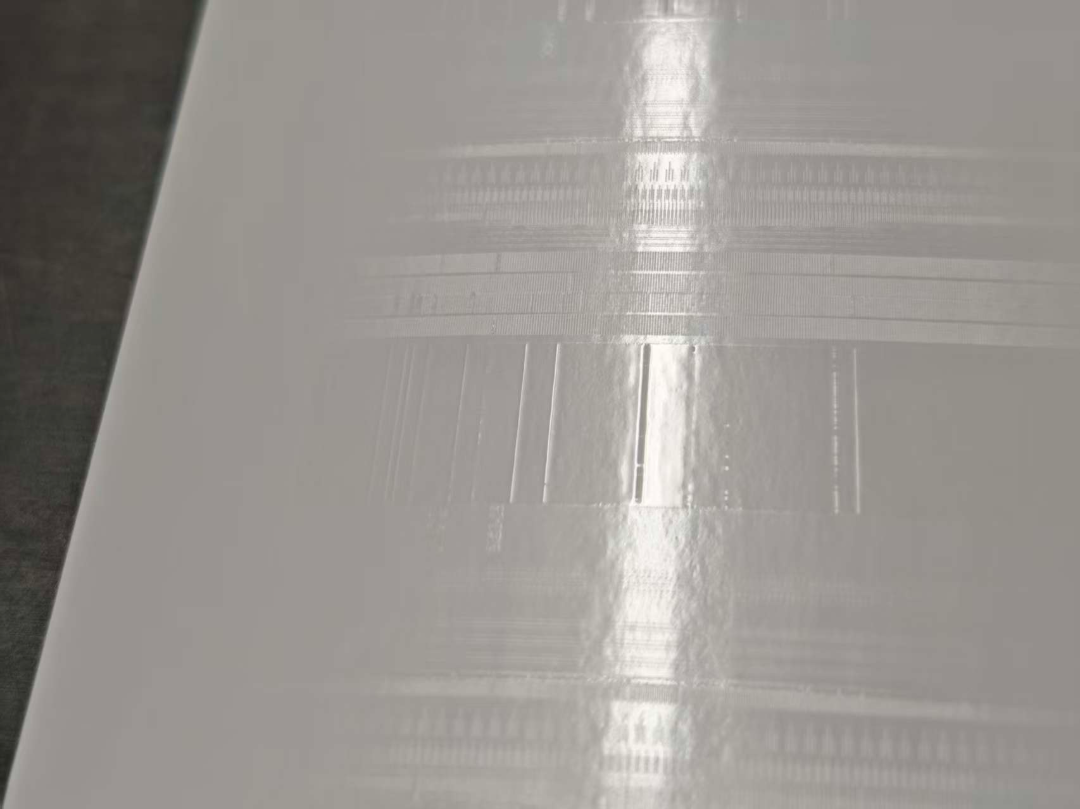 Figure 2 Regular Stringing Type
02
Causes of Formation
The forming process of UV inkjet coating involves three continuous stages: 'inkjet dispensing – substrate wetting and leveling – UV curing and fixing'. The essential reason for stringing issues can be summarized as: before the coating fully wets and levels and the interfacial tension is balanced, external disturbances such as mechanical pulling, too fast curing, or unstable material properties cause the liquid coating to undergo uneven plastic deformation, which is then instantly solidified by UV light, ultimately forming irreversible string-like defects.
In an ideal forming state, the coating spreads quickly on the substrate surface, with balanced tension and smooth leveling, and then undergoes moderate UV crosslinking to form a dense and uniform coating layer. If any material, equipment, process, or environmental parameter is out of balance, it will disrupt the 'inkjet-leveling-curing' equilibrium, triggering problems like stringing.
Multidimensional Cause Analysis
01
Material Factors
The rheological properties and purity of digital UV coatings are the fundamental conditions that determine coating quality.
(1) Excessive viscosity, poor leveling: digital UV coatings are highly sensitive to environmental temperature. Low-temperature conditions, leaving the container open for too long causing solvent evaporation, or a batch with high solid content, all increase fluid viscosity and surface tension, slowing spread rate and extending leveling time. Under high-speed processing, this easily results in pulling and stringing.
(2) Mismatched material selection: using screen printing varnish or regular coating instead of digital-special UV coatings can cause uneven dispensing, poor flow continuity, and severe stringing, which is incompatible with piezoelectric inkjet logic.
(3) Insufficient purity and stability: coating sedimentation, skin formation, impurity contamination, foaming during stirring, or inadequate filtration can cause intermittent inkjet, uneven dispensing, localized pooling, or lack of coating, forming string-like textures.
02
Equipment Factors
The stability of the supply, jetting, transport, and curing systems directly determines spraying quality.
(1) Abnormal nozzle conditions: slight blockages, dried residual coating, or nozzle wear and deformation cause skewed spraying, intermittent spraying, or uneven dispensing, leading to local pooling and stringing.
(2) Supply system pressure fluctuations: unstable negative or air pressure in secondary cartridges, blocked pipelines, or clogged/aged filters cause pulsating supply with inconsistent dispense amounts, forming regular streaky stringing.
(3) Unstable substrate transport: uneven roller pressure, tension fluctuations, or paper shaking cause uncured soft coating to be mechanically stretched, resulting in rough edges and stringing.
(4) Abnormal UV curing parameters: curing power too high or curing too fast will fix the coating before it has properly leveled; aging lamps or insufficient energy will leave surface layers uncured, causing secondary stringing from friction during winding.
03
Process Parameter Factors
Mismatched process parameters are the main cause of sudden stringing during mass production.
(1) Printing speed too fast: if the feed rate exceeds the coating leveling response window, there's insufficient leveling time, and the coating moves with the substrate before it's smooth, forming stringing.
(2) Improper ink output and overprinting: excessive single-channel output or multi-layer stacking can make the coating too thick, with edge tension imbalances, forming string-like patterns during natural leveling.
(3) Misalignment in bidirectional printing: overlapping incorrectly during forward and return passes can create regular transverse stringing stripes, commonly seen within the same batch.
04
Environmental Factors
Workshop temperature, humidity, and cleanliness significantly affect coating rheology and forming effects. Workshop constant temperature and humidity are shown in Figure 3.
(1) When the ambient temperature is below 18°C, coating viscosity increases significantly.
(2) When humidity is too low (relative humidity <40%), the coating surface forms a skin quickly, inconsistent with the underlying layer, producing fine dry lines.
(3) Dust in the air sticking to uncured coating can destroy surface smoothness, leading to minor stringing defects.
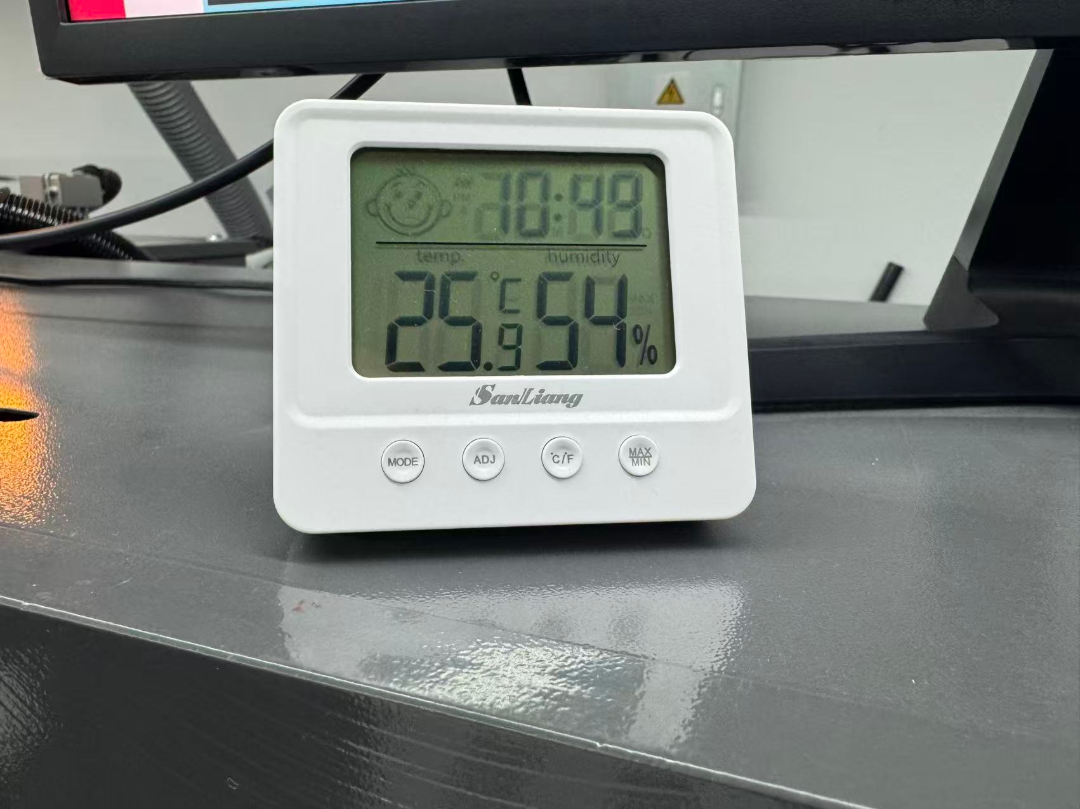 Figure 3: Constant temperature and humidity in the workshop
Tiered optimization technical solutions and implementation processes
By combining the severity of the problem with production continuity requirements, a four-level closed-loop handling system is established, enabling tiered management of digital UV varnish wire drawing issues through non-stop emergency response, batch rectification, hardware eradication, and long-term prevention.
01
Level 1 emergency response
Suitable for sudden slight brushing and occasional tailing at the edges during mass production:
(1) Reduce printing operating speed by 20%~30%, extend oil film leveling time, and eliminate mechanical dragline;
(2) Moderately reduce UV curing power by 10%~15%, slow down the curing pace, and ensure that varnish leveling is prioritized and curing is post-processed;
(3) Perform flash spraying and dust-free surface cleaning to eliminate minor clogging and residual oil buildup.
02
Secondary process optimization
Addressing issues such as uniform fine lines and persistent edge brushing throughout the entire panel:
(1) Precise viscosity control: Standard working environment of 22~25°C, control varnish viscosity at 20~25s (apply 4 cups). High-viscosity materials use micro-blended special UV thinner for stirring, then let it sit for defoaming and filter to 100 mesh;
(2) Precise parameter matching: Reduce single-channel ink output by 5%~10%, optimize the number of overprinting layers, and recalibrate bidirectional printing alignment accuracy;
(3) Stabilizing feeding system: Corrects pressure balance between front and rear traction rollers, fine-tunes tension parameters, and prevents substrate shaking or displacement.
03
Level 3 hardware maintenance
To address recurring issues such as fixed stripes and heavy brushing:
(1) Replace the precision filter, clean the oil supply lines and auxiliary ink chamber, and thoroughly replace the varnish;
(2) Perform deep negative pressure cleaning of the nozzles, repair blocked nozzles and oblique spray issues, and promptly replace worn nozzles;
(3) Check the energy and distance of UV lamps, replace aging tubes, and repair the feeding drive belt and motor stability.
04
Four-level source control
(1) Standardized material management: dedicated materials and dedicated machines, strictly prohibited from mixing across categories; Materials should be stored in a sealed and protected manner;
(2) Standardized environmental control: workshop constant temperature 20~26°C, constant humidity 50%~65%, preheating the lurenishing system in advance during cold seasons;
(3) Standardized equipment maintenance management: pre-shift inspection and cleaning, post-shift oil sealing maintenance, weekly filter element replacement, and monthly overall machine precision calibration.
Standardized pre-production commissioning procedures
To achieve process reproducibility and stable quality, standardized pre-production commissioning procedures should be established:
(1) Material pretreatment: stirring, settling, defoaming, filtering to ensure viscosity and cleanliness meet standards;
(2) Equipment pre-inspection: inspection of sprinkler heads, rubber rollers, optical paths, and oil supply system cleaning;
(3) Low-speed test printing: Print test ladder strips to observe oil uniformity, leveling status, and curing effect;
(4) Parameter fine-tuning: Matching speed, ink amount, and curing power to eliminate poor leveling and drawing;
(5) Batch release: Trial printing is free of brushing, no orange peel, and uniform gloss before mass production.
Analysis of application effects and benefits
This optimization plan was implemented on multiple digital efficiency label production lines, with significant comparison of quality data before and after rectification. Before implementing the graded optimization system, the drawing defect rate was 8%~15%, with high rework frequency and relying entirely on manual experience for process debugging; After implementing the graded optimization system, the issue of UV polish drawing was basically eliminated, and the mass production yield rate remained stable above 99.5%.
This technical solution does not require high equipment upgrades. Through mechanism guidance, standardized parameters, and standardized processes, it effectively reduces material loss, manual rework, and downtime costs, while also reducing dependence on personnel experience, achieving stable processes, controllable quality, and efficient production, fully meeting high-end label appearance acceptance standards.
The digital UV varnish brushing problem is a comprehensive process problem caused by the coupling of material rheological characteristics, equipment operating accuracy, process parameter matching, and environmental working conditions. Its core contradiction is the dynamic imbalance between the varnish leveling timing sequence and mechanical feeding and UV curing rhythms. This paper constructs a practical and replicable governance process system through problem form classification, in-depth mechanism analysis, and layered experimental optimization. Through pre-production standardized debugging, precise in-production parameter matching, and normalized post-production maintenance, the persistent drawing problems in digital efficiency enhancement processes can be thoroughly resolved, significantly improving label printing appearance quality and mass production stability, and providing reference for process upgrades, quality control, cost reduction, and efficiency improvement for similar digital printing enterprises.