


A Hands-On Guide to Fixing Holographic Laser Embossing Defects on Cigarette Packs
Holographic laser card paper, thanks to its unique dynamic optical effects and outstanding anti-counterfeiting performance, has been widely used in food, medicine, tobacco, alcohol, and high-end gifts, as shown in Figure 1. This technology uses a laser holographic embossing process to precisely transfer micro-nano structured holographic images onto the surface of film or paper. Combined with an aluminum coating process to create a metallic shine, the packaging presents a colorful, three-dimensional visual effect under natural light.
Because the holographic laser embossing process involves multiple steps like photolithography and laser embossing with vacuum aluminum coating, production can easily be affected by the material properties, equipment settings, and environmental factors, leading to quality issues such as blurry images, misaligned patterns, and stretched or distorted designs. This article systematically reviews the key points of quality control for holographic laser card paper and proposes parameter optimization and online inspection solutions for common defects in the holographic laser embossing process, aiming to provide theoretical support and practical guidance for improving yield and reducing production costs.
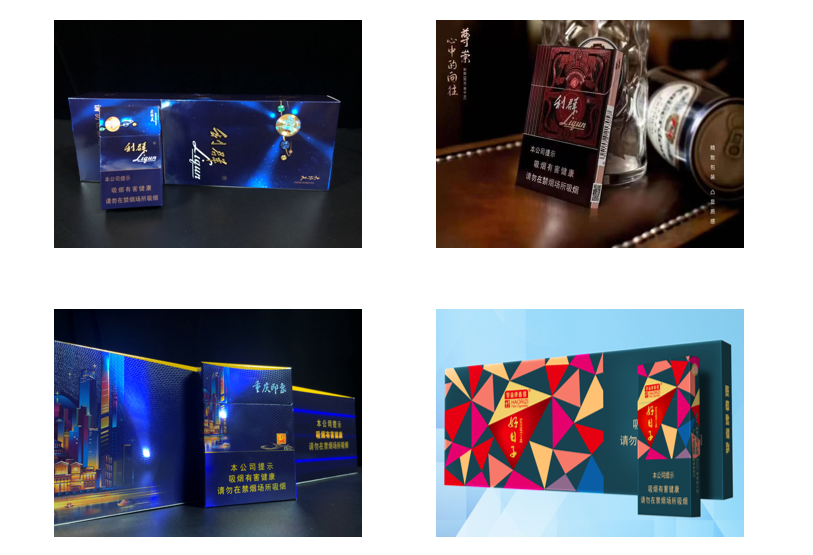
Figure 1 Application Effect of Laser Cardboard in Cigarette Packs
Key Points for Quality Control in Holographic Laser Cardboard Embossing
Due to the optical and material properties of laser cardboard, as well as equipment settings and environmental factors, it's challenging to monitor and control product quality during the embossing process, making laser defects more likely. To ensure consistent quality across the same batch or even different batches of laser products, reduce waste of the laser film, and cut costs, quality control measures need to be implemented at multiple stages, as shown in Figure 2.
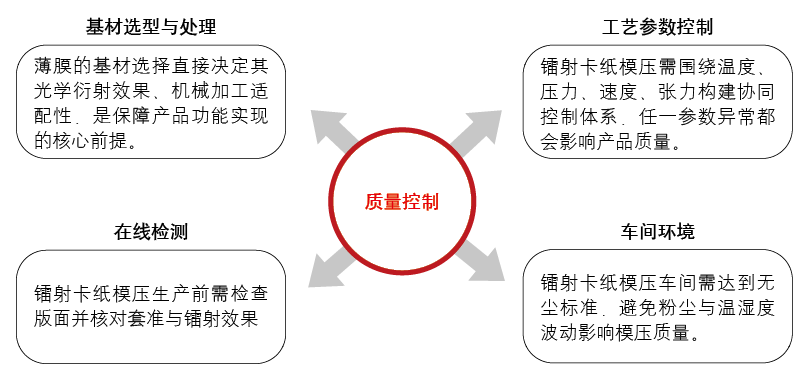
Figure 2 Key points for quality control in the holographic laser card paper molding process
01/ Substrate selection and treatment
Currently, most laser cardboard on the market uses BOPET (biaxially oriented polyester) film as the base film. Compared to BOPP (biaxially oriented polypropylene) film, BOPET has a relatively higher density and offers excellent chemical resistance, heat resistance, abrasion resistance, moisture and water resistance, and adaptability for secondary processing. Because BOPET films have high adsorption on the surface, attention must be paid to dust and other impurities during storage. Additionally, to prevent the film from deforming due to ambient temperatures, the temperature and humidity during storage in the warehouse should be moderate.
The quality of film coating directly affects the quality and effect after molding, so during the coating process, the coating thickness should be appropriately controlled at 2~3μm. The commonly used ceramic anilox roller has a mesh count of 150 mesh, a 60° honeycomb hole, and U-shaped sides; If using metal anilox rollers, the mesh count should be 150~160 mesh, and the dry amount of coating should be controlled within the range of 1.0~2.0g/㎡ when the solid content of the material liquid is 16%. Among them, metal anilox rollers have advantages such as low initial procurement costs, short processing cycles, and convenient maintenance, but their wear resistance, printing precision, corrosion resistance, and thermal stability are relatively weak; Ceramic anilox rollers stand out in wear resistance, ink transfer accuracy, corrosion resistance, and long-term stability, making them suitable for high-speed fine printing scenarios. However, they have drawbacks such as high initial procurement costs and long processing cycles.
02/ Process parameter control
During the molding process, production factors such as temperature, tension, pressure, and speed are involved, each of which has a decisive impact on the quality of the finished film. Therefore, during production, fine adjustments must be made according to actual production conditions, with the adjustment range shown in Table 1.
Table 1 Molding Process Parameter Table
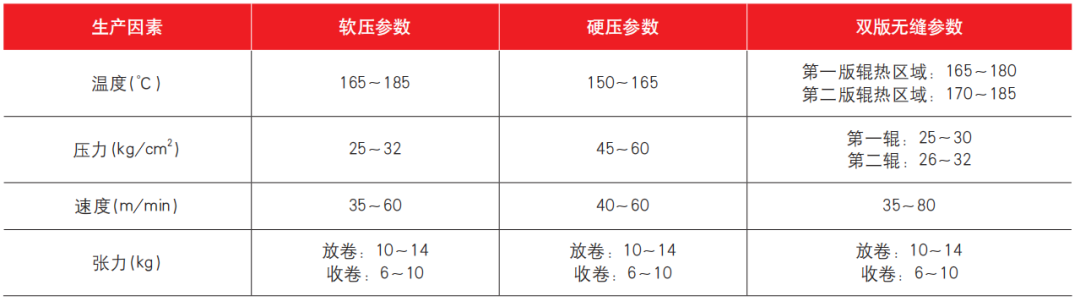
For the holographic molding process, temperature, speed, pressure, and tension are not independent parameters, but rather a "collaborative control system" formed around precisely replicating micro-nano structures, ensuring stable film operation, and balancing production efficiency. Any adjustment or change in any parameter will trigger corresponding changes to other parameters. Excessive temperatures can cause coating fracturing, plate burning, and scorching, resulting in blurred laser graphic and text effects; If the temperature is too low and the resin softening point is not reached, the coating will not soften, micro-nano structure transfer will be incomplete, and the laser effect will be poor. Excessive pressure causes film deformation and damage to the plate roller; If the pressure is too low, the image and text may not be fully printed. If the speed is too fast, it can cause blurred images and text, plate sticking, or film entanglement; If the speed is too slow, the film will deform due to heat, discolor, and reduce wear resistance. Excessive tension causes film deformation, reduced physical properties, and even rebar bursting; If the tension is too low, the film will slide and wrinkle, directly affecting the laser effect. Therefore, these four factors together determine the effectiveness of "film closure control."
03/ Online testing
Before molding production, the machine manager, IPQC, and technical staff must conduct self-inspection, mutual inspection, and patrol inspections. Before starting the machine, ensure that the surface of the plate roller is free of foreign matter; After powering on, a piece of molded laser film must be removed, positioned and registered with the film plate, and the holographic laser effect must be checked to ensure it meets customer requirements. If deviations occur, speed and tension should be adjusted promptly to prevent film scrapping. Production can only proceed after confirming there are no issues.
During the molding machine production process, a stroboscope should be used every 10~15 minutes to check or slow down to check product quality. For full-format products, focus on inspecting their appearance quality to check for issues such as pressure leakage or white spots; For positioning products, special attention should be paid to the deformation of the film. If any problems are found, adjustments should be made promptly. After each roll change, the plate roller should be wiped to prevent dust from falling and causing molding defects.
04/ Workshop environment
During high-speed operation, the film absorbs dust particles and moisture from the surrounding environment, which indirectly affects the quality of the molding. To ensure the production environment meets dust-free and powder-free standards, employees must first pass through the air shower room before entering the workshop to remove dust from their bodies. Large fluctuations in temperature and humidity can cause film deformation or even alter internal properties. Therefore, the molding workshop should maintain a relatively stable working environment, with temperature at 20~25°C and humidity at 55%~65%.
Common quality issues and solutions in holographic laser card paper molding processes
The holographic laser card paper molding process is affected by multiple factors such as material properties, equipment parameters, and environmental conditions, resulting in quality defects. Based on actual production conditions, the causes, characteristics, and targeted solutions for four types of core quality issues are summarized, balancing practicality and operability.
01/ The holographic text and image information are generally blurred
The finished images and text lack clear texture, lack 3D effects and three-dimensional feel, and under high-power microscopes, micro/nano structures may not be fully filled. These defects are mainly caused by four key factors:
(1) Insufficient temperature. The coating has not reached the softening temperature, has poor flowability, and cannot fill the deep microstructure of the laser plate.
(2) Pressure too low. Insufficient filling driving force, especially affecting 3D graphics and text at depths >0.5μm.
(3) Too fast speed. The contact time between the film and the laser plate is < 0.08s, and the micro-nano structure detaches before filling is complete.
(4) Mold contamination. The micro-nano structure of the laser plate is blocked by dust and film precipitates, making it impossible to transfer the images and text.
Precise measures are needed to address the above causes:
(1) Appropriately increase the plate roller temperature to achieve high flow in the base film coating, ensuring full filling of the deep microstructure of the laser plate.
(2) Increase the pressure between plate rollers to fully imprint the laser plate graphic information onto the base film with sufficient driving force, especially suitable for 3D graphics and text with a depth > 0.5μm.
(3) Reduce unwinding and rewinding speeds, extend contact time between the base film and the plate rollers, and ensure full replication of micro- and nano structures.
(4) Before laminating, thoroughly inspect the laser plate to ensure there are no omissions and clear images and text. Wipe the surface promptly to remove dust and deposits, preventing structural blockage.
02/ Partial incomplete images and text
The phenomenon of finished products showing horizontal and vertical fixed strips or missing graphics in the edge areas while other areas remain normal is mainly caused by four key factors:
(1) Abnormal pressure roller condition, manifested as a bulge in the middle of the roller causing lateral blanks or a left-right parallelism deviation exceeding 0.02mm, resulting in uneven lamination contact.
(2) Improper temperature control, with axial temperature deviation of the pressure roller exceeding 3°C, insufficient film softening in low-temperature areas, unable to fully transfer graphics and text.
(3) Mold wear: local micro-nano structures of the laser plate wear out due to long-term lamination, affecting the accuracy of graphic and text replication.
(4) Imbalance in tension adjustment, insufficient edge tension of the wide film, causing local false pressure failure.
To address the above causes, the following procedures should be followed: First, inspect the laser panel to confirm any missing prints or local wear, and promptly wipe and clean any stains found; Next, check the flatness of the pressure rollers, check for any bulging defects, and simultaneously check the temperature conduction of the pressure rollers and the operating status of the transmission system to ensure temperature uniformity and equipment stability; If no abnormalities are found after the above inspection, it is determined that the pressure roller body is worn out and deformed, and the pressure roller should be replaced promptly to restore pressing accuracy and resolve the issue of missing graphics and text.
03/ Graphic stretching and deformation
The dimensional differences between the images and text of the finished laser film and the design dimensions, and the observed increase in micro-texture period under high magnification, are mainly caused by three main factors:
(1) Excessive tension control. Longitudinal tension exceeds the elastic limit of the film, causing stretching and deformation of the film, which in turn changes the dimensions of the graphic text.
(2) Temperature setting is too high. For example, when the PET film processing temperature exceeds 230°C, the film becomes excessively softened, causing molecular chains to stretch under external forces, resulting in abnormal graphic and micro-texture dimensions.
(3) Imbalance in speed matching. The winding speed is higher than the film's speed, creating a tensile force on the film, causing longitudinal stretching and ultimately resulting in dimensional deviations between the images and texts.
To address the above causes, the following targeted measures can be taken:
(1) Reduce longitudinal tension during film processing, ensuring the tension value is kept within the film's elastic limit range to prevent graphic deformation caused by excessive stretching.
(2) Appropriately lower the pressure roller temperature; for example, the PET film processing temperature should be kept below 230°C to prevent excessive film softening and molecular chain stretching.
(3) Adjust the winding and unwinding speeds to ensure the winding speed matches the film's travel speed, eliminate tension caused by speed differences, avoid longitudinal stretching of the film, and guarantee dimensional accuracy of the graphic and text.
04/ Misalignment of text and images
Misalignment between holographic graphic and text information and other film markings, inaccurate nesting, or misalignment between layers of multi-color holographic mainly arise from three types of issues:
(1) Film misalignment. Unstable tension causes uneven force on the film, or deviations in the parallelism of the pressure roller, all of which can cause lateral deviation of the film and cause graphic misalignment.
(2) Mold positioning deviation. If the laser plate and the pressure roller are loosely bonded, the laser plate is prone to positional shifting during the molding process, resulting in inaccurate image and text positioning.
(3) Speed fluctuations. The film's speed fluctuates between fast and slow, disrupting the vertical synchronization of text and image suppression, causing misalignment.
To address the above reasons, it is necessary to first compare film with samples to accurately measure deviation, and then implement targeted measures:
(1) If it is lateral deviation, adjust the film's speed stability to eliminate the impact of speed fluctuations, while optimizing the roller temperature to help improve film misalignment.
(2) If it is longitudinal deviation, focus on adjusting the film tension to ensure tension stability and avoid longitudinal misalignment caused by tension fluctuations.
(3) If the mold positioning deviation is the case, re-fix the fit between the laser plate and the pressure roller, correct the roller parallelism, and resolve the inaccurate positioning issue at the source, ensuring the accuracy of the holographic graphic nesting process.
Summary and Outlook
In the future, the holographic laser card paper molding process can achieve breakthroughs in materials, processes, and environmental protection: on the material side, develop and use more renewable and biodegradable substrates, develop thin, high-strength films, and improve their compatibility with molding processes; Optimize molded rollers and high-speed wide-width equipment in the process to improve large-scale production efficiency; For environmental protection, water-based coatings, UV-LED curing coatings, and other materials with low VOC emissions are used. This technology, which integrates optics, materials, and printing art, has evolved along a path that not only brings visual innovation and industrial progress, but also enriches the dimensions of human perception and expression of the world in a unique way.
In exploring the possibilities of holographic laser card paper molding processes, this article only touches on the surface of this vast field, and it must be acknowledged that current research still has limitations. Whether it is breakthroughs in materials science, deepening environmentally friendly processes, or seamless integration with intelligent digital systems, all require deeper and more interdisciplinary exploration.