


Yutong Technology's Experience Summary of Intelligent Factory Construction, Super Comprehensive!
At present, digital transformation has become a necessary path for Indian enterprises to seek survival and development, enhance competitiveness, and achieve sustainable development. However, what to turn? How to turn? Still a challenge for Indian companies. The Printing Technology Magazine has set up a special "Digital Intelligence Talk" column, focusing on the "ways" and "techniques" of digital transformation for printing enterprises, paying attention to industry trends, exploring construction paths, and sharing excellent cases.
Shenzhen Yutong Packaging Technology Co., Ltd. (hereinafter referred to as "Yutong Technology") is a leading and internationally renowned quality packaging solution provider, founded in 1996 and listed on the Shenzhen Stock Exchange in 2016. With excellent printing and packaging technology and global agile delivery capabilities, Yutong Technology provides innovative one-stop packaging solutions and sustainable intelligent manufacturing services to Fortune 500 companies and well-known brand customers. Its business covers six core areas: consumer electronics, alcohol, personal care, food, healthcare, and tobacco. In addition, we also provide customized services for clients in various industries, including environmental plastic replacement, prepress media, board games&cards, retail store materials, cultural and creative products, injection molding, photolithography printing, etc.
IT operation and maintenance issues and trends in manufacturing enterprises
01/Issues of concern at all levels in the operation and maintenance of smart factories
(1) User personnel
When the system access function is relatively complete, businesses are connected through the system, and most business operations are carried out on the system, users will pay close attention to questions such as "how to solve problems after they occur?" and "how long can problems be solved after they occur?", especially when intelligent logistics handling is used and the connection is very tight.
(2) IT operations personnel
Due to the increasing number of business systems and the complex processes and technical details involved, there are many problems that IT operations personnel need to solve. They pay special attention to questions such as "With so many things to do, who can help me?" "How can I manage such a complex system?" "Who should I turn to for solutions when the system malfunctions.
(3) Managers
From a management perspective, the questions that managers often worry about are: "Is the operation of business systems safe and stable?" "How to manage so many systems and developers?" "What is the information department doing after the project goes live?" and so on.
(4) Decision makers
The decision-makers only see that the APP is running or the system is online, but in terms of results, they still need some data to support it or some planning suggestions to tell them the value brought by the digital system. In short, they are more concerned with questions such as' What has the information department done with so much money? '' What value does information technology bring us? '' What else does our information technology construction need to do? '.
02/Challenges Faced by IT Operations and Maintenance
The management team pays more attention to how to standardize business and combine digital systems to grasp management KPIs at different levels (decision-making, management, and execution) in one minute, achieve end-to-end data application and analysis, and real-time grasp the operation status of smart factories. By relying on systems, processes, and performance, top-down digital driving can be achieved.
04/Basic understanding of enterprise IT operations and maintenance
Relying on a specialized monitoring platform, integrating core elements such as personnel, processes, technology, and tools, we implement a comprehensive and real-time monitoring and management system for IT system architecture and various applications. Its core goal is to ensure the continuity and stability of business operations through real-time fault detection and rapid response, while building a two-way feedback mechanism between the business and IT sides to achieve dynamic adaptation and collaborative optimization of IT resources and business requirements.
05/Build an intelligent IT monitoring platform and establish an active IT monitoring and operation mode
With the increasing demands of business on IT operations and maintenance, the traditional passive firefighting IT operation and maintenance model can no longer meet the requirements of enterprises and provide guarantees for business development. Only by leveraging current advanced technology and building an active patrol style IT monitoring and operation system, can we prevent and intelligently handle various system failures in advance, safeguard the rapid development of business, and meet the requirements of enterprises for IT.
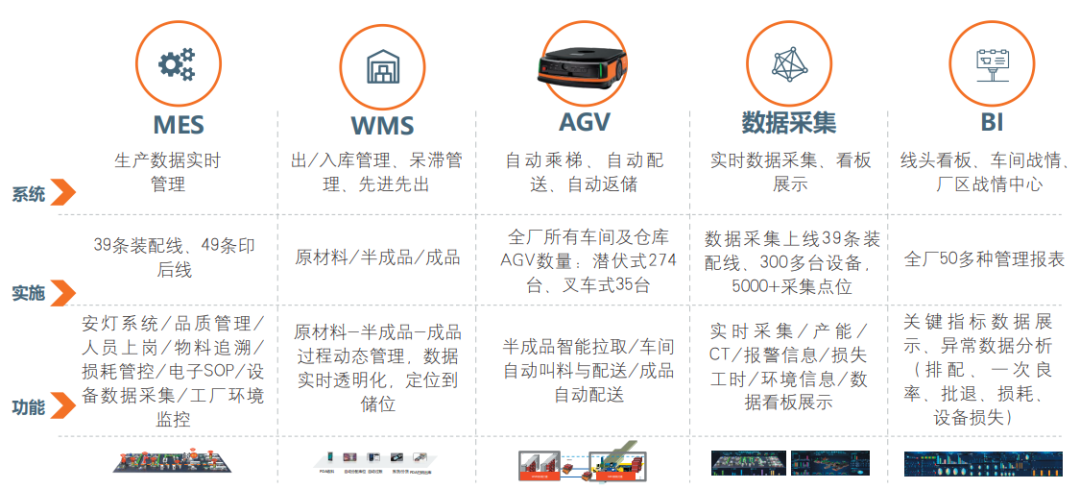 Xuchang Intelligent Factory Stage Achievement Display
02/Highlights of Smart Factory
(1) Paperless workshop
In the production process, especially for mass-produced products, except for the failure to meet production targets and major production abnormalities that require the responsible person to write a PPT analysis report, the production daily report, quality report, loss report, equipment inspection, maintenance, repair and other report information used in daily production meetings are automatically generated through real-time capture by the system, with a daily data collection volume of over 80000. Whether it's on duty work order records or historical data from a week, a month, or even a year ago, they can be retrieved at any time. Real time collection, paperless, error prevention, leak proof, and traceability of data for "people", "machines", "materials", "methods", and "environment" have been achieved through nine management modules.
(2) Warehouse blacklighting
Through the combination of WMS and AGV robots, from raw material warehouses to line side warehouses, semi-finished product warehouses, and finished product warehouses, all business entry and exit handling is unmanned, and materials are automatically loaded and unloaded, fully achieving intelligent scheduling of AGV operations in the warehouse. Considering energy-saving needs, the warehouse achieves all lighting lights off, even air conditioning does not need to be turned on, truly achieving black light, energy-saving, and unmanned warehouse management throughout the factory.
(3) Unmanned logistics in the factory
In order to achieve the intelligent upgrade of the entire logistics process in the factory, the factory has imported more than 270 hidden AGVs and more than 30 forklift AGVs, and built an automated handling system covering workshops and warehouses. By deeply aligning with the core requirements of production business, seamless integration with MES (Manufacturing Execution System), WMS (Warehouse Management System), and RCS (Robot Control System) has been achieved. In the workshop scenario, relying on data interaction between various systems to drive AGV to complete precise automatic material delivery, the material supply rhythm of the production line is highly matched with the production schedule; In the warehouse process, based on the logic of warehousing business, AGV autonomously executes the inbound and outbound operations of materials, achieving full automation of warehousing circulation.
This layout completely replaces the traditional manual handling mode, achieving unmanned operation of all logistics links in the factory. It not only greatly improves the efficiency and accuracy of material handling, but also achieves 100% optimization of logistics handling labor costs, laying a solid foundation for the factory to create an efficient, intelligent, and low-cost production logistics ecosystem.
(4) Systematic KPI assessment
Establish KPI assessment standards for personnel in various departments, rely on the system to automatically collect core data, and achieve automatic scoring and assessment of KPIs. This mode can effectively reduce the subjective judgment in personnel assessment, and the management personnel have only 5%~10% adjustment authority to ensure the fairness and justice of management.
Operation and Maintenance Practice Sharing
01/Planning section
(1) Unified standard for raw material packaging specifications
Many of the raw materials we used in the past had different packaging sizes. To achieve standardization, suppliers must be required to use our system for labeling. And in order to cooperate with automated logistics or unmanned systems, or to use forklifts or other equipment, strict requirements have been put forward for package specifications (weight ≤ 600kg, height below 2.0 meters).
Problem: The incoming raw material packaging specifications are abnormal, resulting in hardware damage to the AGV.
Reason: There is a phenomenon of overweight and over height in the package, with a weight of ≥ 800kg and a height of ≥ 2.3m.
Countermeasure: Develop a quality inventory locking function, conduct unified quality checks on height and weight before storage, and ensure that package specifications do not meet standards and cannot be used online.
Effect: Unified packaging standards, weight ≤ 600kg, height ≤ 2.0m; reduced abnormal damage to AGV related accessories and reduced maintenance costs.
(2) The distribution of small cars is calculated according to the floor rhythm
Problem: The car takes a long time to complete tasks and has low efficiency. The longest execution time from workshop zone 1 to zone 4 is about 30 minutes.
Reason: The workshop has a large area (over 40000 square meters), with a length of 300+meters from north to south and 100+meters from east to west; AGV operates across different areas, resulting in long transportation distances.
Countermeasure: Develop designated vehicle operation functions in the development area, and vehicles in this area will execute tasks in this area.
Effect: Set a reasonable number of vehicles in each area for service, balancing work tasks; The average task execution time of latent AGV is ≤ 5 minutes.
(3) Assign dedicated personnel to dispose of waste paper and garbage in the workshop, resulting in wastage of manpower
Problem: Dedicated personnel dumping, waste of manpower, and insufficient work (2 people in total for day and night shifts).
Reason: Waste paper and garbage are transported from other floors to the first floor, and staff are responsible for dumping the garbage. If the first floor transportation is not timely, the garbage cannot be transported from the upper floor to the lower floor.
Countermeasure: Develop automatic garbage disposal equipment and integrate it with the system.
Effect: Save manpower (2 people in total day and night shifts) and improve the efficiency of garbage dumping work.
(4) Elevator cargo sensor verification
Problem: The hoist chain drum did not transport the shelves to the designated location. The shelf has reached the designated location, but the arrival signal has not been transmitted.
Reason: The photoelectric sensing device of the original hoist cargo sensing device has the phenomenon of false triggering and false alarm.
Countermeasure: Adjust the photoelectric sensing device to a metal sensing device.
Effect: After the shelves are in place, timely transmission of in place signals; The phenomenon of photoelectric false triggering and false alarms has been basically solved.
(5) Plan the raw material warehouse to use forklifts and AGVs to directly pick up and store goods at the dock
Problem: There are safety hazards and low efficiency issues with forklift AGV operations at the dock.
Reason: Mobile forklift unloading at the dock poses safety hazards; Forklift AGV has a large turning radius and low efficiency; The total time for a single cycle assignment is 360 seconds.
Countermeasure: Plan handover points and adjust the operation of mixing forklifts and hidden vehicles.
Effect: Mobile forklifts and forklift type AGVs do not come into direct contact, reducing safety hazards; The combination of two types of AGVs has higher operating efficiency than a single forklift AGV; The total time for mixed assignments is 280 seconds.
(6) Cross floor business, the car cannot respond in a timely manner
Problem: There is an uneven distribution of resources between elevators and hoists, with some areas having idle elevators and others having multiple tasks waiting at the elevator entrance. The elevator task time is ≥ 10 minutes.
Reason: Different regions and business scenarios have different peak business hours.
Countermeasure: Develop a pre scheduling vehicle service function for the elevator, allowing small cars to wait in front of the elevator in advance and limiting the task water level of the elevator (≤ 3).
Effect: When the elevator reaches the target floor, the AGV can respond quickly; Improve the utilization efficiency of elevators and AGVs; Elevator task time ≤ 6 minutes.
02/Efficiency section
(1) Comparison of Efficiency between Hidden Car and Forklift AGV
As far as the industry situation is concerned, the author recommends the latent AGV for the following reasons: firstly, according to the actual operation calculation of the factory, the efficiency of the latent AGV is 1.64 times that of the forklift AGV; Secondly, the channel width of the latent AGV can be adjusted according to the load size, which can reduce space waste; Thirdly, the cost of latent AGVs is lower. Under the same positioning, the price of forklift AGVs may be 1.78-1.80 times or even double that of latent AGVs; Fourthly, from a safety perspective, latent AGVs are more suitable for operation in production workshops.
(2) Comparison of Efficiency between Elevators and Elevators
In the same scenario, the lifting efficiency of the elevator is 1.3 times that of the elevator. The choice between the two depends on the needs of the enterprise itself. Our newly planned factory buildings will all use elevators because of their higher efficiency, lower investment costs, and lower fire safety requirements.
(3) Post press workshop planning forklift AGV operation
Problem: Implementation has found that the post press workshop space is limited, and the efficiency of forklift AGV operation is low and inflexible.
Reason: Forklift AGV has a large turning radius and low efficiency; Forklift AGV cargo walking speed 1000mm/s; The total time for a single cycle assignment is 305 seconds.
Countermeasure: Change and adjust to hidden AGV operation.
Effect: The latent AGV runs fast, occupies a small channel area, and is more flexible; Hidden AGV cargo walking speed of 1500mm/s; The total time for a single cycle assignment is 182 seconds.
03/Management Chapter
(1) Abnormal order grabbing management
In the past, workshop equipment abnormalities occurred frequently, and the abilities of maintenance personnel varied, resulting in problems often not being dealt with in a timely manner. We adopt a rush order model for this: after a problem occurs, we quickly locate the area, link rush orders with performance, and fully mobilize personnel in that area to rush orders for repairs; If the person in charge of grabbing the order fails to complete the repair within the time limit, the technical expert shall designate personnel to repair it. At this time, the performance score of the original regional responsible personnel will be deducted accordingly. By driving performance, achieve rapid handling of anomalies and improve equipment utilization rate.
(2) Full inspection and data entry issues
To accurately record the input data of the full inspection station and grasp the actual first pass good rate of the product, it is necessary to summarize the data through the full inspection input function of the MES system.
Problem: The data entered at the full inspection station does not match the actual data, resulting in insufficient or untimely input.
Reason: The system process is incomplete and lacks constraints, resulting in arbitrary data entry at the on-site inspection station.
Countermeasure: Optimize the original system functions, add quality audit and system visual inspection functions.
Effect: Standardized the input operation process of the full inspection station; The data entered at the full inspection station is consistent with the actual situation, and can truly reflect the first good rate on site.
04/System section
(1) Real time monitoring of AGV system operation and task status
Once an AGV encounters a problem, it will come to a standstill and often wait until it is discovered to know the abnormality. The duration of the standstill cannot be determined unless the task is interrupted due to a disconnection, making it difficult to detect in a timely manner. Therefore, we implement real-time monitoring of AGV tasks in the system. When an abnormality occurs, the duration and location of the abnormality will be pushed to the relevant responsible person and supervisor's mobile phone immediately for timely processing and closure.
(2) Real time monitoring of abnormal conditions in the operation and tasks of the elevator system
By developing mini programs and dashboards, the operating status of the elevator is associated with the system, with green indicating normal and red indicating abnormal, and any abnormalities will be pushed in real-time via WeChat. This allows operation and maintenance personnel to quickly locate abnormal areas and floors, handle anomalies in a timely manner, and reduce the processing time of cross floor tasks from 10 minutes to 6 minutes, improving work efficiency and saving time.
(3) Real time monitoring of system operation and usage status
The operation status of all systems in the factory area will be promptly alerted to the responsible person through WeChat in case of any abnormalities, so that technical personnel can handle and prevent the abnormalities. At the same time, monitor the usage of various business departments in the factory system and develop relevant systems for assessment.
(4) Combining hyper fusion solution and WeChat mini program for real-time monitoring of server operation, hard disk, and resources
The technical architecture management adopts a hyper converged solution, which facilitates backup, rapid handling of exceptions, and includes regular monitoring of servers. When there are abnormalities or indicators exceeding the limit in server operation, hard disk, resources, etc., WeChat mini program will be used to provide early warning, assist in timely closure and handling of abnormalities, and ensure that management personnel can respond quickly and solve problems properly.