


Tonalie lands its SMART architecture with a bang, breaking global data silos and transforming multinational printing companies
Amid the global manufacturing industry's struggles with fragmented supply chains, fluctuating raw material deliveries, and pressures to cut costs and carbon emissions, leading printing and packaging companies are undergoing a fundamental system overhaul, moving from 'standalone automation' to 'fully connected smart digitization.'
As a major packaging and printing giant serving numerous well-known brands worldwide, Tonalie RRD has announced the full deployment of a unified digital manufacturing architecture across its factories around the globe. This strategy, called 'Systematic Manufacturing, Automation, and Robotics Transformation' (SMART), relies on a standardized shared data foundation, connecting production sites and core machines across continents, enabling real-time, dynamic response for global production scheduling.
In traditional heavy-asset printing manufacturing, cross-regional multi-factory operations often create "data silos" due to system heterogeneity. This time, RRD leverages industrial IoT and cloud-native technology to deliver a modern industrial service model with high vulnerability resistance, cross-factory consistency, and agile responsiveness to global brand clients.
Industrial IoT directly connects to ERP, AI-driven cross-border "one chessboard"
The core breakthrough of RRD's newly implemented SMART manufacturing architecture lies in breaking down the barriers between the underlying machine control system and the top-level business management software:
Data synchronization across three continents: By utilizing IIoT sensors and cloud platforms deployed at key nodes of machines, the frontline operational status of the production workshop is directly connected to the enterprise resource planning system. A unified standard data model enables manufacturing bases in North America, Europe, and Asia to achieve high-precision millisecond-level synchronization of production scheduling, raw material inbound and outbound, and real-time inventory management for the first time;
AI algorithms take over dynamic planning: The system integrates advanced industrial artificial intelligence and machine learning algorithms to analyze massive sensor data streams on production lines around the clock, accurately implementing predictive maintenance for equipment failures, detailed forecasting of consumable consumption and capacity demand, and automated triggering of material requirement planning;
Human-machine collaboration and online closed-loop control: At the workshop's physical operation level, the production line has extensively introduced flexible collaborative robots and deeply integrated real-time online sheet-fed automatic scanning quality inspection machines. This hardware-software collaboration not only greatly reduces the calibration and adjustment time between traditional offset presses and digital printers, reducing scrap rates and blank paper layout loss, but also pushes factory throughput efficiency to new heights without disrupting customers' existing business interfaces.
Large-scale hardware standardization enables flexible order transfers across countries and factories
In traditional decentralized or regionally fragmented printing OEM models, once severe weather, raw material supply interruptions, or sudden geopolitical logistics disruptions occur locally, customers' supply chains can easily come to a halt. RRD's interconnected architecture fundamentally resolves this structural risk:
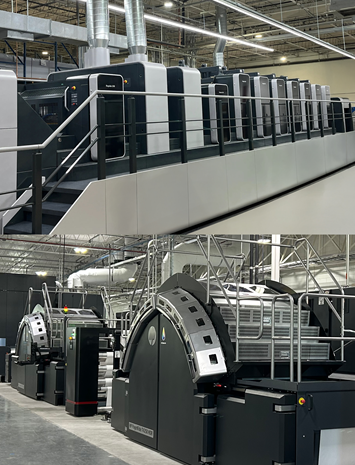
To ensure seamless cross-plant scheduling, RRD recently completed a new round of standardized expansions and iterations of heavy equipment at its global core bases, with newly commissioned assets covering:
Next-generation high-speed sheetfed offset printers and industrial-grade digital inkjet printing matrices; High-speed flexographic printing machines specializing in flexible labels; Multiple 57-inch ultra-large format high-precision die-cutting machines, fully automatic nucleation protection machines, and high-end digital post-press finishing lines.
This "highly standardized hardware configuration + integrated software foundation" ensures that the same set of digital design files and color profile profiles can be delivered with completely zero physical quality tolerances and color reproduction regardless of whether they are distributed to any RRD workshop in North America, Europe, or Asia.
For multinational brands with complex product portfolios (such as cross-publishing commercial prints, special collectible cards, daily chemical self-adhesive labels, and precision folding cartons), RRD's digital hub can automate dynamic order scheduling and even multi-location collaborative manufacturing based on the current load of each factory, material arrival cycles, and the geographic radius of terminal sales distribution warehouses. This not only minimizes the overall logistics costs of the supply chain but also significantly shortens the time-to-market for new products entering the global market.
As RRD President Al Dupont said: "The leap to a connected manufacturing architecture has completely overturned our inherent logic of balancing capacity and resource allocation globally. By laying this unified digital backbone, we deliver highly certain delivery cycles, precise quality uniformity across regions, and truly third-party audit-worthy material loss reduction results." "
Empowering ultimate carbon reduction and restructuring employment models
Beyond the leap in production efficiency, a unified digital foundation injects new empowerment paths into the environmental sustainability and workshop safety that manufacturers care about most.
Green carbon reduction driven by digital twins. Relying on factory-level digital twin models and predictive scheduling, the system can simulate the optimal startup sequence within the simulation space, avoiding frequent car wash and color changes and ineffective idling. This not only significantly reduces scrap scrap rates of physical packaging materials such as paper and ink but also precisely controls electricity consumption in the high-energy heating and drying stages;
Workshop personnel are advancing to the heights of technology and quality control. By collaborative robots taking over high-intensity high-level machinery with potential risks of pinchants or fatigue, and automated systems handling tedious and lengthy paper-based administrative records, frontline workers' risk of work injuries has been significantly reduced. This has promoted the upgrading and transformation of workshop personnel structure, guiding employees from traditional simple manual workers to senior technicians focused on process optimization, technical support, and precise quality control.
From the era of rough competition in single factories for machine speed and manpower, to today's adaptive balance driven by data algorithms for multinational manufacturing capacity, RRD's SMART strategy reflects a deep consensus among global printing giants to break through stock competition: the future of manufacturing will not depend solely on how many expensive machine tools there are in a factory, but on whether an industrial intelligent internet with nerve-ending sensing, autonomous collaborative decision-making, and global risk resistance can be established. In today's normalized global supply chain volatility, this deep digital integration capability is becoming the highest barrier for multinational manufacturing leaders to secure long-term trust from core customers.