


Is it difficult for the publishing industry to transform and monetize? Migu offers a full-scenario solution to break the deadlock
With the official implementation of the 'Regulations on Promoting Nationwide Reading,' the first National Reading Week has officially kicked off, and the construction of a 'Book-Fragrant China' is entering a new stage characterized by legal governance and normalization. Against the backdrop of the deep integration of the digital economy and the cultural industry, relevant data shows that the market size of enterprise intelligent learning has exceeded 40 billion yuan, the adoption rate of AI applications has increased from 70% to 90%, and the entire knowledge service and digital reading industry stands at a critical juncture of high-quality development.
However, under this favorable trend, the publishing industry, as the core provider of content, is facing a profound transformation challenge. A series of practical issues, such as high digital investment, insufficient technical capabilities, stagnation of traditional channel growth, single content monetization models, weak expansion in the B-end market, and fragile user operation systems, have led many publishing institutions into the predicament of 'having content but difficult to monetize, wanting to transform but lacking a path.' How to enable high-quality content to accurately connect with the demands of nationwide reading and enterprise learning, and achieve maximum value, has become a topic of common concern for the industry..
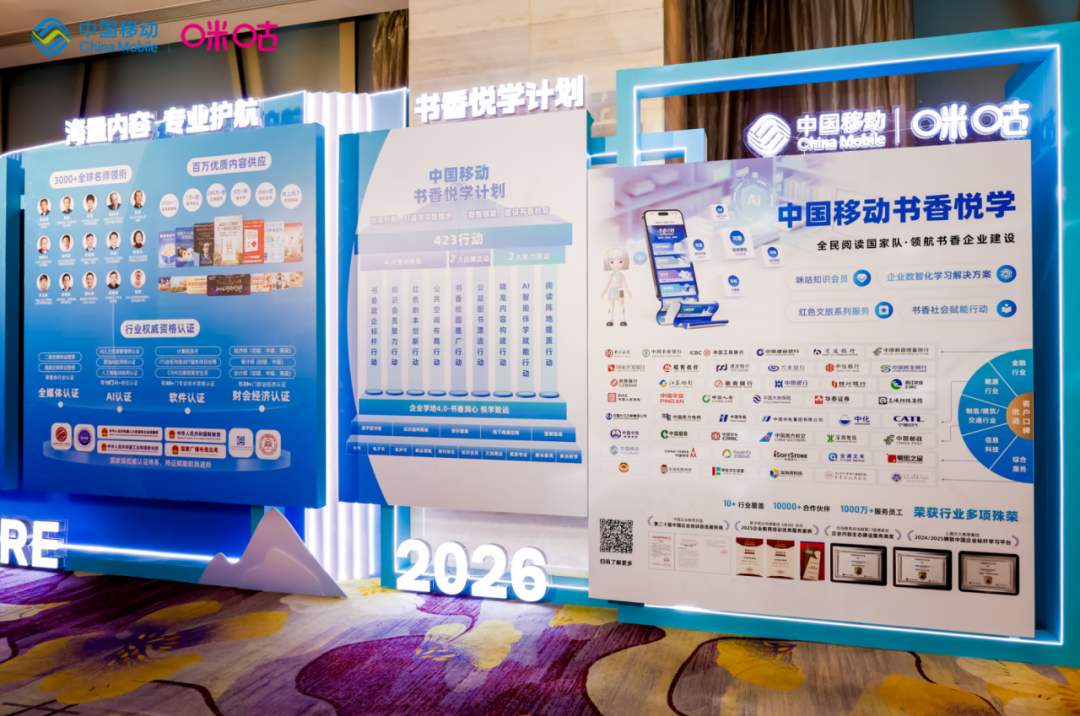
In this context, China Mobile Migu, which has been deeply involved in the field of digital reading and knowledge services for many years, has given a new set of solutions. On April 21, the "Scholarly Joyful Learning Plan" was officially launched at the Enterprise Digital Intelligent Learning Innovation Forum, which is also a new upgrade of the Migu Enterprise Learning Training 4.0 system, supported by digital intelligence technology, supported by full-scenario ecology, and linked by open cooperation model, providing a set of landable paths for the digital breakthrough of the publishing industry.
Part.1
At the threshold of transformation, digital intelligence is imminent
In the face of the dual impact of the digital wave and the upgrading of market demand, we can clearly feel the current pressure of the industry in the exchange with many practitioners in the publishing industry.
First, the technical ability is insufficient. Most publishing institutions generally lack independent research and development capabilities such as AI and big data, and content production and dissemination are still in the traditional stage, making it difficult to adapt to the fragmented, personalized and multi-modal modern learning needs. Second, the channel and profit model are single. The traffic of offline bookstores, traditional e-commerce and other channels has peaked, customer acquisition costs have continued to rise, and multiple values such as IP derivatives, knowledge services, and cultural and creative have not been fully explored. Third, the B-end market is difficult to break through. Government and enterprises, campuses, public cultural spaces, etc. contain stable demand for knowledge services, but publishing institutions lack docking channels and customized service capabilities, making it difficult to enter; at the same time, the industry generally lacks operational capabilities such as user portraits, accurate push, and data tracking, and there is a clear disconnect between content and users.
With multiple challenges superimposed, the industry urgently needs a leading platform with technology, channel and ecological experience to build bridges, and Migu Enterprise Training 4.0 is aimed at this pain point.
Part.2
Four rounds of iterations to create a value conversion channel for content
As the core platform of China Mobile's digital reading and knowledge services, Migu Digital Media has been deeply involved in this track for more than ten years. Relying on technology, network, channels and ecological resources, Migu has covered sub-industries such as finance, energy, communications, manufacturing, medical and health, and education, serving more than 10,000 government and enterprise customers, reaching 2 million employees of high-net-worth enterprises, and accumulating mature experience in digital and intelligent learning services.
In the field of enterprise learning and training, Migu's enterprise learning and training system has completed four rounds of iterative upgrades: 1.0 takes content foundation as the core to build a digital reading ecosystem; 2.0 focuses on digital intelligence empowerment and opens up the integrated service link of books and courses; 3.0 is driven by AI to create an integrated service model of "AI + book + class"; 4.0 comprehensively moves towards autonomy, refinement, and digital intelligence, forming a set of replicable and scalable multi-scenario learning solutions.
Relying on this mature set of system capabilities, Migu further launched the "Scholarly Joyful Learning Plan" for the whole industry. With the goal of "creating a learning organization through scene innovation and empowering digital intelligence to build a scholarly society", the plan extends the solution to multiple scenarios such as enterprises, campuses, public spaces, and public reading, and integrates resources such as books, classes, audio, visual, space, and activities through nine major actions, opening up value transformation channels for published content from production to distribution, from experience to realization.
Part.3
Ecological landing to build a full-scenario digital intelligent reading service
According to the relevant person in charge of the business, the "Shuxiang Yuexue Plan" takes 4 major landing scenarios, 2 major brand activities, and 3 major capacity building as the core framework to open up the path of content dissemination and value transformation in an all-round way.
In the enterprise scenario, the scholarly enterprise benchmarking action creates a customized scholarly position for finance, energy, communications and other industries in the form of "one enterprise, one policy", and embeds reading and learning into the whole process of employee growth; on the public reading side, knowledge members gather together with ten top publishing institutions in the United Nations to launch a series of knowledge membership products, so that famous masterpieces can reach users in the form of the integration of paper, electricity and music courses; in the field of red culture communication, the red script innovation action transforms red stories into immersive digital scripts and opens up new expressions of theme publishing; in terms of public cultural services, the public space layout action uses "mobile + fixed" dual scenarios to create lightweight and intelligent reading spaces in high-speed rail, urban study rooms, and public cultural places, so that reading is truly within reach.
At the same time, the scholarly campus promotion action has entered colleges and universities, linking Generation Z with "promising youth open classes"; the public welfare book drifting action links enterprises to build a sustainable closed loop of reading public welfare through targeted donations and book exchange for books.
Supporting all this are the three major capabilities that Migu continues to strengthen: the genuine content matrix built with more than 300 content partners, the intelligent companion learning system that reconstructs the whole learning process with AI, and the reading position quality improvement action that promotes the digital and intelligent upgrading of traditional reading spaces. From content production and intelligent recommendation to spatial experience and data tracking, a complete set of digital intelligent learning ecology has been formed.
Part.4
Open up and win-win, opening up new space for transformation and growth for the industry
For the publishing industry, Migu Enterprise Learning Training 4.0 and the "Shuxiang Yuxue Plan" are not simply increasing distribution channels, but an in-depth cooperation of capacity openness, ecological co-construction and revenue sharing.
Relying on the knowledge membership system jointly created by Migu and publishing institutions, the high-quality content of publishing institutions can quickly realize the integrated presentation of paper, electricity, audio and courses, so that single content can be upgraded into multi-form products and extend the life cycle. At the same time, Migu will fully open up scenarios such as government and enterprises, campuses, public spaces, and knowledge members, so that published content can reach high-value user groups and open up a complete link from content supply to commercial transformation, which not only brings richer knowledge service supply to end users, but also opens up a sustainable dual income space for publishing institutions.
From digital reading to knowledge services, from corporate training to the construction of a scholarly society, Migu uses open platforms and digital intelligence technology as a link to open up new space for the digital transformation of the publishing industry. It is also expected that China Mobile Migu will continue to deepen technological innovation, expand ecological cooperation, and work with the publishing industry to jointly explore more possibilities for the construction of a scholarly China in the upgrading of digital intelligence.