


Hema milk uses integrated new packaging, reducing paper usage by over 40% on average
"Buying a box of milk, half of it is cardboard" has always been the focus of consumer complaints and criticism about boxed milk. Recently, Hema's own brand of ambient milk series switched to new packaging, changing the previous method of using cardboard inserts for cushioning. The new integrated packaging reduces paper usage by over 40% on average.
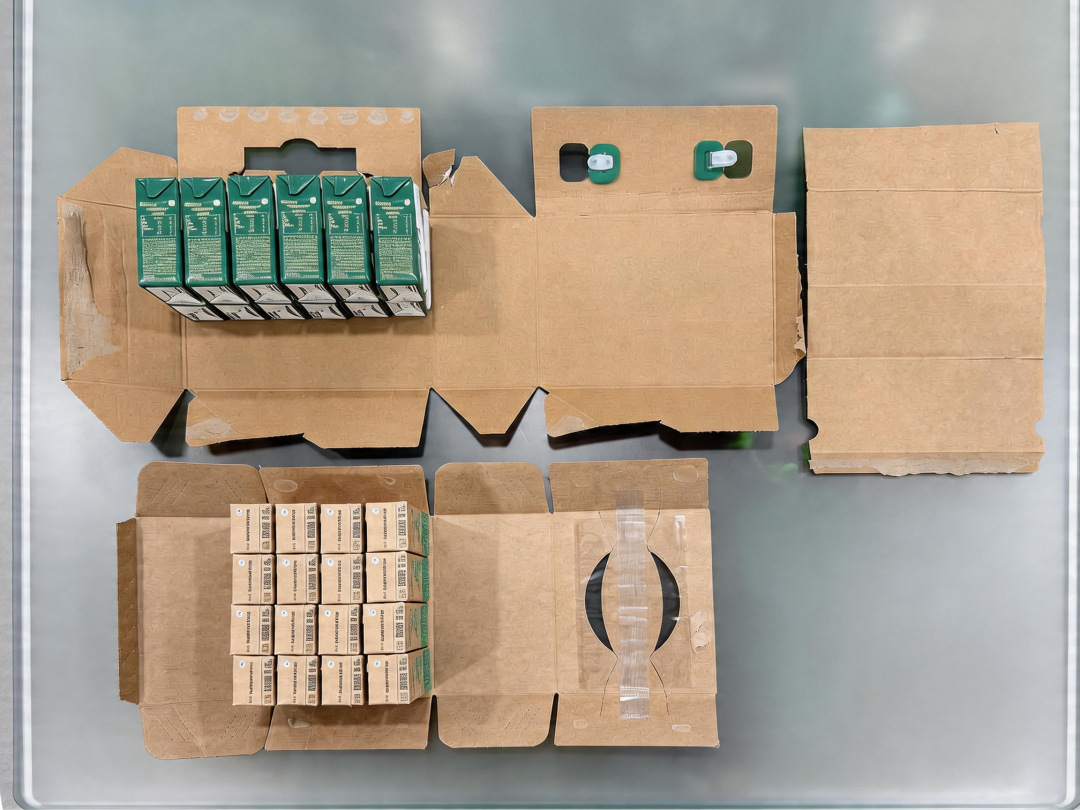
Illustration: Below is the upgraded Hema boxed pure milk.
The new packaging was independently developed and designed by Hema over nearly a year and has currently been applied to eight types of Hema's own brand UHT milk products.
Traditional boxed milk uses manual production line packaging, with paper inserts partly for shock absorption and partly for aesthetics. However, this common industry packaging method seems redundant to consumers who increasingly value practicality. 'Milk boxes take up too much space,' 'After unpacking, you end up with half a bag of paperboard and plastic waste'... such feedback keeps reaching Hema's R&D and procurement team. 'We realized it was necessary to simplify milk packaging to enhance the consumer experience,' said Bi Yin, Hema's UHT milk procurement manager.
Does reducing packaging require R&D? Bi Yin explained that the integrated packaging Hema currently uses completely relies on automated production lines. It not only needs to balance sturdiness and aesthetics but also has to work precisely with the equipment, making design testing quite time-consuming. Initially, Hema considered importing mature foreign packaging solutions but abandoned the idea due to high costs and incompatibility with domestic production lines, thus starting the path of independent development.
The handle was the first challenge in the transformation. The team initially planned to use all-paper packaging, but during weight tests, the paper handles repeatedly broke. Therefore, the team had to repeatedly adjust the cut shapes and crease positions, ultimately establishing a rounded opening design that both prevents hand cuts and distributes force. At the same time, fiber strips were placed inside the handle to ensure durability and prevent breakage.
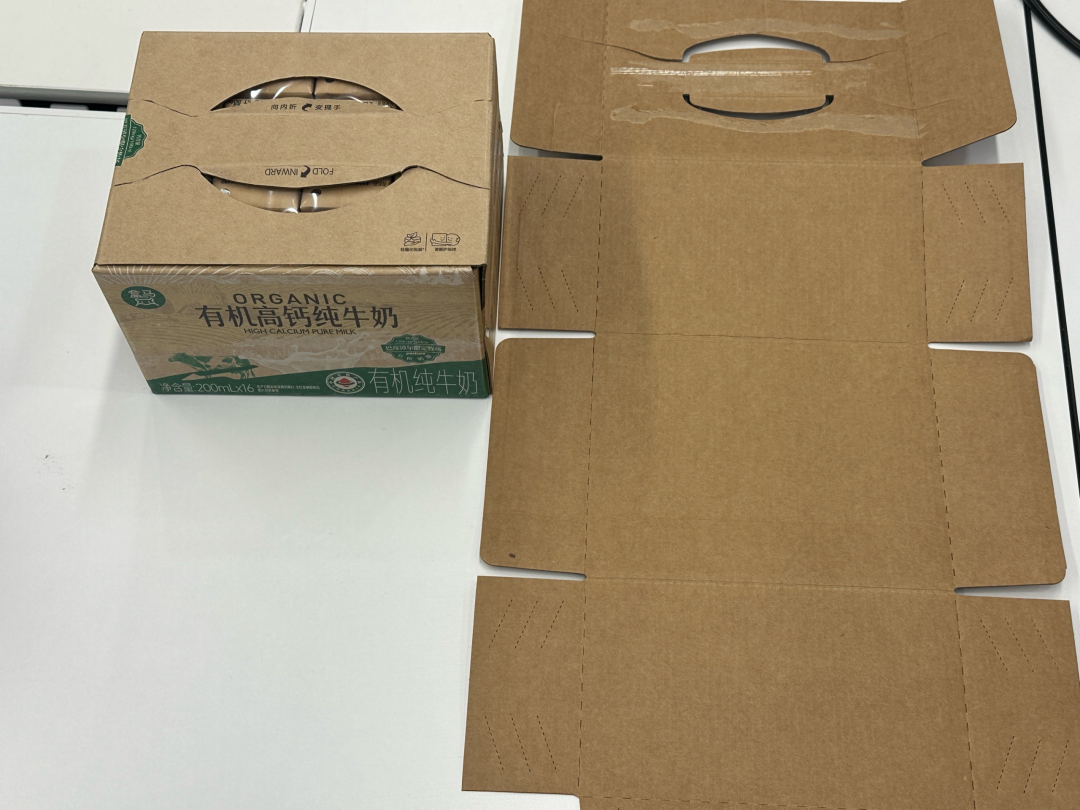
Illustration: The new milk packaging can be easily unfolded.
The old packaging was complex, with raised and widened cardboard, protruding plastic handles, nested layers of cartons, and an outer plastic film, making it difficult to dismantle and recycle. The Hema team drew on integrated carton design, choosing fully recyclable Russian-imported moisture-resistant paperboard, tailoring the cardboard for different milk specifications. The carton can be flattened by unfolding both sides, discarding redundant inner linings and bottom pads, and only retaining necessary dust-proof PVC sheets.
Solving design issues was not enough; production problems had to be addressed too. The reason old packaging had been used for a long time in China was mainly that production line upgrades affected the entire process. Without a sufficiently large order volume, it was difficult to persuade upstream manufacturers to bear the considerable cost of equipment upgrades.
"Hema's room-temperature milk sales volume just happens to be the 'key,'" said Bi Yin. "It not only gives us the confidence to upgrade our own packaging but also drives our partners to upgrade their production lines along with us." It is reported that Hema's upstream factories in Hebei, Inner Mongolia, and Xinjiang have now completed fully automated upgrades, significantly reducing human operational errors and improving overall efficiency.
After the new packaging milk was launched, it also received positive feedback. For instance, Hema's 16-pack Ulanbuhe pure milk saw sales quadruple compared to the same period last year after the new packaging was introduced. Many consumers left comments and posted on social media praising it as 'what you see is what you get.'
At the same time, thanks to economies of scale, Hema expects this move to save 1,750 tons of paper annually-equivalent to the weight of 13 million standard milk cartons. Currently, Hema has officially submitted a patent application for this new line of eco-friendly packaging designs.
In addition to slimming down milk packaging, Hema has also successively launched small bottled water without labels and initiated a 'steps for milk' low-carbon challenge this year. These initiatives are embedding environmental concepts into daily life, from product innovation to lifestyle guidance.