


Heidelberg Reveals Details of Manroland Business Acquisition, 24-Month Integration Kicks Off
Global printing equipment giant Heidelberg, while releasing its latest Q1 financial report, also officially shared details of several key strategic acquisitions and business transformations. The deal announced in June with Langley Holdings to acquire Manroland's sheetfed printing machine service and spare parts business was officially completed on July 1, 2026, at a purchase price of €11 million.
Although the first quarter of the new fiscal year saw losses due to factors like the reduction of external subsidies, Heidelberg is actively building a long-term, high-quality profit moat through measures such as deeply integrating Manroland's global after-sales stock ecosystem, acquiring Bobst's manufacturing technology, setting up low-cost manufacturing bases, and expanding into sodium-ion energy storage.
€11 million to acquire Manroland's aftermarket business, securing long-term recurring cash flow
According to data released by Heidelberg, the acquisition of Manroland's sheetfed press lifecycle business (covering global after-sales service and spare parts supply) officially closed on July 1, 2026, with an acquisition price of €11 million.
Heidelberg expects that integrating this global business network will take about 24 months. As the integration progresses, this segment is expected to generate approximately €50 million in stable recurring revenue annually for Heidelberg and contribute tens of millions of euros in incremental earnings at the net sales and adjusted EBITDA level.
The acquisition brings significant scale effects and synergy potential:
Customer and network expansion: Heidelberg directly absorbed 600 professional employees and successfully tapped into a customer base of over 3,000 users of Roland presses worldwide.
Business synergy: The two companies will achieve comprehensive synergy in areas like cross-selling spare parts, optimizing supply chain procurement costs, and managing consumables pricing.
Extra-large format (VLF) press planning: For the future development of the Cartonmaster and Roland 900 VLF extra-large sheetfed printers, Heidelberg revealed it is evaluating relocating development and production to low-cost regions. Currently, the first VLF press in this series has already been sold to a customer in Croatia.
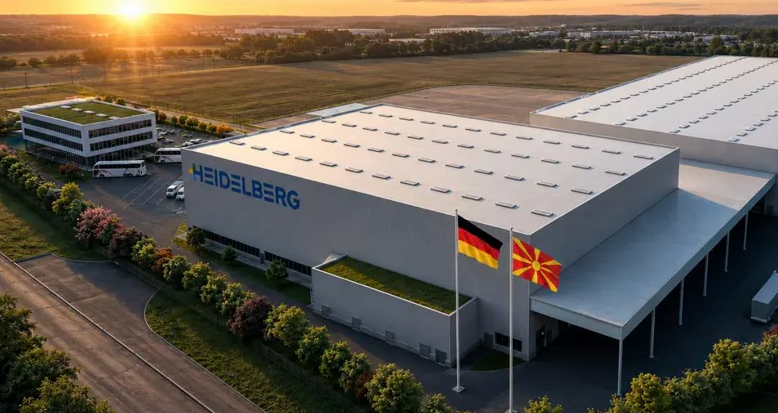
At the same time, Heidelberg also acquired the core manufacturing technology of the well-known cutting press brand Bobst. To further optimize global manufacturing costs, the group plans to use its new North Macedonia manufacturing entity - Heidelberg Industrial Solutions Company - to handle initial post-press equipment assembly.
Labor costs in this region are highly competitive, and Heidelberg has also received special local government support for capital expenditures and operating costs.
Expanding into sodium-ion battery energy storage, leveraging printing technology to reduce costs for print companies
While consolidating its core printing business, Heidelberg is accelerating its expansion into strategically emerging fields such as defense systems and new energy storage.
Heidelberg has entered a deep collaboration with Swiss tech company Phenogy to officially enter the sodium-ion battery energy storage market. This partnership innovatively combines Phenogy's advanced battery chemistry with Heidelberg's proprietary high-precision printing and coating technology to jointly develop new battery products.
This energy storage solution is not only aimed at critical infrastructure like hospitals, which require highly stable power supply, but also has direct application value in industrial printing and packaging workshops. A Heidelberg spokesperson noted that when print shops operate multiple large high-speed presses like Speedmaster machines simultaneously, it often generates extremely high electricity load peaks. Under peak electricity pricing mechanisms, printing companies have to pay hefty electricity fees for these peak loads.
By introducing the energy storage system, print shops can store electricity during off-peak pricing periods or charge the batteries using rooftop solar panels, then release power during peak production periods, leveling load peaks and significantly reducing electricity costs. The first batch of new energy storage equipment is expected to start production in fall 2026.
First-quarter report shows cyclical fluctuations, maintaining full-year profit improvement guidance
Heidelberg's most recent report for the first quarter of fiscal year 2026/27 (for the three months ended June 30) clearly reflects the short-term pressures from the current global macro environment and regional policy adjustments: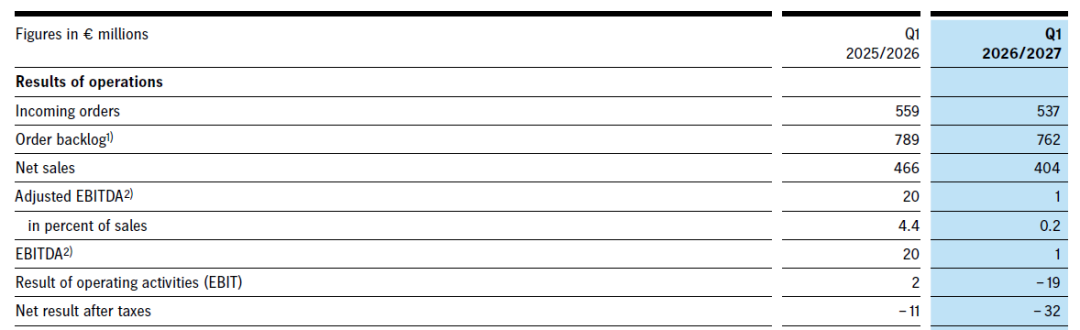
Orders and Revenue: In the first quarter, new orders fell 4% year-on-year to €537 million; net sales were €404 million, down 13.3% from the same period last year.
Profit and Loss: Adjusted EBITDA margin narrowed from 4.4% in the same period last year to 0.2%; the net loss after tax was €32 million, widening from a loss of €11 million a year ago.
One of the main drivers of performance fluctuation was the expiration of a specific Italian government investment subsidy program that previously supported equipment purchases in Europe. This single factor directly reduced Heidelberg's new orders in the first quarter by about €60 million year-on-year.
Despite short-term pressure, Heidelberg's management still described the first-quarter performance as a solid start in line with internal expectations and reaffirmed the full-year guidance: net sales for the full year are expected to be roughly flat compared to the 2025/26 fiscal year, but the adjusted EBITDA margin is expected to improve significantly.
Heidelberg CEO Jürgen Otto emphasized that the company's current focus is firmly on advancing investments according to the planned strategic agenda, solidifying the core of traditional equipment and after-sales services, while actively exploring new business opportunities in areas like renewable energy, laying a solid foundation for future profitable growth and long-term value creation.