


The world's top paper company made 106.5 billion in revenue in half a year, and the CEO directly said the global paper industry is facing the tightest squeeze in history.
In 2026, a year of intense turmoil for the global packaging and paper industries, Smurfit Kappa, the world's largest paper and packaging group, dropped a major signal to the entire supply chain with its Q2 and first-half performance report.
Although the company managed to swing to a profit in Q2 with $803.1 million in sales, earning $8.8 million, rising energy and transportation costs driven by worsening geopolitical conditions squeezed margins, leaving the company with just $151 million in net profit for the first half of the year-a sharp year-on-year decline of 57.58%.
Facing unexpected inflation costs of up to $300 million, this paper industry giant didn't choose to cut prices to grab orders. Instead, it joined peers like PCA and International Paper in a third round of price hikes, raising $100 per ton, and boldly announced that, except for a small amount of coated paperboard, the company's paper products are basically in a state of "sold out".
Net profit shrinks nearly 60% in H1: Inflation eats up $300 million in costs, delisting from London to focus on NYSE
Looking at Smurfit Kappa's overall accounts, revenue and profit show a very clear pattern of "steady revenue, squeezed profit."
In the first half of 2026, the company achieved cumulative net sales of $15.743 billion (about RMB 106.5 billion), a slight increase from $15.596 billion in the same period in 2025; but net profit fell from $356 million last year to just $151 million (about RMB 1.022 billion), a drop of $200 million, or 57.58%.
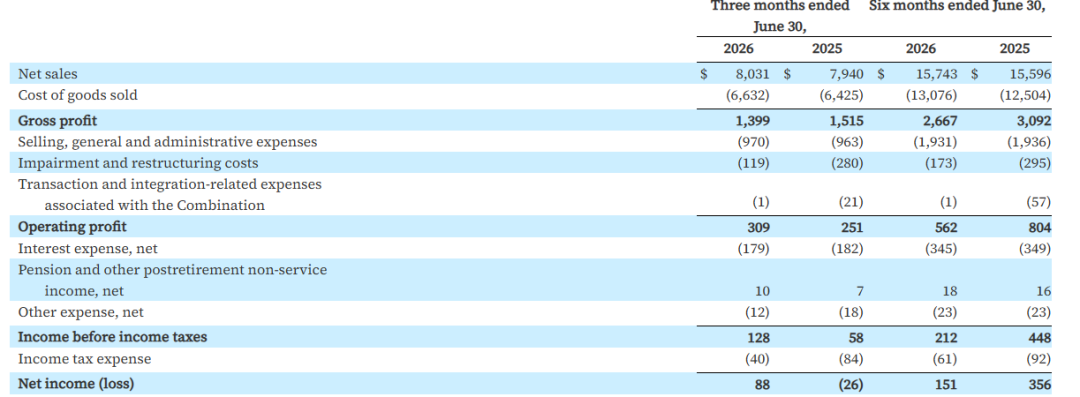
In the second quarter, net sales reached $8.031 billion, slightly up from last year's $7.94 billion, with net profit hitting $88 million, marking a turnaround from the $26 million loss in the same period of 2025.
Looking at regional performance, North America remains the largest base, contributing $9.063 billion in net sales during the first half of the year; Europe, the Middle East, Africa, and the Asia-Pacific regions together contributed $5.581 billion; while Latin and South America contributed about $1.099 billion.
The main reason for the sharp drop in half-year profit was the drastic rebound in costs.
CEO Tony Smurphy and CFO Ken Bowers stated frankly at the earnings call that the deteriorating situation in Iran directly pushed up fuel and shipping costs. The company now expects its annual input costs in North America and Europe to be $300 million higher than anticipated just three months ago.
Rising freight costs have become the biggest operational challenge for 2026.
As a result, the company has lowered its full-year adjusted EBITDA guidance from the previous $5.0–5.3 billion to $4.9–5.1 billion, while keeping full-year capital expenditure at $2.4–2.5 billion.
Regarding capital structure adjustments, the company officially delisted from the London Stock Exchange on June 22, 2026, fully retaining its listing on the New York Stock Exchange to focus resources on advancing its mid-term strategy.
Supply tightened sharply within six weeks: global paper sold out on a large scale, kicking off the third round of $100 price hikes.
Interestingly, despite high costs weighing on net profit, paper supply for end-users has reached a rare tight situation in recent years.
Smurphyvi Slock execs pointed out that the corrugated board market significantly tightened in just six weeks this summer. Apart from a small amount of coated recycled board (CRB) being sold, essentially all grades of paper were sold out, and for the rest of the year, factories will be in a 'catch-up mode' in scheduling production.
Tony Smurphy remarked that the global paper market is the strongest and tightest supply period he has ever seen in his career. This extreme tightening on the supply side directly triggered the third unprecedented round of concentrated price increases in the North American packaging industry this year.
After PCA issued a price increase letter of $140 per ton on July 24, 2026, Smurphyvi Slock quickly followed suit, announcing that corrugated and kraft paper prices would increase by $100 per ton starting September 1, 2026.
In addition, as early as early July 2026, the company announced that starting August 10, prices for SBS folding cartons, commercial printing, and food service paper would rise by 4% to 6%, marking the second time they raised SBS paper prices this year.
Bowers noted that North American corrugated cardboard sales fell 4.5% year-on-year in the first half, which perfectly aligns with the company's strategy to 'pursue value rather than blindly chasing volume.'
Although the company absorbed huge cost increases in Q1 and Q2, with the first two rounds of corrugated price hikes accelerating in Q3 and Q4, and this round of price increases fully taking effect in Q1 2027, the company is confident it will fully pass on this $300 million inflation cost to downstream clients, laying the foundation for a subsequent profit rebound.
Clearing 60 loss-making factories: 8 more plants closed in Europe and North America to reshape asset efficiency.
While passing on costs through price hikes, Smurphyvi Slock is also taking strong measures on internal asset divestments and restructuring.
Management revealed that after closing a factory in the UK, the company has recently implemented multiple plant closures in North America, Europe, the Middle East, and Asia-Pacific.
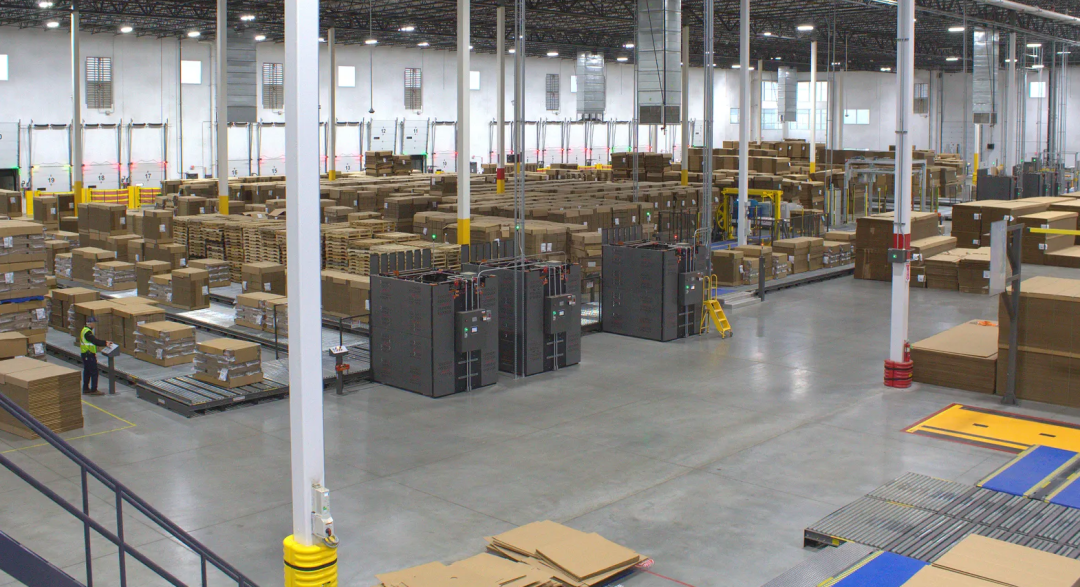
Currently, the company is in the process of shutting down another eight carton processing plants in Europe and North America.
Tony Murphy mentioned that since Morphy Kappa merged with Wesslock two years ago to form Murphy Wesslock, the number of plants labeled as 'loss-making' within the group has been drastically reduced from nearly 80 at the start to around 20.
For the remaining loss-making sites, the company is implementing a strict 'improve or close' screening system.
Looking at regional markets, agricultural packaging in California has underperformed due to climate effects, and the Southern European corrugated market has also been hit by heatwaves affecting agriculture. But the industrial packaging markets in Latin America and Europe are doing well overall, and the North American market is maintaining steady growth.
With the introduction of new corrugated board orders in August and September, coupled with the phasing out of eight inefficient processing plants, Murphy Wesslock is aiming to shake off losses and forcibly transfer costs through this dual strategy, hoping to completely overcome the shadow of supply chain inflation by the second half of 2026.