


Traditional Offset Printing vs. Inkjet Printing: A Full Comparison, Which One Wins?
Since DRUPA 2012, when Landa launched nano inkjet printing technology, it has attracted widespread attention in the industry. What are the differences between traditional offset printing and inkjet printing, as the two core processes in the printing industry, and what are their respective core advantages? This article will compare their printing principles, prepress document processing workflow, print quality performance, equipment structure, and debugging logic from four core dimensions, providing practical references for printing professionals and production selection.
Comparison of printing methods
01
Traditional offset printing
Traditional offset printing follows the core principle of "oil and water do not mix," adopting an indirect transfer model: first, the graphic ink on the printing plate is transferred to an elastic rubber pad, then the ink from the blanket is transferred onto various substrate surfaces via an impression roller, achieving large-scale replication of images and text. It is the most mature and widely used core branch of the printing system, and remains the mainstream process in the global commercial and packaging printing fields, meeting various standardized mass production needs.
02
Inkjet printing
Inkjet printing uses plateless direct imaging technology to directly convert digital images and text into printhead drive electrical signals. Through a high-precision digital control system, the timing of inkjet printing, droplet size, and ejection pattern of micron-level holes on the printhead are precisely regulated, allowing ink to be directly ejected onto the surface of the substrate to complete image and text restoration.
The core difference between the two printing methods lies in whether a printing plate is needed and whether indirect transfer printing is involved. The differences between the two directly determine their differentiation in prepress processing, quality performance, production efficiency, and other aspects.
Comparison of prepress document processing workflows
Based on the different imaging principles mentioned above, there are significant differences in prepress document processing workflows between the two processes, directly affecting production flexibility and cost adjustment.
Traditional offset prepress document processing workflow: document creation→ color management→ typesetting→ output of 1-bit files→ plate making→ printing. This process features "one-time curing." For example, when abnormalities occur during printing and production require adjustments to file colors, small fonts, fine lines, and other details, the entire process must be fully repeated. This process is not only cumbersome and time-consuming, but also incurs additional plate material and labor costs.
Prepress inkjet printing document processing workflow: Document creation → RIP rasterization parsing (the grating image processor converts graphics and text into printhead recognizable dot matrix signals) → printing. The process is simple and highly flexible. If files need to be adjusted during production, operators can directly modify them in AI, Photoshop, or other drawing software, and after exporting RIP, production can be resumed immediately; or parameter adjustments can be completed directly within RIP software. The entire process eliminates steps such as outputting 1-bit files, plate making, and mounting and proofreading, significantly improving file processing efficiency and flexibility compared to traditional offset printing.

Based on the comparison above, the fundamental differences between the two can be summarized as follows: the prepress file processing of traditional offset printing is a 'one-time finalization' process. Once the file is output to a plate, it cannot be modified, and any adjustments require starting over; whereas the prepress file processing of inkjet printing is a 'real-time adjustable' process. The text and image information always remain in digital form and can be adjusted anytime as needed. This is also the core reason why digital printing has flexible production advantages. This difference in prepress processing further extends to the quality of the printed output, resulting in distinct quality characteristics for each process.
Comparison of Printing Quality
01
Advantages and Drawbacks of Traditional Offset
Traditional offset printing involves a 'plate → blanket → substrate' transfer process, which can lead to issues like uneven gradient transitions and poor recovery of light halftones. Additionally, because controlling water-ink balance is challenging, color variations can occur across the same print run.
However, due to the pressure transfer characteristics, offset printing achieves uniform and full ink coverage on large solid color areas, with a rich texture even though the ink layer is relatively thin. For fine details like small text and thin lines, its clarity and sharpness surpass inkjet printing, making it very suitable for standardized printing products that require high precision.
02
Advantages and Drawbacks of Inkjet Printing
Inkjet printing does not require any transfer stage, fundamentally avoiding the loss of text and image quality during printing. Gradient transitions and light halftone recovery are significantly better than traditional offset printing. There's also no need to manage water-ink balance, eliminating common defects such as dirty or smudged prints in offset. Relying on digital precision ink control, the ink output for each sheet is highly consistent, and the color consistency within the same batch far exceeds that of traditional offset.
However, inkjet printing has its own specific quality issues. During printing, it can suffer from streaks, banding, ink pooling, or missing ink if the ink and substrate are not compatible. Multi-head devices may also have joining lines between heads. The root cause of these problems mainly lies in the insufficient driving control precision of the print heads and the inadequate interface match between the print heads, ink, and substrate.
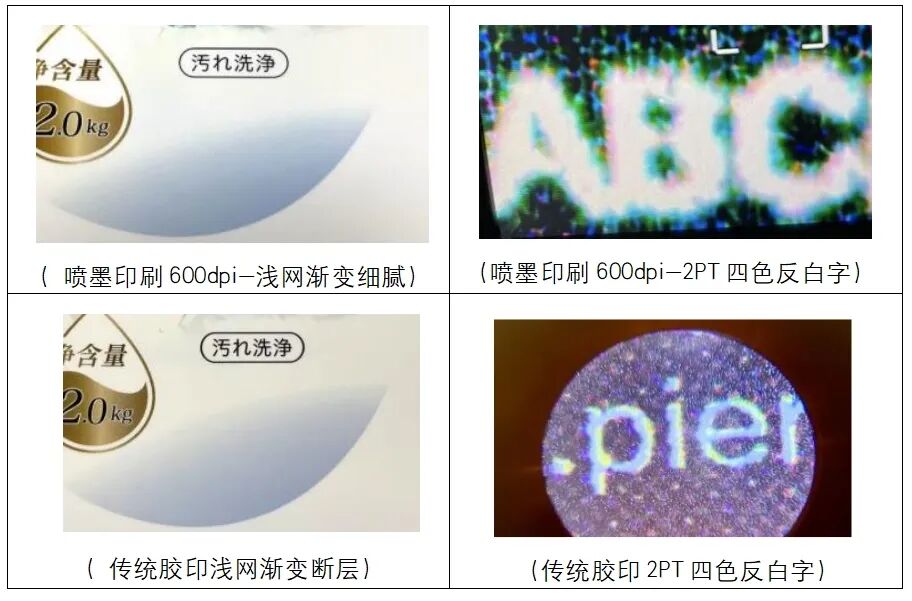
In summary, the advantages of traditional offset printing are concentrated in large-area solid color block printing and fine graphic and text reproduction, while the advantages of inkjet printing are reflected in gradient transitions, shallow screen layering, and color consistency within the same batch. Their quality characteristics complement each other, jointly covering different printing scenarios and forming the core foundation of the current mixed printing model in the industry. Behind these quality differences lies the distinct equipment structure between the two processes.
Comparison of equipment structure and debugging logic
01
Core system architecture differences
Traditional offset printing, as indirect printing, requires precise control of printing pressure, ink output, and water flow during the printing process. Therefore, the ink path system and water flow system are the core of the equipment and the focus of daily operation and maintenance for printing companies. Its operational stability directly affects key quality indicators mentioned earlier, such as the uniformity of real color blocks and the reproduction of fine graphics and text.
Inkjet printing is a plate-free direct printing without the need for ink transfer transfer; ink is printed directly from the printhead onto the surface of the substrate, so the data transmission system and inkjet control system are its core. The stability and accuracy of this system directly determine the core quality performance mentioned earlier, such as gradient reproduction and color consistency.
Currently, the core technical challenge of industrial-grade Singlepass inkjet printing equipment is print head control. Its ink drop size control and seam optimization capabilities directly affect printing quality, placing high demands on equipment manufacturers' R&D capabilities. For example, Samba printheads use diamond-shaped arrangement designs, enabling seamless, seamless printing with high ink drop control accuracy, but their technical development is challenging, with only a few manufacturers maturely applying them. This directly reflects the core role of inkjet printing equipment print head control.
02
Core system function correspondences
Although the core architectures of the two devices differ fundamentally, each system has a clear corresponding operating logic. Clarifying this correspondence can help practitioners better understand the working principles of the two devices.
The ink circulation system of inkjet printing equipment is responsible for achieving a complete closed-loop transfer of ink from the ink cartridge to the printhead, and then from the printhead back to the ink cartridge, ensuring stable ink supply and smooth circulation. This system corresponds exactly to the traditional offset printing ink path system, where ink is stepwise transferred through the ink bucket to each ink roller in the supply process.
The gas circuit system of inkjet printing maintains constant negative pressure during operation to stabilize the pressure inside the printhead and ink cartridge, ensuring normal ink circulation and precise ejection, while preventing ink leakage and overflow. This system is similar to the traditional offset printing water circuit system: the dampening solution is delivered via a water hopper to the plate water roller, forming a uniform thin water film in the non-graphic areas of the printing plate, blocking excess ink from adhering and preventing plate dirt and pasting. At the same time, moderate emulsification between water and ink maintains the stability of offset printing operations.
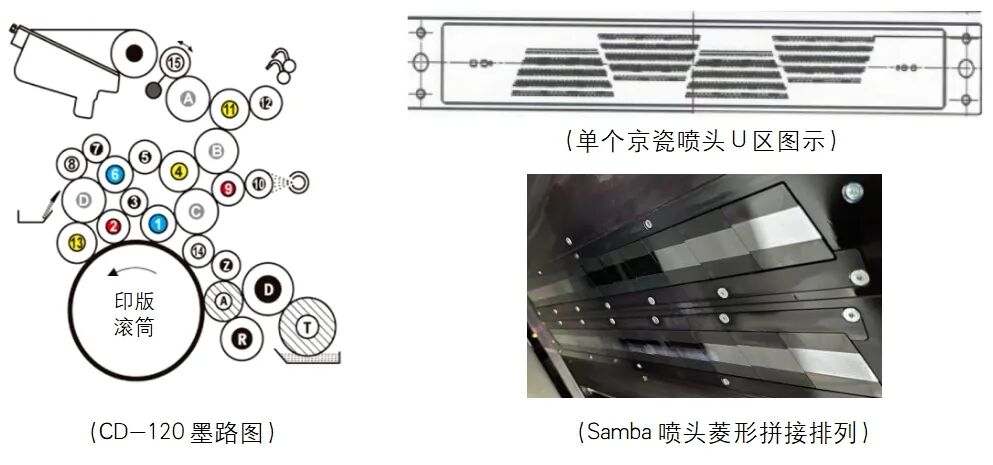
Although the two system architectures differ, the approach and goals for printing adjustments are the same for both processes.
The core of traditional offset printing adjustments is 'even ink rollers, even water rollers, even ink keys.' By adjusting parameters such as the pressure between the ink and water rollers, the speed of the ink fountain roller, and the rollers' opening and closing, issues like uneven printing from left to right, deep color at the front but light at the back, and inconsistent color blocks can be resolved, ensuring stable print quality.
For inkjet printing equipment, the equivalent adjustment focuses on printhead color calibration. This means managing the color differences within a single printhead's U zone and between different printheads, primarily by controlling the printhead driving voltage and ink temperature to unify the colors on the page and improve the smoothness of gradients.
Here's the principle: most printheads in inkjet printing use a piezoelectric structure, working based on the inverse piezoelectric effect. The higher the driving voltage, the greater the deformation of the piezoelectric ceramic, which exerts more pressure on the ink chamber, and the larger the volume and amount of ink droplets ejected. Ink temperature directly affects its viscosity; when the temperature rises, viscosity decreases and flow improves, causing larger droplets under the same driving parameters-basically achieving the same effect as increasing the printhead voltage. So, when dealing with color differences on inkjet printheads, adjustments are usually made by tweaking the
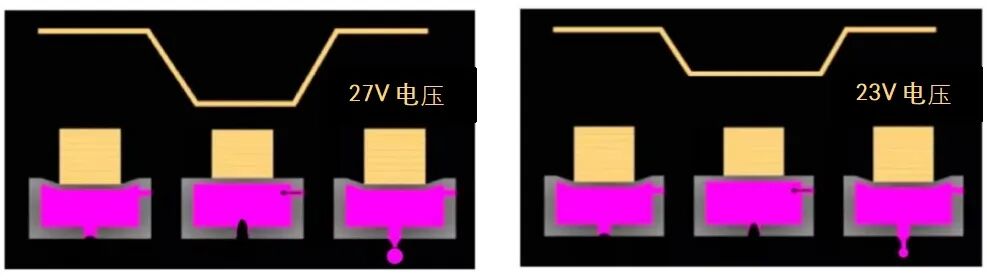
Hopefully, through the comparison above, this article can help printing professionals better understand the differences and similarities between the two printing processes, and choose the right production process based on the characteristics of their own products.