


Senior prepress expert's understanding of dot attributes
Halftone dots are the basic units that represent the layering and color variations of continuous-tone images. They form the foundation of printed images and play a role in conveying the tonal scale of the layout. The state (size and shape) and behavioral characteristics of halftone dots will affect whether the final print can accurately reproduce the tonal and color variations of the original. In this article, we invite senior prepress experts to share their interpretation of the four attributes of halftone dots.
Dot Size
Dot size is determined by the coverage of the dot, also known as the dot area percentage. It is generally represented using 'cheng.' A dot with 10% coverage is called 'one cheng,' 20% is called 'two cheng,' and so on.
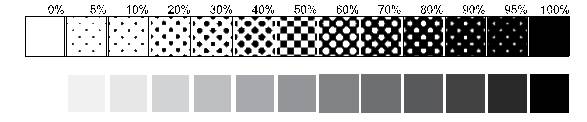
Before color separation, it is first necessary to determine the dot percentage at a certain point on the screen. Dot percentages can be measured using a densitometer: first measure the integral density of the dot, and then convert it into the percentage of the dot area. This method is relatively scientific.
Another method for measuring dot percentages is visual estimation: judging the dot percentage based on the relationship between the dot and the blank space.
The rules are as follows:
- If three dots of the same size can fit between two dots, this size of dot is called 'one-tenth,' i.e., 10%;
- If two dots of the same size can fit in, it is called 'two-tenths,' i.e., 20%; if 1.5 dots of the same size can fit in, it is called 'three-tenths,' i.e., 30%;
- If 1.25 dots of the same size can fit in, it is called 'four-tenths,' i.e., 40%;
- If the black and white are evenly split, this size of dot is called 'five-tenths,' i.e., 50%.
When the dot reaches 50%, overlapping occurs. For easier calculation, the black and white dots can be inverted, using the paper color as the blank. For example, if three blank dots of the same size can fit between two paper-colored blank dots, it is 'nine-tenths,' i.e., 90%.
Of course, if the sample itself is a printed product, dot gain must be considered. Dot gain is related not only to the printing pressure but also to the dot shape.
Dot Shapes
Dot shapes include round, oval, square, chain (diamond), cross, diamond, line, dispersed, and other special shapes. The most commonly used dot shapes domestically are round, square, and chain shapes.
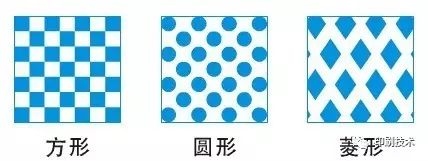
First, we need to determine the halftone shape of the sample, and then understand how different halftone shapes expand during printing in order to restore the ideal state of the sample's digital original.
Next, let's discuss the characteristics and properties of several halftone shapes:
Circular halftones, when expressing the layers of an image, have highlights and midtones running parallel, with overlapping only appearing in the shadows. When the circular halftone percentage is about 78%, the perimeter is the longest. At this point, halftones begin to overlap and reach their maximum expansion.
Square halftones have the longest perimeter at 50% coverage. At this point, halftones begin to overlap, reach their maximum expansion, and are prone to banding.
Elliptical (chain-shaped) halftones appear diamond-shaped, especially showing a noticeable chain-like pattern after overlapping. Because elliptical halftones have short and long axes, the overlapping occurs at about 35% and 65% coverage, so these points have the maximum halftone expansion.
It is important to note that the expansion of halftone areas caused by overlapping in printed samples must be taken into account during color separation.
Halftone Angle
Halftone angle refers to the angle between the halftone line arrangement and the horizontal line. Generally, when the angle difference between two halftones is 30° to 60°, the overall moiré pattern appears aesthetically pleasing. When the angle difference is 15° or 75°, the moiré pattern becomes noticeable and produces interference lines, commonly known as a turtle pattern.
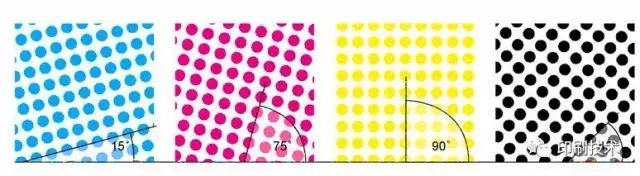
From a visual perspective, a 45° screen angle produces the most comfortable and aesthetically pleasing effect and is the preferred angle for the main color in both monochrome and multicolor. A 0° screen angle has the worst visual effect and is generally used for the weakest color plate, such as the yellow plate.
Number of halftone lines
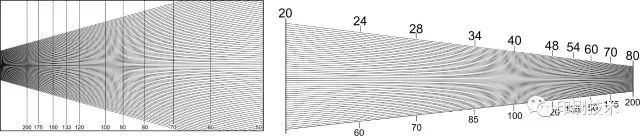
The size of the dot is affected by the screen ruling; the higher the screen ruling, the smaller the dot and the higher the fineness. Common screen rulings include 80 lpi, 100 lpi, 150 lpi, 175 lpi, and 200 lpi. The screen ruling can be measured using a screen ruling gauge.