


Control logic and practical path for precision of die-cutting equipment in high-speed scenarios
With the continuous expansion of the application scenarios of self-adhesive labels towards high speed and refinement (such as the labeling speed of 600 bottles/minute in the food and beverage industry, and the precision requirement of electronic labels controlled within ± 0.05mm), the balance between die-cutting speed and precision has become the core issue of technological breakthroughs. The inertial impact caused by speed increase, subtle fluctuations in material properties, and cumulative effects of tool wear will directly affect the die-cutting accuracy, and insufficient die-cutting accuracy will in turn restrict the improvement of labeling speed. Next, the author will explore the control logic and practical path of die-cutting accuracy in high-speed scenarios from four dimensions: die-cutting equipment accuracy, tool accuracy, material accuracy, and ultra high speed labeling process requirements.
In this article, let's first take a look at the first dimension: precision of die-cutting equipment. What is its control logic and practical path?
01
Dynamic synchronization of feeding system
The synchronization error between feeding speed and die-cutting speed is the main source of die-cutting accuracy deviation during high-speed die-cutting. When the die-cutting speed is increased from 60 meters/minute to 200 meters/minute, the feeding delay or advance of the material will show nonlinear growth - this is due to the elastic deformation of the material under high-speed traction (such as the instantaneous stretching rate of BOPP film surface material can reach 0.3%) and the inertial slip of the feeding roller.
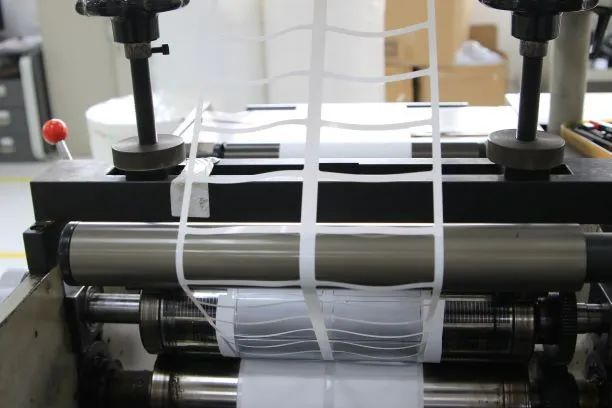
At present, the mainstream solution in the industry is to adopt a feeding structure of "servo motor+precision ball screw", which means that the 16 bit encoder of the servo motor can achieve position feedback of 0.001mm level. Combined with a tension sensor with a sampling frequency of 10kHz, it can compensate for the stretching amount of the material caused by speed changes in real time. The surface of the feeding roller is laser engraved to form micro convex patterns (roughness Ra is 1.6 μ m), which can increase the friction with the material and control the slip amount within ± 0.01mm.
Practical application cases have shown that after this optimization, the feeding positioning error at a high speed of 200 meters per minute can be reduced from ± 0.08mm to ± 0.03mm.
02
Rigidity and dynamic balance of die-cutting unit
When the die-cutting roller rotates at high speed (≥ 2000 revolutions per minute), centrifugal force will be generated. If its concentricity deviation exceeds 0.01mm, the radial fluctuation of the cutting trajectory can reach ± 0.05mm. Therefore, the equipment needs to ensure stability through a triple design:
Firstly, the die-cutting roller is made of 45 # quenched and tempered steel and forged as a whole, with precision grinding to ensure a roundness error of ≤ 0.003mm;
The second option is to use angular contact ball bearings, which eliminate clearance through pre tightening force and control the radial runout of the shaft system within 0.003mm;
The third is to calibrate the dynamic balance to G0.4 level (international standard), ensuring that the residual unbalance during high-speed rotation is ≤ 0.5g · mm, and avoiding unstable blade contact caused by vibration.
03
Real time correction of closed-loop positioning
During the high-speed die-cutting process, random errors such as thermal expansion and contraction of materials, mechanical vibration, etc. need to be offset through real-time detection and adjustment.
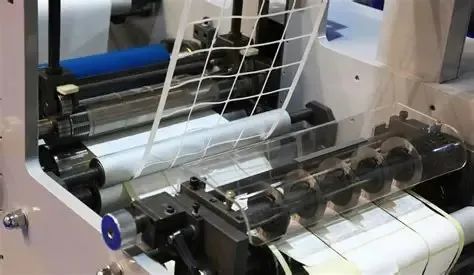
Currently, mainstream devices mostly integrate laser positioning systems, with a 650nm wavelength laser that can recognize a contrast of 0.1mm at the edge of the label. Combined with high-speed image processing chips (response time ≤ 3ms), the die-cutting phase is dynamically corrected through PID algorithm. At a speed of 180 meters per minute, the system can control the printing error within ± 0.03mm, meeting the production requirements of precision labels.