


So this is the biochemical secret behind color-changing cold chain labels (TTI smart temperature control labels)!
For a long time, cold chain environment monitoring has mainly relied on thermometers, data loggers, and manual temperature checks. While these tools are able to collect valid data, interpreting that data to determine whether goods are safe often poses challenges. Temperature curves often fluctuate in complex ways, making it hard for on-site managers to tell if the goods have been exposed to harmful high temperatures. TTI smart temperature control labels offer brands a completely new way to monitor this.
01
How TTI Smart Temperature Control Labels Work
TTI smart temperature control labels are no longer limited to isolated single-point temperature measurements. Instead, they can continuously accumulate and record the combined effects of temperature and duration throughout the entire product circulation process. With an easy-to-use design, they can turn the product's heat exposure history into an intuitive visual signal, allowing relevant personnel to instantly understand the product's condition.
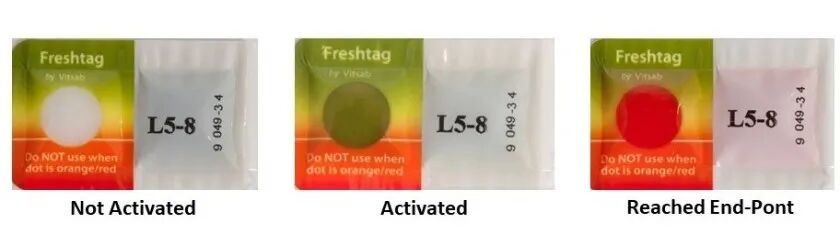
Behind this simple and intuitive color-changing effect lies a rigorous and complex scientific system. Each color change relies on precisely engineered biochemical reactions to reflect environmental conditions that can trigger food spoilage and promote microbial growth.
1. Enzyme-based TTI intelligent temperature-controlled tags
The core of the enzyme-based TTI intelligent temperature-controlled tag is the biochemical reaction system encapsulated inside the tag. The tag is divided into two independent chambers: one chamber stores enzymes, which are natural biocatalysts responsible for driving chemical reactions; the other chamber stores substrates, which react with enzymes after system activation. Once the tag is activated, enzymes and substrates initiate controlled reactions. As the reaction progresses, the pH inside the tag gradually changes, eventually resulting in visible color changes.
The principle of this reaction is similar to high-precision pH test paper: the higher the ambient temperature, the faster the reaction speed; the lower the temperature, the significantly slower the reaction speed. At the same time, the reaction has irreversible properties; once started, traces of temperature exposure are permanently preserved. Relying on this mechanism, the label can continuously accumulate and record the effects of all temperature fluctuations throughout the food supply chain. Brief warming only slightly accelerates the reaction process, while prolonged high temperatures greatly accelerate the reaction; Even if the product returns to the refrigerated environment, the reaction speed decreases, but it does not reverse recovery and fully records the cumulative heat exposure throughout storage and transportation. The entire biochemical system is specifically designed to respond to environmental conditions that alter food quality and affect microbial activity.
2. Bio-type TTI intelligent temperature control label
The bio-type TTI intelligent temperature control label records heat exposure cumulatively, rather than directly responding to a single abnormal signal. The enzymatic reaction continues, and the label ultimately presents the complete heat exposure process of the product. With proper calibration, compared to isolated single-point temperature measurements, these labels can more accurately reflect the spoilage risks caused by temperature changes to food.
02
Factors affecting TTI intelligent temperature control tags
To create a reliable TTI intelligent temperature-controlled label, simply achieving color change over time is far from enough. The reaction speed must be precisely calibrated to match the specific risks of biological spoilage of the food. Different foods have different spoilage modes and rates, such as the focus on microbial control for seafood, which is clearly different from fresh leafy greens and prepared meals. Each category of food has pathogens that need to be controlled, critical temperature thresholds, and expected shelf life.
Transportation conditions also affect calibration results, such as significant temperature variation curves for ocean shipments and meals delivered locally within hours. Packaging solutions such as ice packs, dry ice, and mechanical refrigeration also need to be considered during the design phase. Food safety management follows conservative principles, with models usually leaving a safety margin-that is, labels issue warnings in advance before simulated microbial risks rise to unacceptable levels. After a complete R&D calibration process, a small label becomes a dedicated monitoring tool, tailored to the biological characteristics of the food.
Of course, the implementation of reliable monitoring tools depends on the collaboration between the research community and regulatory agencies. Food safety regulatory authorities formulate protective standards, university research teams and industry experts provide research data, and the industry is continuously deepening its understanding of microbial activity patterns in different environments. Bridging interdisciplinary barriers requires companies to transform complex scientific research results into practical tools that can be directly implemented in the food industry.
03
Market trends for TTI intelligent temperature control tags
For the label and packaging industry, the popularization of TTI intelligent temperature-controlled labels has also expanded the value boundaries of labels: labels no longer serve only basic functions such as labeling, brand display, and carrying compliance information; intelligent labels can directly convey product status and support full-chain cold chain monitoring. This collaborative R&D model also allows TTI intelligent temperature-controlled labels to continuously evolve alongside microbiological research. As the academic community deepens understanding of pathogenic bacteria characteristics and shelf-life evolution patterns, new research findings can be continuously integrated into next-generation label designs.
As the global food supply chain continues to expand and distribution models become increasingly fragmented, the market's demand for clear and reliable cold chain information will keep rising. TTI intelligent temperature control label technology, which integrates scientific modeling with intuitive visual cues, will play an increasingly important role in the food industry, facilitating full-chain monitoring of perishable products, reducing food waste, and stabilizing end-user quality.