


Adhesive materials breaking during waste discharge? These reasons should not be ignored!
It is relatively common for the waste edge of self-adhesive materials to break during die-cutting. Once a break occurs, operators have to stop the machine to reorganize the waste edge, which in turn leads to reduced production efficiency and increased raw material waste. So, what are the causes of waste edge breakage in self-adhesive material die-cutting, and how should one deal with it?
01 Low tensile strength of the material itself causing waste edge breakage
Some materials, such as coated paper (also known as glossy coated paper), have shorter paper fibers and are relatively fragile. During the die-cutting waste removal process, the tensile strength of the waste edge is lower than the tension imposed by the equipment, making it easy to break.
In such cases, it is necessary to minimize the tension on the equipment's waste removal. If the tension has already been set to the minimum and the problem persists, then in the early stage of process design, the waste edge should be designed to be wider to ensure that frequent breakage of the waste edge does not occur during die-cutting.
02 Unreasonable process design / overly narrow waste edge causing breakage
Many labels used for variable information printing in the current market feature tearable score lines. Some self-adhesive label processing companies, constrained by their equipment, have to place the score lines and border cuts on the same die-cutting station. Additionally, considering cost and pricing factors, the waste edge is often designed very narrow, usually only 1mm wide. This die-cutting process requires extremely high material quality, and even minor issues can lead to waste edge breakage, affecting production efficiency.
The author suggests that, whenever possible, self-adhesive label processing companies should die-cut the tearable score lines separately from the label borders. This not only reduces the frequency of waste edge breakage but also significantly increases die-cutting speed. For companies without the conditions to do so, they can address the issue by adjusting the scale of the score lines or removing the portions of the score lines that extend beyond the label borders.
03 Raw material defects causing waste edge breakage
Defects in the raw material can easily lead to waste edge breakage. This problem is relatively easy to identify, so it will not be elaborated here. It should be noted that some self-adhesive materials have minor edge defects that are not easily visible and require careful observation to detect. When encountering such problems, simply remove the defective material before die-cutting.
04 Excessive adhesive fluidity or excessive coating causing waste edge breakage
The amount of adhesive coating on self-adhesive materials has a significant impact on their die-cutting performance. Generally, in die-cutting equipment, the self-adhesive material is not immediately disposed of after cutting but continues to move forward for a short distance before reaching the waste removal station. If the adhesive is coated too thickly, during the transfer from the die-cutting station to the waste removal station, the adhesive can flow back, causing the already cut material to stick together again, leading to breakage of the waste edge when pulled.
Generally, the coating amount for water-based acrylic adhesives should be between 18–22 grams per square meter, while hot-melt adhesives should be between 15–18 grams per square meter. Exceeding this range significantly increases the likelihood of waste edge breakage. Some adhesives, even when applied in small amounts, can also cause waste sticking due to their high fluidity.
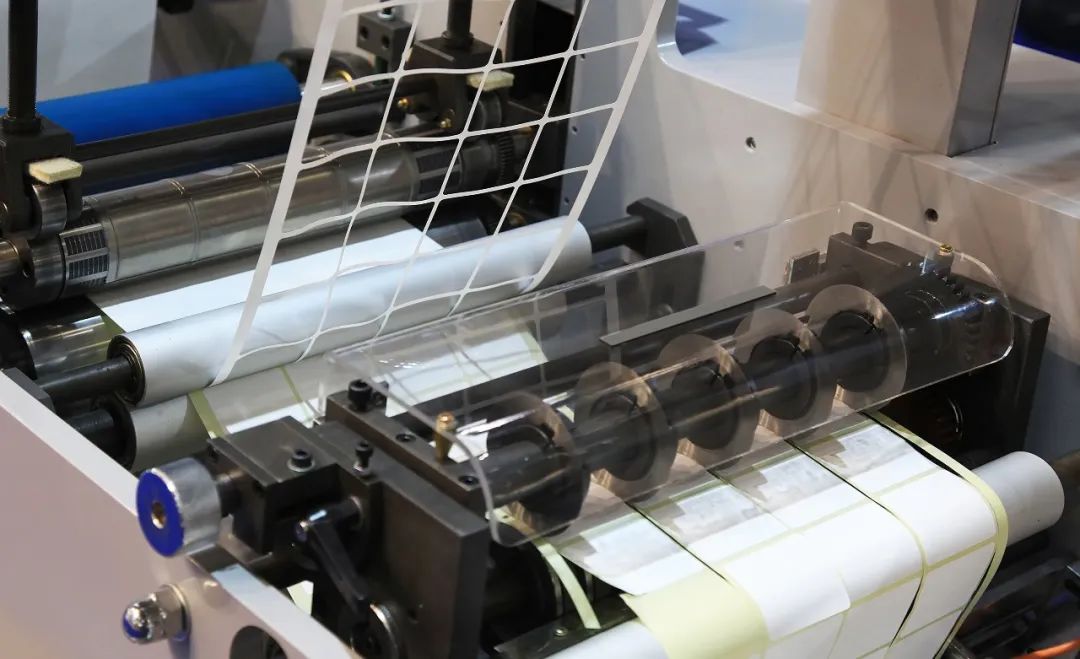
When encountering such problems, you can first observe whether there is a relatively severe stringing phenomenon between the waste edge and the label. If the stringing is relatively severe, it indicates that the adhesive amount is large or its fluidity is strong. This issue can be resolved by applying some silicone oil additive to the die or by heating with an electric heating rod. Silicone oil additive can effectively slow down the backflow of the adhesive, while heating the self-adhesive material can quickly soften the adhesive, thereby reducing the degree of stringing.
05 Die tool defects leading to waste edge breakage
Defective die tools can also easily cause waste edge breakage. For example, small notches on the blade edge can prevent the adhesive face material from being completely cut through. The uncut portion experiences more concentrated force compared to other parts, making it more prone to breakage. This phenomenon is relatively easy to determine because the location of the break is fixed. In such cases, the damaged die needs to be repaired before being used for die-cutting.