


Digital hot-stamping pattern missing or deformed?
In recent years, digital printing has been widely applied in the field of adhesive label printing. Many industry professionals believe that digital printing is the mainstream development trend for the future of adhesive label printing. Against this backdrop, digital finishing processes that complement digital printing have also gradually developed. In this article, the author will take a look at some of the currently popular digital finishing processes together with you.
01 ONE
Digital cold foil stamping
01
Introduction to digital cold foil stamping
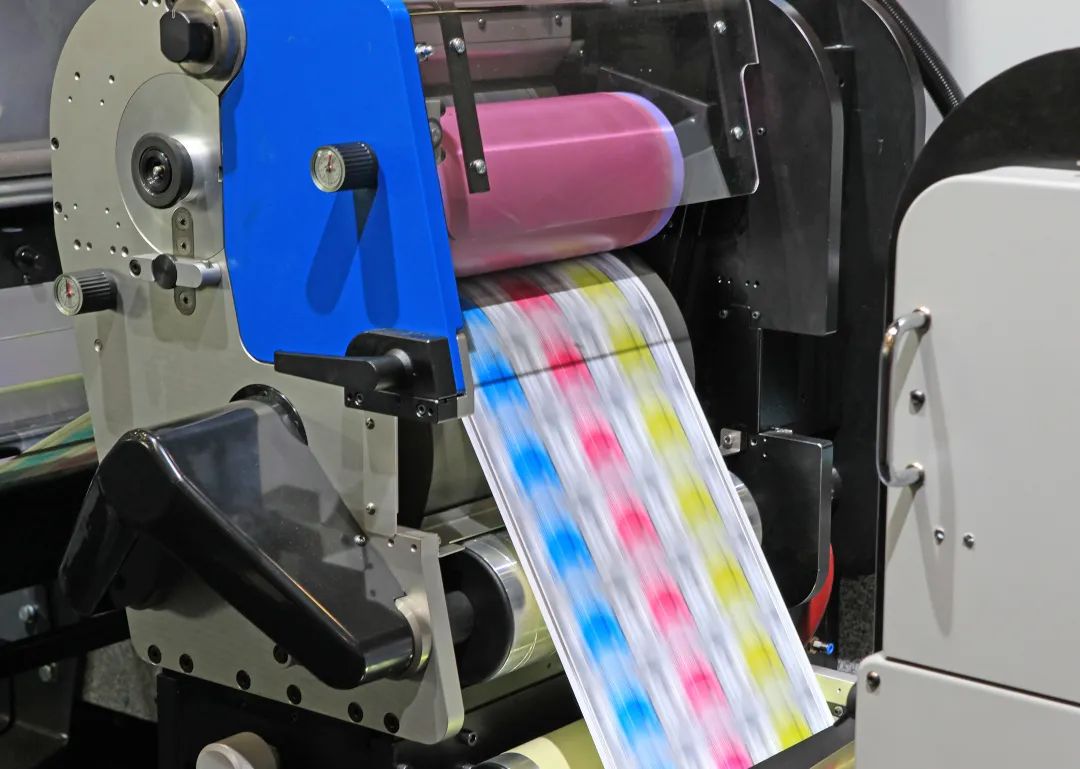
Digital cold foil stamping refers to a process where UV glue is sprayed onto the surface of a substrate with a print head and then laminated with a foil to form a final gilded pattern. One characteristic of this process is that it can foil variable information. Since the UV glue is applied by a print head controlled by a computer program, digital cold foil stamping can achieve patterns that change randomly like a digital printer, allowing every label to have a different foil pattern. In principle, any pattern within the accuracy range of the print head can be done. Another characteristic is that the foiled patterns have a raised effect, which can completely replace traditional embossing. This is because the amount of glue sprayed can be controlled by computer, and if enough glue is applied, the foiled pattern can be raised. The raised effect of cold foil patterns is clearly more three-dimensional and better than traditional embossing.
It is particularly worth noting that, unlike traditional cold foil stamping, digital cold foil stamping requires two UV curing steps. Because a relatively large amount of glue is sprayed by the print head, if it is not immediately cured, the glue will quickly level out on the substrate surface and affect the foiling result. Therefore, after spraying the glue, it must first pass under a low-power UV lamp for pre-curing, with the aim of maintaining the shape of the glue without fully curing it. After pre-curing, the glue is laminated with the foil and then undergoes a second UV curing, which fully hardens the glue and bonds it tightly with the foil, finally forming the foiled pattern.
Currently, digital cold foil stamping also has certain limitations. On the one hand, digital cold foil stamping equipment is relatively expensive, with market prices ranging from several hundred thousand to one million RMB. On the other hand, most digital cold foil stamping equipment currently operates at a speed of only 5~20m/min, making it difficult to achieve high-efficiency, large-scale production. Digital cold foil stamping equipment in its initial stage is more suitable for small-batch, personalized variable information orders.
02Analysis of common problems with digital cold hot stamping
(1) Small pictures and texts become thick and pasted
Digital cold stamping is to spray glue on the surface of the substrate through the nozzle, and the glue has a certain thickness, in this process the glue will flow and cause the pattern to be slightly deformed, and even cause the fine pattern to become thick and paste. Therefore, special attention needs to be paid to the design of the prepress, and the designed pattern must match the post-press process, otherwise it will be too late for problems to occur during production.
In addition, in the production process, pay attention to the control of equipment speed, match the inkjet amount of glue, and do not change the speed arbitrarily after finding the best speed match, so as not to cause the graphics to become thick and pasty due to the mismatch between the speed and the inkjet volume.
(2) The bronzing pattern is deformed
Sometimes the foil stamping pattern will be deformed, and there is often a problem with the pre-curing process. If the UV lamp is not powerful enough, the UV glue will continue to flow on the surface of the substrate, causing the pattern to be deformed. At this time, it is necessary to check the power of the pre-cured UV lamp to see whether the sprayed glue has achieved the appropriate effect after being pre-cured by the UV lamp, and if it does not achieve the effect, it is necessary to increase the power of the pre-cured UV lamp.
In addition, excessive inkjet volume is also easy to lead to pattern deformation, especially after a period of production to clean the printhead, the increase in ink volume of the cleaned printhead can easily lead to pattern deformation.
(3) The bronzing pattern is missing
The lack of hot stamping pattern is mainly due to the blockage problem of the nozzle, in principle, the nozzle should be cleaned after a period of shutdown and continuous production, and a special cleaning agent should be used to wipe the nozzle to avoid clogging. If the sprinkler is clogged, it is necessary to use a special cleaning agent to unclog the sprinkler in time.
02 TWO
Digital die-cutting
01
Introduction to digital die-cutting process
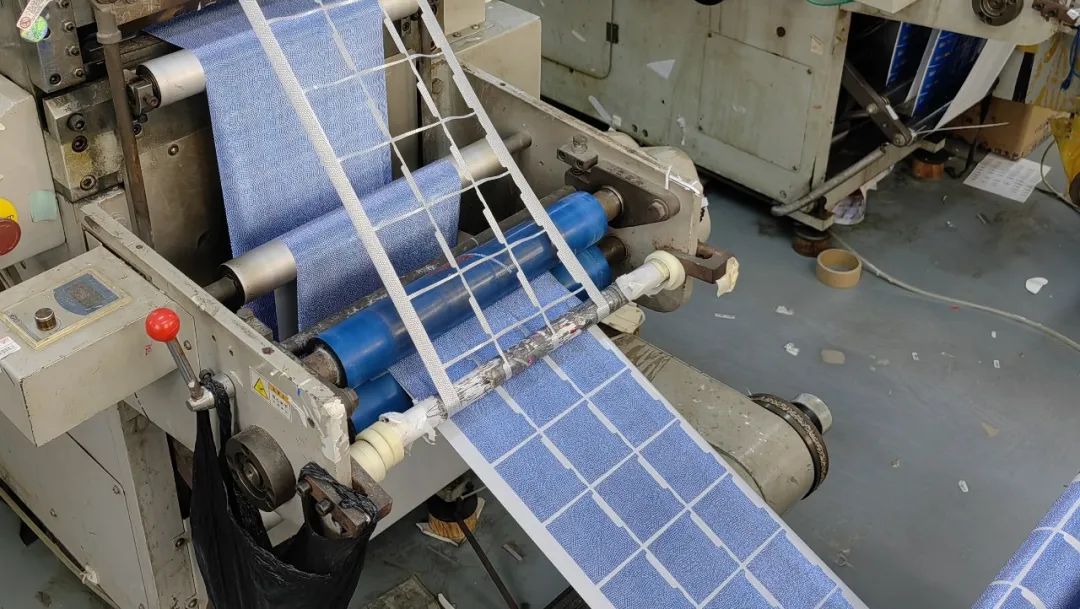
The so-called digital die-cutting refers to a die-cutting process in which the robotic arm uses a utility blade to cut out the required pattern on the substrate material through a computer program. The advantage of this die-cutting method is that it is highly variable, and it is a cold die-cutting method, which will not cause the edge of the material to shrink, blacken, yellow, etc., and is mostly used to produce some small batches of variable pattern orders with digital printing machines. Because the tools used are quite cheap, the die-cutting cost is low, and the market price of the equipment is between 10~250,000 yuan, and the equipment investment is small. For some small and medium-sized label businesses, this die-cutting equipment is a good choice.
At present, the running speed of digital die-cutting equipment is only 5~8m/min, which is more suitable for small batch orders, and cannot die-cut particularly complex patterns, and can only be used for proofing. It can be seen that digital die-cutting has certain limitations.
02
Analysis of common problems with digital die-cutting
(1) Die-cutting positioning is inaccurate
Digital die-cutting equipment determines the die-cutting position through the cursor positioning, if the cursor size is not right or the color contrast is not enough during printing, it will lead to the wrong recognition of the positioning electric eye of the die-cutting machine, resulting in inaccurate die-cutting positioning, so we must pay attention to the size of the cursor and the printing position when printing, generally speaking, the size of the cursor is best 5 mm X5mm, the minimum can not be less than 3 mm X3mm, and other patterns can not be printed around the cursor to ensure the accurate positioning of the die-cutting machine.
(2) Die-cutting continues
Digital die-cutting mainly uses utility blades to die-cut substrates, according to the hardness of the material, the service life of the utility knife is also different, if the blade is dull, it must be replaced in time, otherwise it is easy to have the problem of continuous die-cutting. Operators should observe whether the blade is dull and replace the blade in time to avoid continuous die-cutting.
03 THREE
Laser Die Cutting
01
Introduction to Laser Die Cutting Process
Laser die cutting is a method of die cutting where a computer program controls the laser head to burn the required pattern on the surface of the substrate material. Each label pattern cut with laser die cutting can vary, and it can cut particularly complex patterns, such as cutting out a world map. Additionally, laser die cutting equipment operates at a high speed, and if cutting regular patterns, the maximum speed can reach about 120m/min.
A major drawback of laser die cutting is that the laser generates heat. When cutting some relatively soft film materials, edges of the labels may shrink or turn yellow. Moreover, laser die cutting equipment is expensive, usually ranging from several hundred thousand to one million yuan, with some high-end equipment even more costly. Therefore, for some small to medium-sized label companies, investing in such equipment is quite challenging.
02
Analysis of Common Problems in Laser Die Cutting
(1) Cutting all the way through or not cutting through the material
The power of the laser head is set before die cutting. If the laser head power is too low, it will not cut through the material; if the power is too high, it may cut through or even sever the material. Therefore, it is necessary to determine the appropriate cutting power through testing before die cutting, and the cutting power must also match the speed. After the power is set, if the equipment speed increases, the power should be slightly adjusted according to the actual situation, generally slightly increased. Conversely, if the speed decreases, the power should be slightly reduced. The specific operation should be adjusted according to the actual situation, and if there is no effect, adjustment may not be necessary.
(2) Lines are too thick or too thin
If the lines of the graphic patterns being cut are too thick or too thin, it is often because the focus has not been adjusted properly. In this case, the machine needs to be stopped to adjust the focus so that the line thickness meets the design requirements before continuing die cutting.
(3) Distortion of the cut patterns
If the patterns cut by the laser are distorted, first check if there is a problem with the computer program. After ruling out program issues, if the problem remains, check the mechanical parts for any looseness or excessive vibration. Generally, the likelihood of a computer program issue is higher. You can restart the computer or check whether there are strong interference sources around the computer.