


The hot stamping effect is unsatisfactory because this was not done correctly.
As a surface finishing technique for printed materials, hot stamping plays a key role in high-end printing by highlighting the design and emphasizing the theme with its clear patterns, bright colors, wear resistance, heat resistance, and exquisite appearance. Electrolytic aluminum, as an indispensable component of the hot stamping process, often plays a decisive role in the process.
In the past, printing companies mostly analyzed the hot stamping process from aspects such as equipment, stamping temperature, stamping pressure, and the production of stamping files, and conducted refined control. In this article, the author will start with electrolytic aluminum to analyze its impact on the hot stamping process and control techniques.
Microscopic Structural Characteristics of Electrolytic Aluminum
First, by understanding the basic composition and structural characteristics of electrolytic aluminum (heat stamping), we can recognize electrolytic aluminum and the corresponding properties of its components from a microscopic perspective.
Ordinary electrolytic aluminum generally consists of five layers of different materials, while laser electrolytic aluminum generally consists of six layers (as shown in Figure 1).
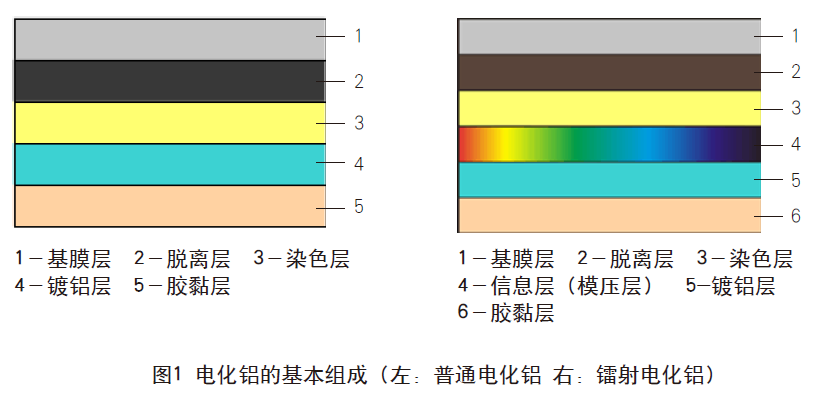
After understanding the basic composition of metallized aluminum, we will separately explain the characteristics of each layer of metallized aluminum and its impact on hot stamping effects.
1. Base Film Layer
The base film layer is generally a biaxially stretched polyester film (PET), mainly serving a supporting role, with all other layers adhering to it. The PET thickness varies from 12 to 25 μm. Common metallized aluminum base film is 16 μm thick, while the base film for positional stamping is 22 μm thick. In hot stamping, the base film layer functions as the carrier of the metallized aluminum information, which is the transparent film peeled off after stamping.
2. Release Layer
The release layer isolates the aluminum plating layer from the base film layer, making foil release easier during stamping. It generally uses resin wax, cellulose acetate, or silicone resin. Commonly, the looseness of metallized aluminum is related to this layer: for large-area solid stamping, a looser foil is used; for fine text or lines, a tighter foil is used. When used for stamping before printing, the surface tension must also be able to accommodate subsequent ink printing.
3. Color Layer
The main function of the color layer is to display the color of the metallized aluminum and, after stamping, to provide protection over the stamped pattern. The color layer is made of synthetic resin and pigments. Main resins include polyurethane, nitrocellulose, melamine formaldehyde resin, and modified rosin resin.
4. Information Layer
This layer primarily serves to carry embossed information and is now generally combined with the color layer. It is usually made from a blend of polyacrylic resin and polyurethane resin, forming a thermoplastic resin layer that requires high-temperature resistance, non-stick properties, a long thermoplastic range, and strong adhesion to the aluminum layer.
5. Aluminum Coating Layer
Its function is to provide a metallic luster backing for the color/embossed layers. By utilizing aluminum's high reflectivity and strong light-reflecting optical properties, the light reflected by the color layer appears as colorful light with a metallic sheen. Modern transparent metallized aluminum uses aluminum washing processes or directly deposits transparent media, such as zinc sulfide and silicon dioxide.
6. Adhesive Layer
During hot stamping, when the metallized aluminum contacts the substrate, the adhesive layer melts under heat and provides strong bonding. The adhesive mainly consists of hot-melt resins such as methyl methacrylate (or ethyl methacrylate, butyl methacrylate) copolymerized with acrylate. Depending on the material being stamped, other resins such as Cuba lacquer, shellac, or rosin may also be selected. Compatibility with the substrate must be considered to ensure firm adhesion. The hot-melt temperature should not be too high and must match the release layer resin.
Production Process of Metallized Aluminum
In addition to the composition affecting hot stamping performance, the production process and process control of metallized aluminum also influence hot stamping. The production process and technology of metallized aluminum are shown in Figures 2 and 3.
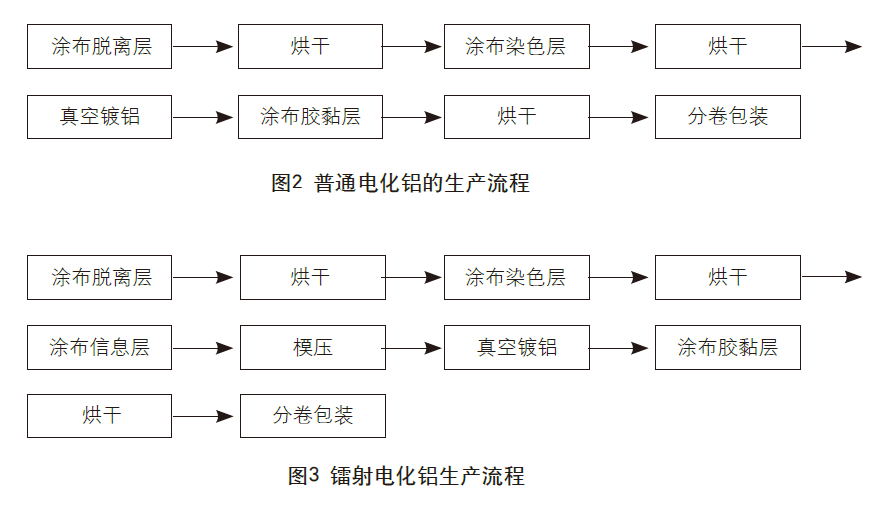
We take laser-electrolytic aluminum as an example to further illustrate the production process of electrolytic aluminum.
1. Coating
Coating is carried out using a coating machine. The typical coating thicknesses are roughly as follows: separation layer coating thickness 0.01–0.05 μm, dye layer coating thickness generally 1 μm, information layer coating thickness 2 μm, and adhesive layer coating thickness generally 1.5 μm.
2. Drying
After each layer is coated, it needs to be dried before proceeding to the next process. The drying temperature is adjusted according to the nature of the coating material and the equipment used.
3. Holographic Embossing
Using an embossing machine, the holographic metal mold is heated to a certain temperature and pressed onto the information layer with a certain pressure. This transfers the fine relief pattern from the holographic metal mold to the surface of the thermoplastic information layer. After cooling, setting, and separation, the surface of the information layer forms stripes identical to those on the holographic metal mold, which is the copied embossed hologram.
4. Aluminum Coating
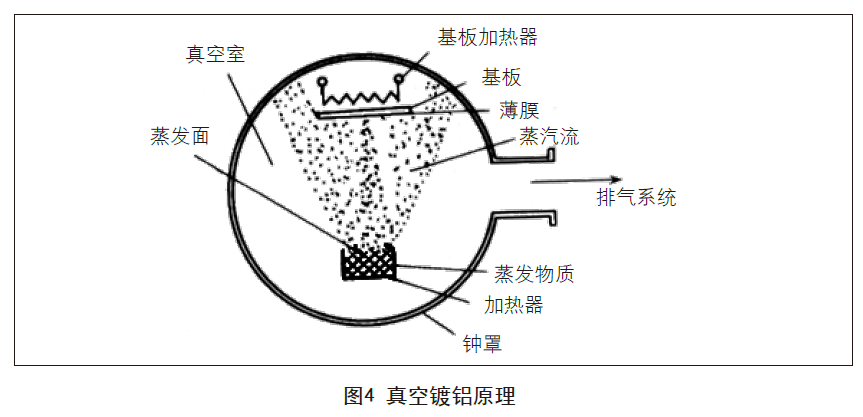
Vacuum aluminum coating is a process in which metal is vaporized by resistance, high-frequency, or electron beam heating under high vacuum conditions (above 4–10 MPa) and attaches to the surface of the film substrate to form a metal composite film. The metal materials used for coating can be gold, silver, copper, zinc, chromium, aluminum, etc., with aluminum being the most commonly used. The thickness of the vapor-deposited layer is about 0.02–0.05 μm. The principle is shown in Figure 4.
5. Acceptance
The quality of electrochemical aluminum shall be accepted in accordance with national standards or the standards of manufacturing units and user units. The industry standard "BB/T 0031-2006 Electrochemical Aluminum Hot Stamping Foil" includes the following requirements: brightness and appearance, firm adhesion, stable foil performance, easy separation of the isolation layer, clear and smooth graphics, qualified VOCs inspection, positioning of electrochemical aluminum in accordance with the requirements, etc.
6. Packaging
After inspection and slitting, the general electrochemical aluminum is packaged according to 120 meters/roll or 1200 meters/roll, and the electrochemical aluminum is packaged according to the actual required specifications. Of course, electrochemical aluminum also has a shelf life, and electrochemical aluminum stored for too long is prone to hot stamping failure in use.
The effect of electrochemical aluminum on the hot stamping process
Finally, we specifically analyze the influence of electrochemical aluminum production and compositional characteristics on the hot stamping process.
We know the three elements of hot stamping: temperature, pressure, and time. So what is the connection between electrochemical aluminum and these three elements in the hot stamping process?
1. Temperature
If the temperature is too low, the isolation layer and adhesive layer of electrochemical aluminum are not melted sufficiently, which will cause the hot stamping to fail or the hot stamping is not firm, resulting in incomplete imprints and flowering. The hot stamping temperature must not be lower than the temperature resistance range of electrochemical aluminum, and the lower limit of this range is to ensure the temperature at which the electrochemical aluminum adhesive layer melts.
If the temperature is too high, the adhesive layer will melt beyond the range, causing the electrochemical aluminum to adhere to the blot and produce a paste. It will also cause the synthetic resin and pigment in the electrochemical aluminum dyeing layer to oxidize and polymerize, resulting in the blistering or cloud-like appearance of electrochemical aluminum imprints. High temperature will also cause oxidation on the surface of the electrochemical aluminum aluminum plating layer and dyeing layer, causing the hot stamping product to lose its metallic luster and reduce its brightness.
2. Stress
The effect of applying pressure is to ensure that the electrochemical aluminum can adhere to the substrate and realize the shearing of the electrochemical aluminum hot stamping part. There are three forces in the hot stamping process: the peeling force generated by the electrochemical aluminum peeling from the base film layer, the adhesion force between the electrochemical aluminum and the substrate, and the adhesion force on the surface of the substrate (such as the printed ink layer and white paper).
If the hot stamping pressure is too low, the electroconcide aluminum will not be able to adhere to the substrate, and the edge of the hot stamping cannot be fully cut, resulting in the hot stamping failure or the imprint of the hot stamping part blooming.
If the hot stamping pressure is too high, the compression deformation of the liner and substrate will increase, which will produce pasting or the printing coarseness. If the pressure is too high, the plate will be crushed and even the equipment will be damaged.
3. Speed
The hot stamping speed determines the contact time between the electrochemical aluminum and the substrate, and the contact time is directly proportional to the hot stamping fastness under certain conditions. The hot stamping speed is slightly slower, which can make the electrochemical aluminum and the substrate adhere firmly, which is conducive to hot stamping. If the hot stamping speed is too fast, the adhesive layer and detachment layer of electrochemical aluminum have not melted or are not melted sufficiently in an instant, which will lead to hot stamping or bloating. The hot stamping speed must be compatible with the pressure and temperature, and there are disadvantages to being too fast or too slow.
Generally, in the case of low hot stamping temperature, fast hot stamping speed, thick ink layer on the surface of the printed product to be stamped, and low smoothness of the paper, the hot stamping pressure is increased, and vice versa, the hot stamping pressure is reduced.
To sum up, the composition and production process of electrochemical aluminum will have a huge impact on the hot stamping process. Printing companies will encounter many problems in the process of pursuing the exquisite and stable hot stamping effect, and most of the problems can be found from every detail of the process composition to find the best solution. This article briefly expounds the influence of electrochemical aluminum composition and production process on the hot stamping process, hoping to provide some ideas for everyone to solve the hot stamping problem.