


Adhesive materials breaking during waste discharge? These reasons should not be ignored!
It is a relatively common phenomenon for self-adhesive materials to break the waste edge during die-cutting. In the event of a break, operators have to stop the machine to rearrange the waste discharge section, which leads to reduced production efficiency and higher raw material loss rates. So what are the reasons for the fracture of the waste edge in die-cutting of self-adhesive materials, and how to deal with it?
01 The low tensile strength of the material itself leads to the fracture of the waste discharge edge
Some materials, such as glossy powder paper (also known as mirror coated paper), have short paper fibers and are relatively fragile, and the tensile strength of the waste discharge edge is lower than the waste discharge tension of the equipment during the die-cutting waste discharge process, so it is easy to break.
If such a situation occurs, it is necessary to minimize the exhaust tension of the equipment. If the waste discharge tension of the equipment has been adjusted to the lowest level or the problem cannot be solved, then it is necessary to design the waste discharge edge wider during the early process design to ensure that the waste discharge edge will not be frequently broken during the die-cutting process.
02 The process design is unreasonable/the waste discharge edge is too fine, resulting in the waste discharge edge breaking
At present, many labels for variable information printing on the market have easy-to-tear virtual knife lines, and some self-adhesive label processing enterprises have to put dotted line knives and border knives in the same die-cutting station due to equipment limitations. In addition, due to cost and price factors, the waste discharge edge is designed to be very thin, usually only 1mm wide. This die-cutting process places extremely high requirements on label materials, and the slightest carelessness can lead to the breakage of the waste discharge edge, thus affecting production efficiency.
The author suggests that self-adhesive label processing enterprises should try to separate the easy-to-tear knife line from the label frame for die-cutting when conditions permit, which can not only reduce the frequency of waste edge breakage, but also greatly improve the die-cutting speed. Enterprises without conditions can solve this problem by adjusting the proportion of the dotted knife and removing the dotted knife line beyond the label border.
03 The breakage of the raw material leads to the breakage of the waste discharge edge
The breakage of the self-adhesive material is also easy to lead to the fracture of the waste discharge edge, which is relatively easy to find, and this article will not go into details. It should be noted that some self-adhesive materials have relatively small edge gaps and are not easy to find, and need to be carefully observed to find them. In the event of such a problem, the defective material can be removed and then die-cut.
04 The adhesive fluidity is too strong or the amount of glue is too large, resulting in the fracture of the waste discharge edge
The amount of adhesive applied in self-adhesive materials has a great impact on the die-cutting performance of self-adhesive materials. Generally, on die-cutting equipment, the self-adhesive material is not immediately disposed of after die-cutting, but must continue to be transmitted forward for a certain distance, and the waste disposal station will begin to be disposed of. If the adhesive is applied too thickly, the adhesive will flow back during the transfer from the die-cutting station to the waste discharge station, causing the cut self-adhesive surface material to stick together, causing the waste discharge edge to break due to adhesion when pulled up.
Generally speaking, the coating amount of water-soluble acrylic adhesives should be between 18~22 g/square meter, while the coating amount of hot melt adhesives should be between 15~18 g/square meter. Even if the amount of coating is not large, some adhesives can easily lead to waste adhesion due to their strong fluidity.
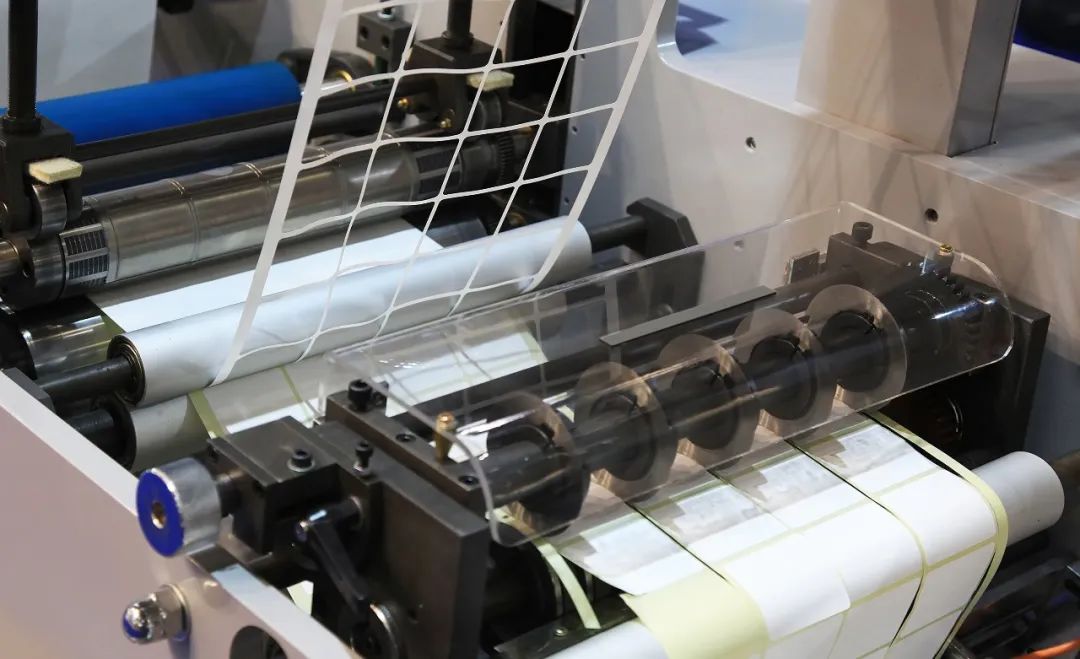
When encountering such problems, you can first observe whether there is a relatively severe stringing phenomenon between the waste edge and the label. If the stringing is relatively severe, it indicates that the adhesive amount is large or its fluidity is strong. This issue can be resolved by applying some silicone oil additive to the die or by heating with an electric heating rod. Silicone oil additive can effectively slow down the backflow of the adhesive, while heating the self-adhesive material can quickly soften the adhesive, thereby reducing the degree of stringing.
05 Die defects leading to waste edge breakage
Defective dies can also easily lead to waste edge breakage. For example, small notches on the edge of the blade can prevent the adhesive face material from being completely cut. The uncut part bears concentrated stress relative to other parts, making it prone to breakage. This phenomenon is relatively easy to identify since the breaking location is fixed. In such cases, the damaged die should be repaired first before being used for die-cutting.