


A big reveal of the latest prepress software tech-get the full scoop in one article!
Looking back at the development of flexographic plate-making technology in the past few years from the beginning of 2026, a clear trend emerges: even amid the continuous high-speed growth of digital printing, flexographic printing has not only avoided being replaced but has continued to expand globally, especially in the Asia-Pacific region. According to Smithers' research report, from 2024 to 2029, the compound annual growth rate of both the output value and production volume of flexo printing is expected to exceed 5%.
As flexographic printing penetrates further into the packaging field, the demands on plate-making systems are rising in parallel. This improvement doesn't stem from a breakthrough in a single technology but from the long-term cumulative requirements of the packaging printing supply chain regarding print quality, production efficiency, sustainability, and overall cost control. This driving force has persisted over the years and still dominates the direction of flexo technology development today.
In labels, flexible packaging, and some paper packaging sectors, flexographic printing remains one of the processes with the best overall performance. Compared to digital printing, flexo still holds irreplaceable advantages in mid-to-long run print consistency, system stability, material adaptability, and unit cost.
Against this backdrop, prepress software, screening algorithms, laser engraving equipment, exposure systems, and flexo plates form a highly coupled plate-making system. Any change in the performance of any link in the system will directly affect the final quality of flexo printing.
In the next few articles, I will review and analyze the development of key flexo plate-making technologies over recent years from this system perspective. In this article, let's first look at the development of prepress software in recent years.
Prepress Software
Technological Innovation Boosting Flexo's Overall Competitiveness
The traditional prepress workflow we are familiar with usually looks like this:
Designers create files using design software.
Prepress staff process the design files according to printing requirements, which involves a lot of work including image adjustment, color separation, trapping, checking, and finally saving as standardized PDFs for output. Many workflow software options can now greatly simplify this part.
Files are sent to the RIP (Raster Image Processor) for screening, color separation, and generation of 1-bit TIFFs.
The RIP output is the actual data used for plate-making/digital printing. This separation has several common issues, and they exist on nearly all RIPs:
· Inconsistent preview: what you see in design software may differ from the actual printed result after RIP (especially dot shape, overprints, transparency, trapping, ink limit, etc.). This is why, even 30 years after digital proofing appeared, many flexo printers still rely on traditional proofs made on press.
· Low efficiency: every change requires re-processing through RIP, back and forth.
· High communication costs: files are exchanged repeatedly between design, prepress, plate-making, and the print shop, which can easily cause errors.
At the same time, some highly integrated prepress workflow systems, although functionally complete, are often complex to set up, difficult to operate, and require repeated training to use proficiently. Software licensing costs are also relatively high. From the user perspective, these systems' design logic is more based on software engineering than the actual workflow of prepress staff or designers. With AI technology entering prepress rapidly, this "big and comprehensive, heavy on configuration" workflow model is facing potential challenges.
PACKZ Max - Challenging Traditional Prepress Workflows
In 2025, Belgium-based Hybrid released PACKZ Max, building on its well-known product PACKZ. The improvement is that the Harlequin RIP engine is directly embedded into PACKZ, which allows a "what-you-see-is-what-you-get" preview of the RIP result during the editing stage. The benefits of this software include:
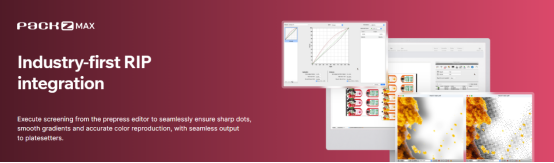 Figure 1 Packz Max - the first prepress editing tool in the printing industry to integrate RIP
Real-time RIP preview
a) During editing, you can directly see the effects of halftone effects, overprinting, and layered transparency, avoiding the situation where "the design looks right, but the actual RIP is wrong." It must be said, these kinds of problems still keep occurring nowadays.
b) Especially valuable for flexograph, gravure, and digital printing, because different dots, number of lines, and angles can vary greatly in effect.
Reduce rework and save time
a) In design, you can modify → instant preview → directly output 1-bit TIFF, without needing to export files and send them to another RIP system.
b) Saves on document travel and shortens delivery times.
Consistency and accuracy
a) The RIP engine and output are consistent to ensure "what you see is what you get."
b) Reduce customer complaints: Avoid situations where "documents are fine but printed out have issues."
Advanced network addition and network point control
a) Harlequin RIP offers more flexible network addition features, such as AM/FM hybrid dots and flexible pad point compensation checks, the latter of which is especially significant for plate makers.
b) Users can adjust these network addition parameters during the PDF editing phase, making it very intuitive.
Directly outputs 1-bit TIFF
a) For plate making (especially flexo, relief, etc.), the ultimate requirement is 1-bit TIFF.
b) PACKZ Max can directly generate these types of files, eliminating the need for additional RIP software.
For different user groups, this feature integration brings a lot of value, including:
Prepress Department: Editing and RIP are combined to reduce communication steps and improve efficiency.
Flexographic and gravure plate making companies: are especially sensitive to dot shape and dot compensation, allowing real-time visibility of differences to reduce trial and error costs.
Digital printing vendors: For variable data printing (VDP) files, which are large in volume, they can preview RIP effects on the editing side and avoid errors in mass operations.
Brand owners: Can more intuitively display the final effect, reducing the number of prototyping cycles.
The biggest advantage of PACKZ Max integrating RIP is "what you see is what you get, process compression, and reduced rework," allowing prepress editing, webbing, and output to be completed on one platform, greatly improving efficiency and consistency. This is a bold technical attempt we've seen in the past decade against traditional digital processes. However, it must also be noted that the challenges this product may face:
Performance pressure: RIP itself is highly computational, and when integrated into PDF editors, the requirements for workstation hardware (CPU, memory, hard drive) increase. However, considering recent improvements in computer performance, this may not be a serious issue.
Changing user habits: Teams used to handling prepress work separately need time to adapt to an "integrated" working style. Process changes may cause discomfort for some operators, requiring adjustments to their work scope, and possibly some temporary inconveniences.
Software licensing costs: Software licensing costs for RIP integration may be higher, so customers need to weigh the return and investment.
Bellissima-Advanced network addition technology brings a leap in quality
Notable developments in flexographic prepress technology in 2025 Also worth mentioning are the progress in Bellissima's dot technology, developed by Hamllroad. Its flagship product for flexographic printing, Bellissima DMS (Digitally Modulated Screening), was first released in 2017. This technology is positioned as a high-end dot solution for flexographic printing. Bellissima's dot is characterized by achieving a visual effect close to 350~450 LPI on flexographic plates, approaching or even surpassing the quality of gravure and offset printing. Users can clearly identify Bellissima dot prints without relying on any tools.
Bellissima's dot technology features digital modulation for each pixel and uses a random petal structure to interweave multiple dot channels, reducing the risk of noise and moiré patterns, while maximizing ink utilization and expanding the color gamut, supporting gradient control from 1.0% highlight point and dark dot up to 99.5%. It also reduces issues such as jitter, ink bar, and color shift during printing. The appearance of Bellissima DMS marks an important step forward for flexo printing in the field of high-quality packaging printing, attracting attention from many international printing factories and brands.
Early Bellissima dots focused on label and flexible packaging printing, and in the plate-making process, there were few plates that could perfectly reproduce Bellissima's dots. The main reason was that this dot technology required stable production of fine dots on the plate, with sharp and clear edges. Many flexibly printed plates struggled to handle this task, so users had limited options for flexible plate materials.
After several years of development, with the further popularization of flexible flat dot technology for flexible plates, the range of flexible plate materials available for Bellissima's dots has expanded, and more flexible plates can now use their dots, including domestic Huaguang's self-flat-top flexible plates. Hamillroad's Brazilian customers have successfully conducted extensive testing and success using Huaguang printing plates. In 2025, after extensive testing, Hamillroad officially launched a dot for preprinting corrugated cartons and also showcased corresponding products.
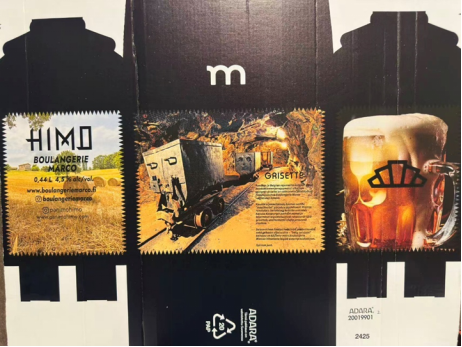
Figure 2: Pre-printed cardboard products from Bellissima Halftone
In addition, Bellissima Halftone has made special optimizations for the commonly used 7-color printing. Each color corresponds to a special dot, so there's no cross-dot issue at all, which provides strong technical support for the development of 7-color printing.

Figure 3 Bellissima Preprint Dots
SPIR@L and GridTune - Another Flexo Screening Technology
ECO3 originally came from the famous Agfa company. In August 2022, the Agfa Group announced the sale of its offset printing division to the European private equity firm AURELIUS. In April 2023, this division officially became independent and was renamed ECO3 (headquartered in Mortsel, Belgium). After that, ECO3 officially entered the flexographic plate field and quickly launched flexo plate solutions. At the 2024 Drupa exhibition, ECO3 unveiled a water-wash flexo plate solution based on offset technology. The system incorporates SPIR@L spiral screening technology and GridTune micro-dot screening software for process control. The former improves tonal reproduction and gradient smoothness with a more efficient dot structure, while the latter enhances solid ink density through microstructure optimization. ECO3 stated that using its GridTune technology, for printing with film solvent inks, ink density can be raised to ESKO's P dot level.
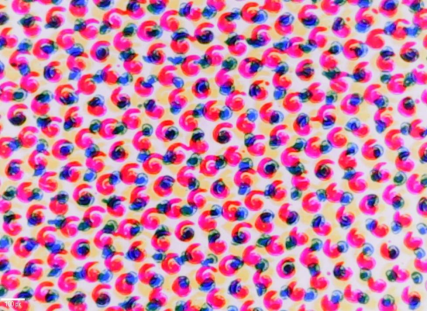
Figure 4 ECO3 Company SPIR@L Screen Dots
Quartz SQ/VQ - Differentiated Screening Strategies Under the Same Imaging System
When ESKO launched its Quartz laser imaging technology, it also introduced two dot solutions based on this imaging system, named Quartz VQ and Quartz SQ. The two aren't just about different parameters; they're designed for different printing scenarios.
Looking at the dot structure, Quartz VQ is an improved version of traditional amplitude-modulated dots, focusing on the overall balance between solid areas and highlights. It emphasizes stability in large solid areas and gradient regions, aiming to reduce noise and unevenness while keeping enough detail. So, Quartz VQ is more suitable for wide-format printing and applications where overall image uniformity is important, making it very practical in real production.
On the other hand, Quartz SQ is a frequency-modulated dot, geared more toward high-precision detail reproduction. According to ESKO's public technical info, Quartz SQ focuses on crisp, clear rendering of fine and complex graphics, with stronger resolution in high-frequency detail areas. This makes it more appealing for high-resolution, highly detailed printing, particularly useful for label printing users.
It's worth noting that these distinctions are mainly based on ESKO's published data and technical samples. Since there are currently very few Quartz laser imaging devices installed domestically (only one unit), the performance of these dots under different substrates, processes, and real production conditions still needs to be verified with more printing samples and batch-use data.
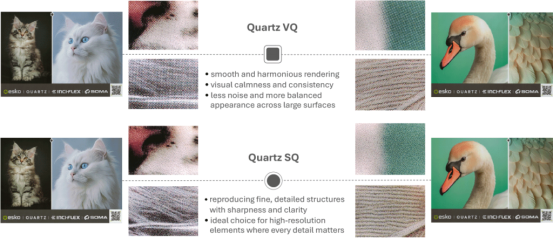
Figure 5 Comparison between Quartz VQ and Quartz SQ
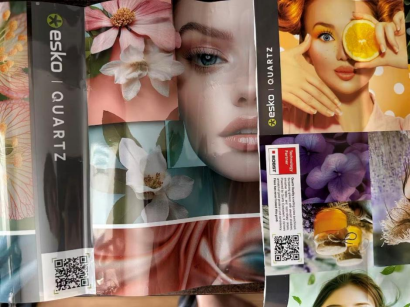
Figure 6 Quartz Sample
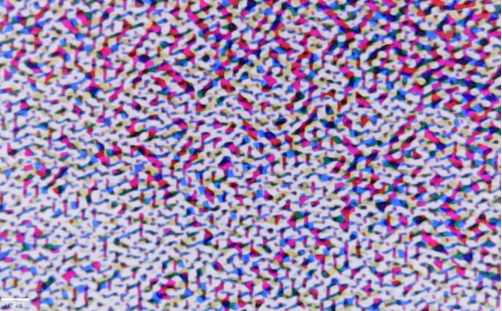
Figure 7 Effect of Quartz SQ dots under a magnifying glass