


Unlock the Tips for Using the Founder Changliu System
Currently, digitalization, automation, and intelligent technology have become the direction and consensus for the development of the printing industry. As the mainstream choice for domestic party newspaper printing plants, the Founder Changliu System acts as an accelerator for intelligent production, with a market share as high as 90%. However, how can this powerful system truly run "smoothly" and achieve fully automated imposition? This article will share some practical experiences and give you an inside look.
Page Layout File Naming Rules
The core of the Founder Changliu System (Figure 1) lies in using scripts to achieve fully automated imposition, and the key to all of this is hidden in the rules for naming page layout files. Taking the Hubei Daily as an example, its page layout file naming rules are as follows: 20250112xxhbrba0001c.pdf. The first eight digits represent the year, month, and day; "xxhbrb" represents the newspaper name; "a" represents the fold name; "0001" is the page code, and for common pages, such as pages 6–7, the page code would be "0607"; "c" indicates color. Only by thoroughly analyzing these elements can we accurately write the script.Figure 1 Founder Changliu System Client Interface
Custom Scripts
In the script editing interface, click the " " icon to add a script, and the name can be customized. After entering the editing interface, as shown in Figure 2, the first column is "Analysis Edition Name." An edition name refers to the name we set when creating a plan, as shown in Figure 3. It is usually represented by uppercase or lowercase letters, but can also be named in Chinese, such as "Edition 1" or "Special Issue." For newspapers with simple operations, the "Analysis Edition Name" can be omitted without affecting automatic pagination; for newspapers with complex operations, such as Hubei Daily, Edition A is used regularly, while Editions B and T may be used during special periods. Therefore, the "Analysis Edition Name" is crucial.
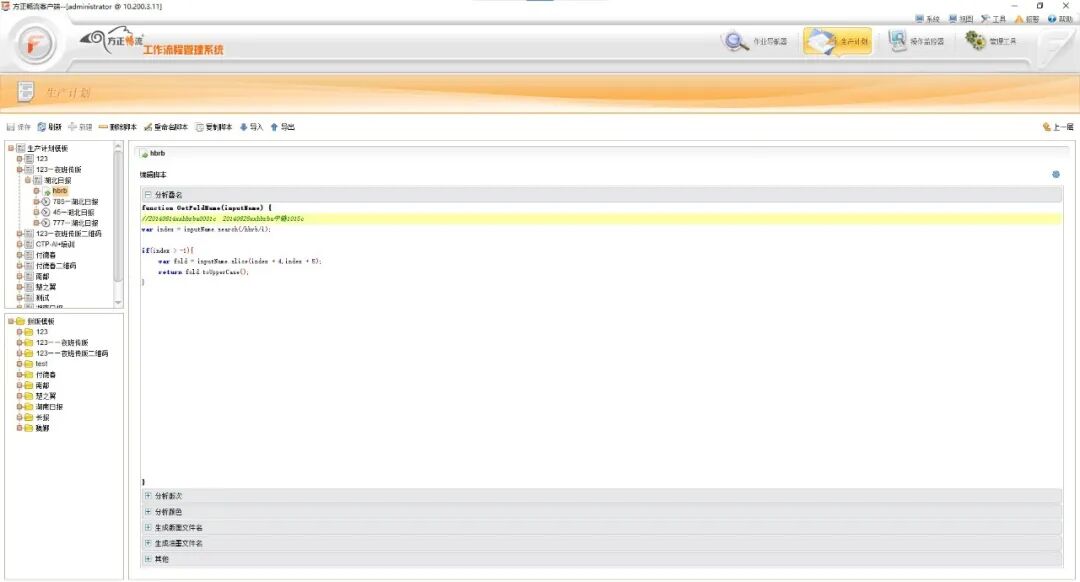
Figure 2 Script Editing Interface
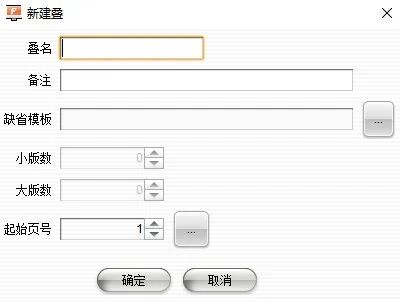 Figure 3 New Fold Interface
The script of the Founder ChanFlow system supports the JavaScript language. In the function GetFoldName(inputName), inputName represents the string parameter being passed in, which is the layout file's filename (excluding the .pdf extension). Here is a simple code example:
Var index = inputName.search(hbrb/i);
if(index > -1){var fold = inputName.slice(index + 4, index + 5); return fold.toUpperCase();}
The first line of code uses inputName.search(hbrb/i) to search for the characteristic string "hbrb" in the filename and assigns the result to the variable index. In the regular expression /hbrb/i, the i indicates case-insensitive matching, ensuring that the code works correctly whether the filename is in uppercase, lowercase, or a mix of both.
The second line checks whether the characteristic string was found. If it is found, index will be greater than -1.
The third line extracts the fold name using the slice method. The first parameter of slice specifies the starting position, and the second parameter specifies the end position. Here, it starts from the 4th character after "hbrb" and extracts up to the 5th character (i.e., the fold name).
The fourth line converts the fold name to uppercase and returns it to the system.
Next is "Analyzing the Version," which is the most critical part of the script writing. The code is as follows:
var index = inputName.search(/hbrb/i);
if(index > -1){
var page = inputName.slice(index + 7,index +9)
return parseInt(page,10);}
parseInt
The function converts the extracted version string into a number and returns it to the system.
With the above code, we can not only achieve automatic page imposition, but also, when the layout personnel select the wrong file, automatically place the file into the unrecognized area, preventing errors in automatic imposition and thus improving the production efficiency of CTP.
In short, after mastering these techniques, by applying analogical reasoning, one can complete 90% of intelligent newspaper imposition tasks. If we encounter more difficult coding problems, we can consult AI large models, such as Kimi or Tongyi. With the empowerment of AI large models, even programming enthusiasts can reach the level of professional programmers. In the future intelligent society, using AI large models to solve problems will be a basic skill essential for company elites.