


The market will continue to grow over the next five years! What is the current state of the electrostatic imaging printing market?
Electrostatic imaging printing (EP) technology was invented by Chester Carlson in 1938. Xerox introduced the first electrophotodry plain paper copier in 1959. The introduction of Xerox's DocuTech digital printing system in 1990, followed by the introduction of the Indigo Eprint and Xeikon continuous paper presses in 1993, drove the development of production electrostatic imaging printing and led the transformation of the printing industry from traditional offset, flexo, and gravure to digital printing over the past three decades. With inkjet printing and even digital offset printing and flexo printing gradually seizing market share, the development speed of electrostatic imaging printing technology seems to have slowed down, but there is still room for growth and innovation in this field, so electrostatic imaging printing technology may be with us for a long time.
Market growth trend
For decades, the field of electrostatic imaging printing has been receiving investments and innovations. In fact, even in the face of competition from inkjet printing and traditional printing, electrostatic imaging printing technology can still maintain growth, thanks to a number of key factors: first, as a mature technology, its problems in media adaptation and post-processing have been gradually solved; Second, the initial cost of equipment is lower than that of most other technologies, lowering the entry threshold for the industry. While there are limitations in terms of speed and paper width, these limitations are being mitigated by supporting long web formats and optimizing imaging engine performance, among other things.
Looking ahead, the global electrostatic imaging printing market is expected to grow at a compound annual growth rate (CAGR) of 1.9% between 2025 and 2035, implying an expansion of approximately 21% within a decade. Although this indicates that the market is growing relatively slowly and has entered a mature stage, the global electrostatic imaging printing market size is still expected to reach approximately $11.24 billion by 2034. The market share erosion of electrostatic imaging printing is more obvious in large-volume applications such as direct mail and transaction documents.
Today, the core application areas of electrostatic imaging printing are concentrated in the following industries:
(1) Enterprise and office printing: transaction documents, business communication documents, manuals and reports covering enterprise office, banking, insurance, government and other fields. With fast turnaround, reliability, and cost-effectiveness for monochrome and color documents, electrostatic imaging printing continues to dominate in this field.
(2) Commercial printing and professional printing shops: widely used in brochures, catalogs, bookmarks, banners, commercial brochures and other high-quality printing businesses that require high clarity and durability;
(3) Packaging and label printing: The usage rate is increasing in product packaging applications such as labels, cartons, and folding boxes, especially suitable for scenarios that need to meet regulatory compliance, durability, and fast delivery requirements.
(4) Education and medical field: suitable for economical printing needs of textbooks, forms, legal documents and medical records.
Technological innovation and breakthrough development
Electrostatic imaging presses are mainly divided into liquid toner type (represented by HP Indigo) and dry toner type (used by most other manufacturers), while they are divided into sheetfed and web printers according to the paper supply method - web printers are more productive but slightly less flexible in application.
HP Indigo occupies an important position in the electrostatic imaging printing market: since its launch in 1993, it has installed more than 10,300 units worldwide, covering 4,500 customers in 120 countries, including about 2,000 presses for labels and packaging. According to IDC 2024 data, HP Indigo accounts for 51% of the digital printing machine market, and its B2 format printing machines (including HP Indigo 10000 for commercial printing, HP Indigo 20000 for web and HP Indigo 30000 for packaging) have been installed. In the field of labels, relying on the 6K series and the pioneering V12 model, its printing machine installation exceeds 2,500 units, with a market share of 50%; In the field of flexible packaging, with more than 400 installations, it has become a market-proven mainstream solution.
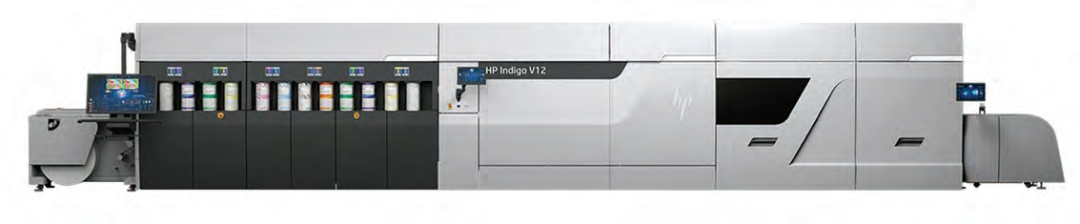 HP Indigo V12Digital Printing Presses
01Speed Improvement
Although most electrophotographic press manufacturers have also launched production-level inkjet printing products, they are all working to enhance the productivity of electrophotographic presses by increasing speed and optimizing the intelligence of new integrated operating systems-this is because, as an important component of the printing technology portfolio, performance improvements in electrophotographic printing are in high demand.
Recently, several new electrophotographic presses have debuted with significant performance upgrades. For example, HP's Indigo 5 Series presses offer a 30% speed increase compared to the 4 Series; its V12 label press uses the new 6 Series inline printing architecture (rather than the traditional shared impression cylinder printing structure), with a rated speed of up to 120 meters per minute and support for up to 12 ink stations.
The Seikoh SX3000 roll-fed paper press, redesigned on a new platform, achieves a 30% performance improvement over its predecessor. The new SIRIUS platform features hardware upgrades and design optimizations in areas such as substrate pre-treatment, print units, fusing, and cooling systems, with speeds reaching up to 30 meters per minute (equivalent to 404 pages of A4 per minute).
In the roll-fed label printing field, the Konica Minolta AccurioLabel 400 is one of the fastest electrophotographic label presses, with a maximum speed of 40 meters per minute.
Not long ago, most full-color sheet-fed electrophotographic presses reached maximum speeds of 80–100 pages per minute; for duplex-capable devices, speed was usually halved. Today, we see significant performance improvements for these machines. For instance, Canon's imagePRESS V1350 reaches up to 135 pages per minute, Canon's varioPRINT 6000 (Titan) monochrome press reaches up to 320 pages per minute; Konica Minolta AccurioPress C14000 (e) series reaches 140 pages per minute; Ricoh Pro C9500 (also sold as Heidelberg Versafire EP) reaches up to 135 pages per minute; Fujifilm's Commercial Innovation IridesseTM (Revoria PressTM PC1120) reaches up to 120 pages per minute, with the IGEN 5/150 model reaching up to 150 pages per minute.
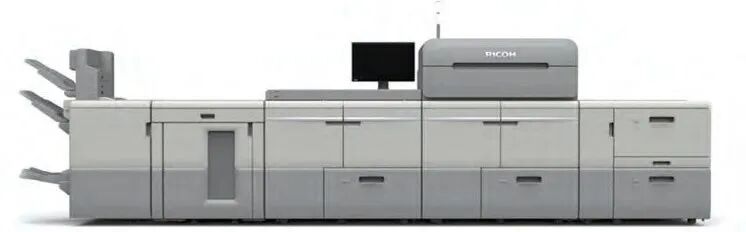 Ricoh Pro C9500
02
Comprehensive Performance Optimization
In addition to speed, enhancing the overall equipment effectiveness (OEE) of the device has become a key focus of technological development, with core optimization directions including:
(1) Media Adaptation and Stable Paper Feeding: Whether conveying lightweight coated paper or heavy packaging media, envelopes, or magnetic materials (each material has its own unique properties), they all affect the paper feeding and imaging process. Duplex printing makes potential issues even more complex, especially as high-end single-sheet electrostatic imaging presses increasingly support 24-inch and longer sheets.
For example, Canon's POD DECK F1 uses a fully pneumatic paper feeding system with excellent separation performance, capable of handling a wide range of media from lightweight paper to heavy packaging materials, envelopes, and magnets. Even in the event of double feeding, it can automatically divert problematic media to a waste tray, allowing continuous printing without operator intervention.
(2) Precise Registration Control: The Konica Minolta AccurioPress C14000 is equipped with the IQ-501 Intelligent Quality Optimizer, which can automatically adjust front-to-back registration before printing, ensuring that images are accurately aligned on both sides of the paper and minimizing registration deviations and manual intervention. Ricoh has also introduced a new paper transfer unit specifically designed to improve duplex registration, further enhancing alignment precision.
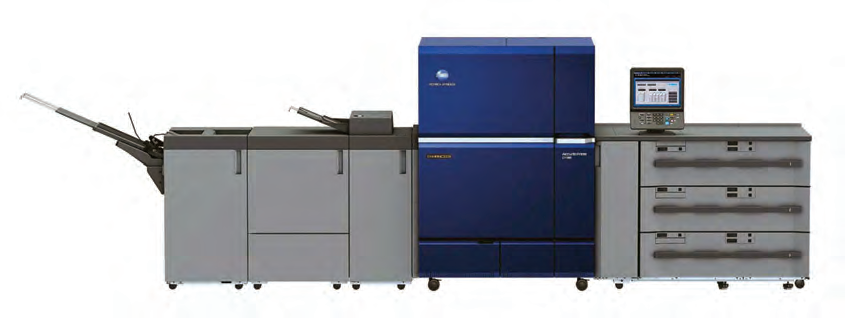 Konica Minolta AccurioPress C14000
(3) Color Stability Assurance: Nowadays, most electrophotographic printing machines achieve precise color control through built-in online spectrophotometers. For example, the Ricoh C9500 is equipped with an automatic color diagnosis unit that monitors print output in real time and automatically adjusts color deviations. Canon's imagePRESS V1000 comes with a built-in densitometer that automatically measures 20 color patches (20%, 40%, 60%, 80%, and 100% density for each primary color) every minute (or every 102 pages); the imagePRESS V1350 performs this measurement between each image, and if colors are detected outside the tolerance range, the printer automatically makes real-time adjustments. Additionally, this series supports media calibration, creating custom media profiles, calibration according to G7 standards, and even verification checks for multiple color standards. Ricoh's Image Quality Monitor (IQM) offers seven selectable inspection levels, automatically comparing data processed by the Raster Image Processor (RIP) with scanned printed samples to identify and correct issues. Users can also adjust gloss according to media and print requirements, and perform fully automated color registration to maintain image alignment and clarity. The Konica Minolta AccurioPress C14000 ensures long-run print color consistency by continuously measuring and correcting printed colors, automatically detecting color deviations, banding, and other issues.
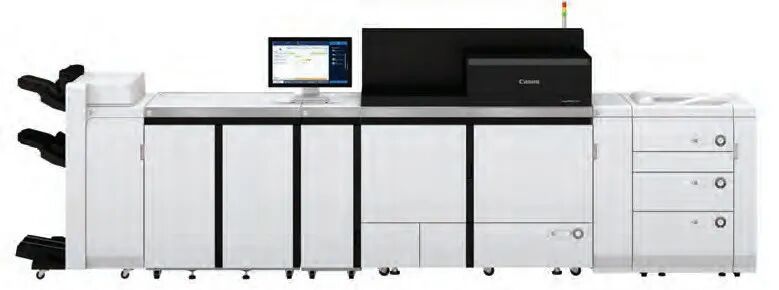 Canon imagePRESS V1350
03
Expanded Color Capabilities
Today, printing has become a truly value-added communication method, and with the help of new digital tools, value-added printing is gradually becoming mainstream. Fujifilm's commercial innovation Iridesse™ first adopted CMYK EA-Eco toners combined with Vertical-Cavity Surface-Emitting Laser (VCSEL) imaging technology and is equipped with two additional stations for specialty effects processing. These two additional toner stations can use a variety of specialty toners, including clear, pink, gold, silver, white, as well as high-gloss gold and silver metallic toners, to achieve three-dimensional effects through multiple printing passes. Fujifilm's commercial innovations also support expanded color capabilities in four new entry- to mid-level color production printers in the Revoria series (including the Revoria Press EC2100, EC2100S, SC285, and SC285S). These printers also use CMYK EA-Eco toners and VCSEL imaging technology, with resolutions up to 2400 dpi. It is expected that in the near future, other electrophotographic printing manufacturers will also launch more devices supporting expanded color capabilities.
Printing technology is by no means stagnant. The digitization and automation of offset printing have further enhanced its competitiveness compared to digital printing technologies; production inkjet technology continues to advance in both quality and productivity, with several new products appearing on the market. However, in this context, electrophotographic printing technology is also experiencing a new period of technological growth, and therefore will maintain strong market vitality for a long time to come.