


The couple from the printing industry on the Hurun list is worth 60 billion, surpassing Liu Qiangdong, as their printing company taps into the new market of emotional consumption!
Recently, the '2025 Hurun Rich List' was officially released, and the entry of an industry 'dark horse' has garnered widespread attention. Li Qibin and Qi Yan, a couple from Zhejiang Kayou Technology Co., Ltd. (hereinafter referred to as Kayou), made their first appearance on the list with a net worth of 60 billion yuan, even surpassing JD.com founder Liu Qiangdong. This news has lifted the spirits of the entire printing industry.
While most printing companies are still competing in the red ocean of traditional business, this company, founded in 2019, has leveraged small cards to achieve a leap from traditional manufacturing to an emotional consumer brand in just six years. This article will analyze the 'Kayou Miracle' from three perspectives: track selection, product logic, and business positioning, and reflect on its practical implications for the printing industry.
The Three Keys to the 'Kayou Miracle'
1. Track Selection: Exit the Red Ocean, Capture the Emotional Value Upswing
The rise of Kayou fundamentally capitalized on an underestimated trend: print products are evolving from 'functional products' to 'carriers of emotional value.' While many traditional printing companies are still focusing on cost-saving, equipment upgrades, and software development, Kayou was the first to discern a gap in youth social interactions - that cards are not merely paper items but 'symbols of identity,' 'social currency,' and 'vehicles of emotion.'
Kayou's globally popular IP cards, including Ultraman, Naruto, Harry Potter, My Little Pony, and Nezha Conquers the Dragon, have become 'hard currency' on campuses: behind the trading and collecting lies a sense of belonging, identity recognition, and social circle building. The core of this kind of consumption behavior is no longer the product itself, but 'emotional release and social expression.'
In an era where emotional consumption has become the mainstream trend, Kayou has targeted the most growth-oriented age group - Gen Z and the post-2010 generation. This group is more willing to pay for emotional experiences and is more easily attracted to IP cards that 'naturally carry storytelling.' In essence, what Kayou has tapped into is not the cards themselves, but the 'right of adolescents to express themselves.'
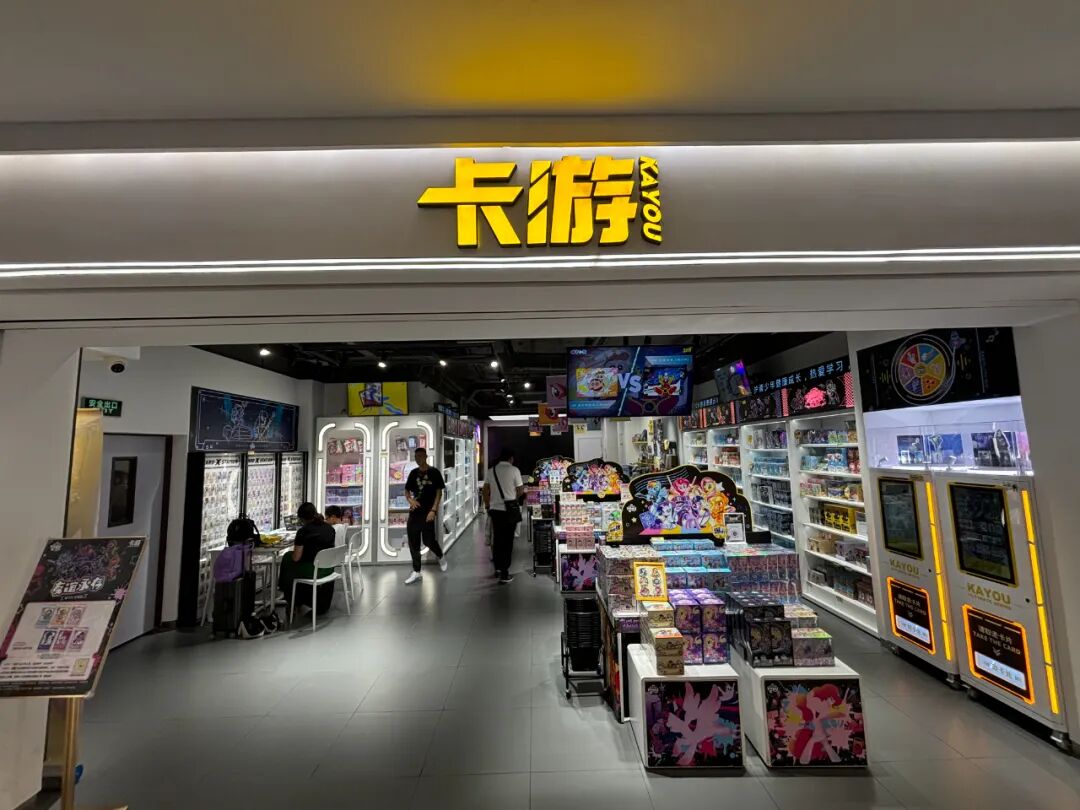 Offline Card Game Stores
2. Product Logic: The Value Leap from 'Printed Material' to 'Emotional Symbol'
If the choice of market segment determines the starting point, then the product system of Card Game determines whether it can become a true consumer brand.
First is gameplay. Card Game transforms cards from static collectibles into dynamic 'game tools.' It goes beyond 'printed IP' and has established a complete TCG system (such as 'Hero Showdown'), allowing cards to be both collectible and playable in battles.
Second is the uncertainty mechanism. By combining a rarity system (R/SR/SSR/UR/SP) with a blind box mechanism, Card Game creates a clear value hierarchy, so that consumers are buying not just the card itself, but the 'anticipation' of drawing rare cards and the excitement that comes from the unknown.
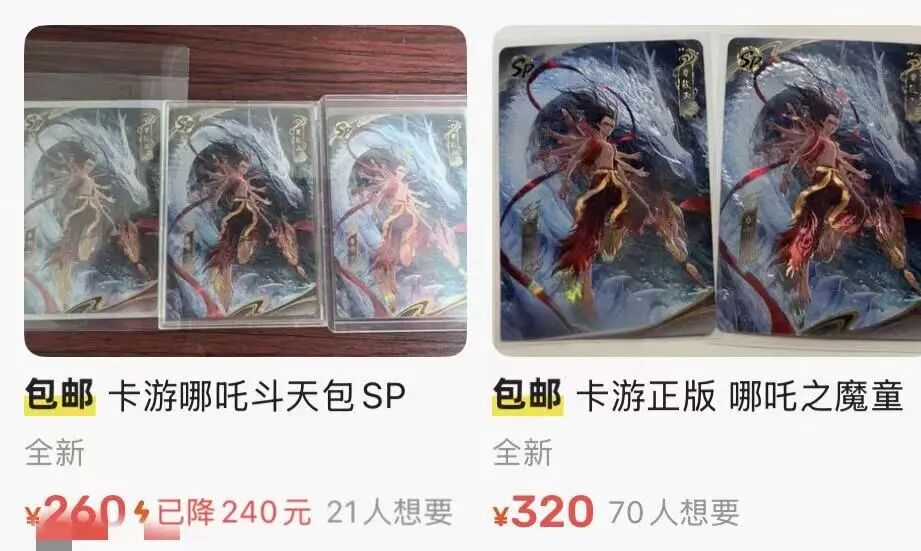
For example, the 'SP' cards in the Nezha: Demon Child Causes Havoc Series can sell for tens of times their original price on the secondary market, essentially monetizing the emotional value.
The third is process improvement. Make "paper pieces" more advanced. Kayou's "8 superimposed printing technologies" include hot stamping, flash film, reverse lithography, cold stamping, color, 3D grating, silk screen hot stamping and anti-counterfeiting processes. "Showmanship" is not to show the craftsmanship itself, but to strengthen the ritual and collection value of the product, so that the cards have a more advanced sense in terms of texture, light effect and space level.
3. Business positioning: from processing and manufacturing to "IP + content services"
In the traditional printing industry, "scale, capacity, equipment" is a keyword that is often mentioned. But card games have chosen another path - no longer taking manufacturing capabilities as their core competitiveness, but focusing their strategies on content, IP and brand operation.
The positioning of card games is shifting from "processing manufacturers" to "content and experience providers". upstream, it can obtain IP authorization and develop original IP; downstream, it has established a brand, marketing, operation and customer operation system, so that the card is not only a product, but also the starting point for the continuous extension of content. This "two-end force" path allows card games to find new growth space outside the highly homogeneous manufacturing field.
Looking at the industry from card games: how printing companies nugget emotional consumption
The success of card games shows that the growth of the printing industry is extending to higher-value areas. For printing companies, although the experience and path of card games cannot be completely replicated, they provide transformation ideas that can be used as a reference - to see the track clearly, deepen products, and clarify positioning.
1. See the direction of the track clearly: tap the market potential of emotional consumption
The emotional economy is becoming a consumer force that cannot be ignored. According to iiMedia Consulting, the market size of China's emotional economy will reach 2.3 trillion yuan in 2024 and is expected to grow further and exceed 4.5 trillion yuan in 2029. Card games are cut into ACGN (animation, comics, games, novels) that young people love. This track is one of the fast-growing sectors.
In addition to the young people's market, there are also a large number of underestimated scenarios in emotional consumption: parent-child interaction, pet emotional companionship, holiday rituals, graduation commemoration, etc., all of which contain the possibility of productizing emotions, and printing companies happen to have natural advantages to turn "emotions" into visible and tangible products.
For example, Shenzhen Baixinglong Creative Packaging Co., Ltd. joined hands with "Goodbye Ex" to launch emotion-themed packaging, establish consumer emotional connection through visual narrative, and realize the upgrade of "packaging is emotional media".
2. Reconstruct product logic: build a user-centered product system
The product logic of card games shows that the key to increasing the value of printed products is not the accumulation of investment, but whether to build a complete product experience around user needs.
On the one hand, it is necessary to do content design from the user's perspective. For example, Shanxi Gene Packaging and Printing Technology Co., Ltd. relies on local cultural resources such as Wutai Mountain and Yungang Grottoes to launch the "Shanxi Ancient Building Cultural Exploration Passport", which allows tourists to collect exclusive stamps of various ancient architectural attractions while visiting Shanxi. It has successfully upgraded traditional printed materials into cultural and creative products with both collection and interactive functions.
On the other hand, technology is used to enhance the function and trust value of products. AR and AI technologies can give packaging interactive narrative capabilities; Anti-counterfeiting technology can ensure the scarcity and authenticity of collectible products, which are technical support to enhance emotional value.
3. Clear business positioning: from "manufacturing execution" to "content service"
The enlightenment of card games is that enterprises should gradually shift from "processing manufacturers" to "content services and brand operators", and extend their value focus to the "R&D side" and "brand side".
This means that printing companies must not only do a good job in production, but also intervene in content planning and IP construction forward, and open up brand operation and user connection backwards. Whether it is developing original IP, cooperating with mature IP, or providing complete "packaging solutions" for brand customers, the essence is to reconstruct the value chain of printed products with content and services.
It should be noted that the transformation process also comes with risks. There is a possibility that original IP will not be accepted by the market, so the strategy of "authorized introduction and original cultivation" can be adopted to diversify R&D risks. In addition, collectible products need to strengthen the construction of anti-counterfeiting technology to maintain brand reputation and market order.
The story of the card game is far from a replicable wealth myth, but a profound enlightenment about the reconstruction of industrial value. This does not mean that every printing company has to become the "next card game", but reminds us that in the seemingly solidified industrial pattern, there will always be emotional scenes and value spaces that have not been fully explored. The boundaries of the industry are being broadened, and the role of enterprises needs to be redefined.
Card games have lit up a lighthouse with a value of 60 billion, and the real route still requires each printing company to explore that unique growth path based on its own genes and resources.