


Tetra Pak's annual revenue is 97.4 billion yuan, selling 174 billion packages a year, and it is reshaping the food supply chain.
In a cycle marked by frequent extreme weather events, natural resource shortages, and intensified global economic fluctuations, the food packaging industry, at the core of the consumer goods supply chain, is undergoing a profound restructuring concerning resilience and value. In a report at the beginning of 2025, the World Economic Forum listed biodiversity loss, ecosystem collapse, and critical changes in Earth's systems as the most severe long-term global risks, which undoubtedly puts the global food system under direct pressure.
However, in this protracted race of risk management, the choices of leading companies often display a distinctive business aesthetic. The latest 2025 sustainability report from global food processing and packaging giant Tetra Pak demonstrates to the entire industry how a corporate behemoth with annual revenues surpassing tens of billions of euros can, amid market fluctuations, anchor the certainty of long-term growth through heavy asset investment and organizational adjustments.
According to the latest financial data, Tetra Pak is expected to achieve annual operating revenue of 12.35 billion euros (approximately 97.4 billion RMB) in fiscal year 2025. Compared to the previous fiscal year's 12.82 billion euros, this figure shows a slight downward trend. This not only reflects global commodity price fluctuations and overall weakness in the fast-moving consumer goods market, but also highlights the cautious attitude downstream food and beverage brands face when expanding capacity.
However, minor revenue adjustments have not shaken Tetra Pak's overall industrial foundation, and its penetration rate in the global supply chain remains impressive. During this fiscal year, Tetra Pak still sold as many as 174 billion Tetra Pak packages to the global market. These packaging products penetrate various global consumption scenarios, serving a massive industry valued at up to 2.6 trillion euros, becoming an indispensable foundational infrastructure in the daily lives of hundreds of millions of people.
Within this vast global network, China continues to hold its position as Tetra Pak's second-largest regional market after its Swedish headquarters. Currently, Tetra Pak has 24,617 employees worldwide, with 2,455 employees in China, including 1,941 male and 514 female, followed by Italy with 1,786, the United States with 1,760, and India with 1,558.
By 2025, Tetra Pak will deliver a total of 215 filling machines, 3,120 processing units, and 550 distribution machines worldwide. Compared to the previous year, the number of processing units grew against the trend from 2,712, while filling equipment and distribution units experienced varying degrees of decline.
Deep transformation in the food industry often relies on strategic foresight of R&D infrastructure. Adolphe Olivet, President and CEO of Tetra Pak, bluntly stated that the increasing environmental risks make feeding the global population increasingly complex, but addressing these risks can also unlock the long-term value of sustainable growth. It is precisely based on this commitment to value creation that Tetra Pak will launch an intensive global innovation network expansion in 2025.
That year, Tetra Pak successively established a brand-new product development center in Cholet, France, a customer innovation center in Bangkok, Thailand, and a new food technology development center in Karlsport, Sweden. With this, Tetra Pak now has 12 product development centers, 6 business innovation centers, and the newly established food technology development center worldwide.
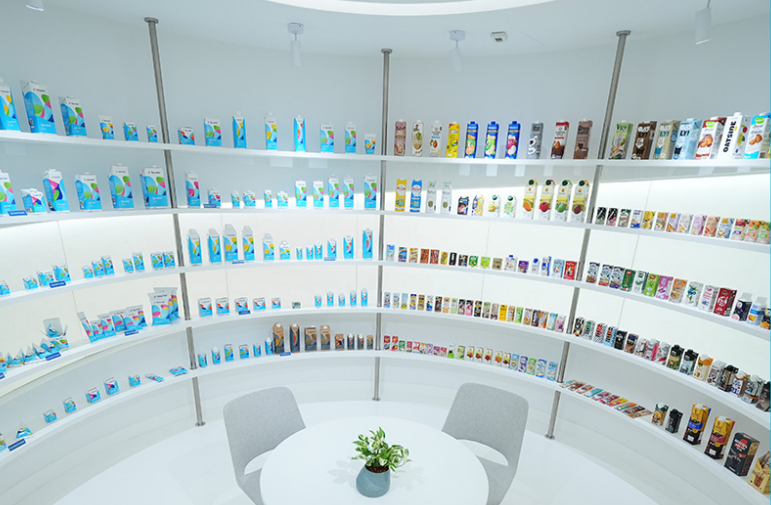
These heavy-asset innovation hubs have a core mission to support the large-scale commercial implementation of new food sources and alternative proteins, helping downstream customers find new growth points in uncertain markets. This building of food system resilience is reflected in concrete numbers as more tangible social benefits.
By 2025, Tetra Pak will leverage its carton packaging technology to help customers worldwide safely transport over 70 billion liters of food, and process 10.5 million tons of food with advanced process solutions. In the broader area of social responsibility, Tetra Pak has ensured access to nutritious beverages for 68 million children in 52 countries worldwide through school meal programs.
At the same time, the scope of customer support for its dairy center project has further expanded, successfully benefiting 89,200 smallholder dairy farmers, helping them connect with legitimate commercial markets through technological empowerment, thereby gaining more resilient income protection.
To address systemic challenges in the food value chain involving implicit intermediate links in processing, logistics, warehousing, and packaging, Tetra Pak renewed its memorandum of understanding with the United Nations Industrial Development Organization at the COP30 climate change conference, embedding the logic of collective action into the framework for long-term corporate development.
In the fields of circular economy and green packaging, which are the most concerned areas for the public, Tetra Pak has demonstrated strong capital offensives and a determination to break through technological barriers in 2025. To maximize the lifespan of materials and reduce the overall carbon footprint of cartons, Tetra Pak will invest approximately 100 million euros in 2025 for research, development, and industrialization of new carton technologies.
Meanwhile, to break the traditional curse of "empty packaging turns to trash," Tetra Pak invested 42 million euros specifically to expand and upgrade packaging collection and recycling infrastructure worldwide. This dual-pronged investment logic is changing the lifecycle of high-quality packaging materials.
Tetra Pak packaging is made from high-quality paper fibers, polymer layers, and aluminum foil, and these materials remain highly valuable for recycling even after their first use. Tetra Pak's unique blend of short and long fibers can become highly sought-after after secondary recycling to manufacture certain advanced fiber products. The previously recognized toughest challenge in the industry-non-fibrous polymer aluminum components (commonly known as polyaluminum)-will also see the dawn of large-scale, high-value transformation technology in 2025.
Tetra Pak is working with policymakers and stakeholders in the recycling value chain to transform these polyaluminum components into high-strength, durable logistics solutions such as shipping boxes and pallets. This closed-loop model of transforming discarded packaging into durable logistics assets not only reduces the industry's dependence on native fossil resources, but also proves to the market that the circular economy is far from just about cost consumption, but rather a closed-loop business model that can generate entirely new industrial value.
Echoing the massive green capital investment is Tetra Pak's solid report card on its own carbon reduction ledger. Using 2019 data as a baseline, by 2025, Tetra Pak's own greenhouse gas emissions at the operational level have already dropped by 56%, and emissions across the entire value chain have also dropped by 34%.
Currently, Tetra Pak's global manufacturing plants have achieved an astonishing 97% renewable electricity usage, making it extremely robust on the path toward the 2030 net zero emissions target of its own operations approved by the Science Based Targets initiative.
This carbon asset management capability naturally translates into the core competitiveness of its packaging products. Multiple life cycle assessments show that, thanks to its lightweight structure mainly composed of fibers and its ability to transport at room temperature without refrigeration and ensure food safety, Tetra Pak cartons, compared to traditional fossil-based packaging, can significantly reduce negative climate impacts. Even in regions with extremely limited cold chain infrastructure, they can effectively block secondary carbon emissions caused by food loss.
To manage ecological risks over longer cycles, Tetra Pak completed its first comprehensive climate and nature risk and opportunity assessment in 2025. This comprehensive health check not only provides underlying data support for its packaging design, but also directly empowers the comprehensive upgrade of its "natural response framework." This upgraded framework introduces more rigorous and measurable quantitative metrics aimed at curbing natural loss, proactively restoring specific ecosystems, and comprehensively enhancing water security for factories and surrounding communities, ensuring that the company's business footprint keeps pace with the evolution of modern ecological science.
However, all complex supply chains, advanced technological R&D, and intensive capital operations ultimately ultimately end up with living people. Tetra Pak understands that the food chain depends on people, so by 2025, its initiatives in social sustainability and internal governance will be equally aggressive.
Starting January 1, 2025, Tetra Pak has launched a benefit policy of one paid volunteer service leave per year to all employees worldwide, encouraging employees to engage with the community to give back to society. In terms of safety production, through continuous and rigorous comprehensive safety measures, Tetra Pak's total recordable accident rate in 2025 will be significantly reduced by 25% compared to the 2022 baseline, which is a highly valuable metric for a heavy industry and manufacturing enterprise. At the same time, its annual workplace experience survey score increased significantly by 10.8 points compared to 2023, fully demonstrating its effectiveness in humanistic care and cultural reshaping within the organization.
The underlying logic behind all this, as advocated by its corporate vision, is that building a resilient food system requires long-term self-discipline, collaboration, and sustained leadership. Protecting food, humanity, and the planet is not only a social responsibility but also the only path for giants to thrive in uncertain cycles.