


Six-Year Standardized Transformation Solves Printing Color Challenges
Anhui Xinhua Printing Co., Ltd. (hereinafter referred to as "Anhui Xinhua"), as the core printing enterprise of textbooks and key publications, shoulders the printing responsibility of textbook publishing units such as the People's Education Publishing House (hereinafter referred to as "People's Education Society"), and also undertakes the political task of "arriving at the book before class, one book for each person". The requirements for "color accuracy, batch consistency, and green environmental protection" of textbook materials are increasing year by year, and the fault tolerance rate of quality inspection is almost zero - even a very small color deviation may lead to return and rework. As the largest publication printing enterprise in Anhui Province, Anhui Xinhua is facing the pressure of quality inspection of the whole chain, high standards and strong supervision, especially for key products such as unified textbooks and theme publications, and the content and printing standards are becoming increasingly strict.
Quality inspection pressure and common problems in the publishing and printing industry
Jumping out of the enterprise to look at the industry, the common problem of the current publishing and printing industry is essentially the chain reaction caused by the "lack of standardization", which is specifically concentrated in 5 core dimensions:
First, at the policy-oriented level, the state promotes the high-quality development of publishing and printing and the implementation of mandatory standards for green printing, requiring the industry to shift from "scale expansion" to "quality improvement and new quality productivity cultivation".
Second, at the level of technology application, most enterprises still stay in the traditional mode of "experience color grading", the lack of quantitative standards for color indicators, the color consistency of multiple machines and batches cannot be guaranteed, and the lack of an effective starting point for continuous optimization, high reprint rate, large rework loss has become a common pain point;
Third, at the level of market demand, customers have more and more strict requirements for the color restoration and stability of printed products, and at the same time, they force enterprises to "reduce costs and increase efficiency".
Fourth, at the level of digital transformation, the digitalization process of the industry is accelerating, but color management and digital production processes are seriously disconnected, and data cannot be precipitated and reused, which restricts the overall efficiency improvement.
Fifth, at the level of talent supply, the printing industry lacks high-end compound professionals, and there is no perfect talent career development channel.
Learn about the chance and initial expectations of the C9
Around 2018, the China Academy of Printing Science and Technology (hereinafter referred to as the "China Academy of Printing Sciences") began to promote the C9 evaluation system, at that time Anhui Xinhua was deeply trapped in the bottleneck of "difficult color control, low efficiency, and high loss" - diversified equipment, new and old coexist, and there were 3 machines of different brands and different service years in the lithographic offset printing workshop alone, and some machines had a service life of more than 15 years.
Through industry exchanges and technical sharing of the China Academy of Indian Sciences, we found that C9 evaluation is a standardized control system independently developed by the Chinese Academy of Indian Sciences focusing on the quality of printing and packaging, and its core concept of "color dataization and evaluation standardization" can just solve the pain points of Anhui Xinhua, which is highly consistent with the core demands of Anhui Xinhua "transformation from experience-based management to data-based management", so we took the initiative to apply to become the first batch of C9 certification pilot enterprises in East China.
When we first approached C9 Evaluation, our expectations were clear:
First, it is necessary to solve the pain point of "no color standard", get rid of the dependence on the captain's experience, realize accurate color quantification through data means, make the color of different machines and different batches of printed products consistent, and completely solve the industry stubborn problem of "multi-machine printing color difference of the same product";
second, it is necessary to solve the "contradiction between efficiency and loss", shorten the time of proofing and sample tracking, reduce the loss of raw materials such as paper and ink, and bid farewell to the passive situation of "sacrificing efficiency for quality";
third, it is necessary to establish "customer trust endorsement", demonstrate the hard power of color management with authoritative certification, reduce the signing process, and deepen the stickiness of customer cooperation;
Fourth, it is necessary to build a "standardized management framework", take C9 evaluation as the starting point, improve the internal quality control system of the enterprise, and realize the standardization and standardized operation of the whole production process through effective tools or reasonable methods.
C9 evaluates the specific data results of the application
Anhui Xinhua became the first C9 qualification enterprise in East China in 2018 and the first C9 multi-machine evaluation qualification enterprise in China in 2024.
Table 1 Specific data results of C9 evaluation application
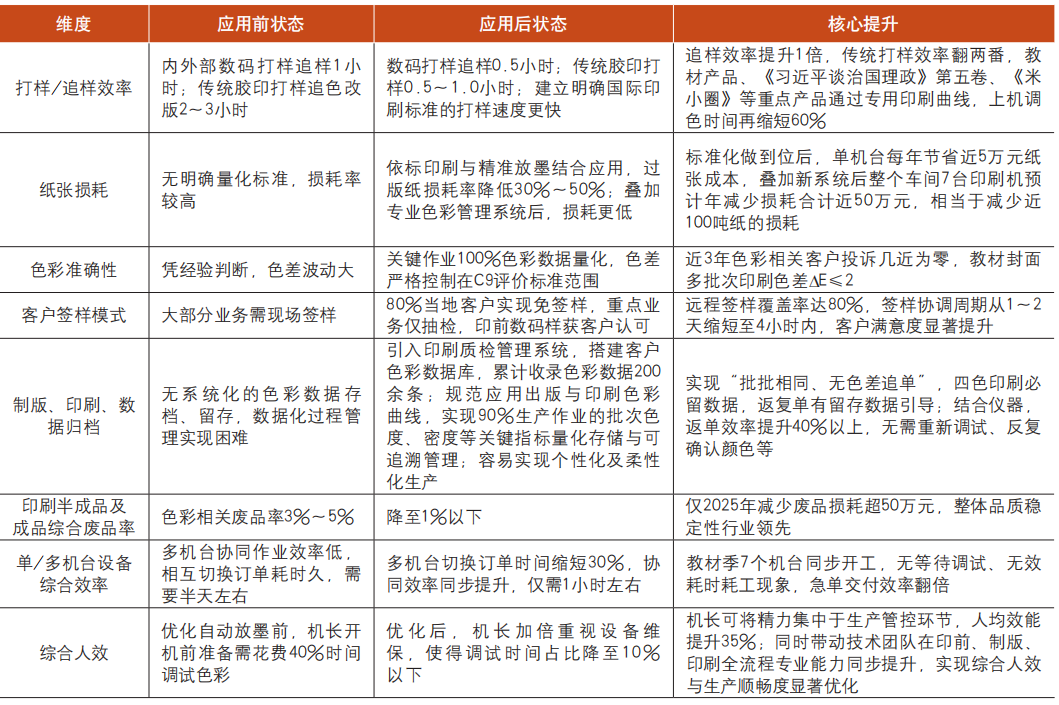
These data do not exist in isolation; rather, they are the inevitable result of the C9 evaluation and standardization system running throughout the entire production process. For example, high-quality book products like 'Mi Xiao Quan,' which are frequently reprinted (the full 'Mi Xiao Quan' series has published 17 volumes to date, with reprints on average every 2 months), used to require proofing and adjustments for each reprint. Now, the C9 standard curves and data from the color database can be directly applied, allowing printing to meet standards immediately, ensuring color consistency while saving a significant amount of time and paper.
From the first contact in 2018 to the implementation of multi-machine certification in 2024, the six-year journey of Anhui Xinhua alongside C9 evaluation reflects the printing industry's transformation from 'experience-driven' to 'data-driven.' We firmly believe that only by breaking the pattern with standards and empowering with data can we maintain a solid footing and sustainable growth amid industry changes. In the future, Anhui Xinhua will continue to delve into the practical application of C9 evaluation, continuously optimize full-chain color standardization management, and contribute more Xinhua experience to the high-quality development of the printing industry.