


See how Tetra Pak is redefining freshness technology!
In today's global food industry landscape, packaging is no longer just the 'shell' of a product; it is evolving into the core of brand competitiveness, logistics efficiency, and even sustainability strategies. With the return of home cooking and the boom in the ready-made food market, Tetra Pak's Tetra Recart food carton division is breaking the century-long dominance of metal cans and glass jars with a set of disruptive packaging solutions.
Recently, Laura Lattisohn, Product Management and Marketing Support Director of Tetra Recart, provided an in-depth breakdown of the innovation logic in this field. This is not just a technological revolution about 'cartons'; it is a business evolution about how to extend shelf life, maintain nutritional value, and significantly reduce waste.
A technological-level game-changer: the 'heat treatment' cutting-edge technology in cartons
For a long time, ready-to-eat soups, sauces, and vegetable cans have relied on metal cans or glass jars because they can withstand high-temperature sterilization. However, the advent of Tetra Recart has completely rewritten this technological boundary.

Laura Latisonoka pointed out that Tetra Recart's core differentiator is its unique "in-box heat treatment" technology. Unlike traditional carton sterilization and refilling, Tetra Recart allows food to be heat treated directly inside the carton. This means that things like soups, rich sauces, and even large chunks of food can be built in a closed carton environment.
This process ensures that food products maintain their ultimate safety and deliciousness without the need for preservatives for up to several months. For modern food merchants who pursue "clean labels", this is undoubtedly a shortcut to product upgrades. At the same time, this packaging form is excellent in protecting food nutrients, through advanced material technology, the carton can effectively block light and oxygen, prevent oil oxidation or vitamin loss, and make the prepared food closer to the "taste in the mother's kitchen" in taste.
Spatial magic in the efficiency dimension: "slimming" logistics costs by 20%
In business competition, efficiency is the lifeline. When traditional round packaging (such as cans) is stacked, it inevitably leaves a large amount of gaps due to circumferential contact, which means expensive waste of space in long-distance transportation.
Tetra Recart's "square design" shows perfect spatial geometry. According to Laura, Tetra Recart stacks extremely efficiently on pallets thanks to its compact cuboid structure. Under the same logistics storage conditions, each pallet is loaded with a full 20% more product than a round can. When compared to heavy glass bottles, the advantage of this loading density is even more striking.
For large producers, this 20% space increment translates directly into a 20% reduction in distribution costs. In today's world of fuel price fluctuations and high supply chain costs, this logistics dividend is a very strategic "hidden profit" for the brand. In addition, the lightweight carton material greatly reduces the transportation load, which not only reduces transportation energy consumption, but also complies with the global policy orientation to reduce carbon footprint.
In-depth insights into the market dimension: the convergence of the home cooking boom and the "lazy economy"
Since the outbreak of the pandemic, the eating habits of consumers around the world have undergone profound structural changes. Laura observes that the rise of at-home dining is not a flash in the pan, but has evolved into a new way of life called "convenient exploration."
Modern urban life is fast-paced, and consumers want to avoid the tedious cutting process without sacrificing taste and quality. According to the data, in the UK market, for example, up to 41% of consumers buy ready-to-eat soup at least once a month. Tetra Recart seized this opportunity. Its square box makes it easy to store in the cold and laser-perforated easy-to-tear openings on the sides make it incredibly easy to open – no can opener or worry about scratching your hands.
This packaging is also particularly suitable for the social trend of "small families". The characteristics of single-serving, easy-to-open lid, resealable and flattened recycling accurately solve the serious pain points of bulk food waste. Consumers can conveniently purchase different flavors of global cuisine, from Thai tom yum to Italian bolognese, simply tear it open, heat it, and complete a high-quality dining experience. This convenience is the key to the growing importance of prepared foods in the modern diet.
Visual tension in the brand dimension: full-format printing and environmental endorsement
On the shelves of information overload, whether it is offline supermarkets or e-commerce pages, packaging is the first medium for brands to communicate with consumers. Tetra Recart's square hexahedron provides a complete, printable visual display platform that is more visually striking than curved printed cans or glass bottles with limited label area.
Brands can clearly present natural ingredient descriptions, health benefit certifications, and compelling brand stories on the packaging. More importantly, sustainability has become a core consideration for contemporary consumers. Tetra Recart packaging contains more than 71% cardboard and is sourced from sustainably managed forests certified by the FSC (Forest Stewardship Council).
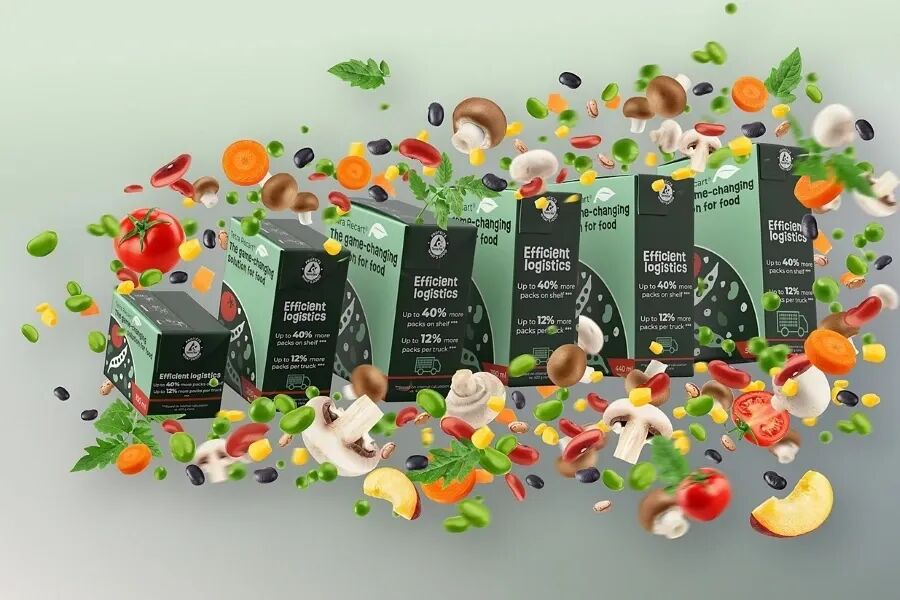
This 'naturally green' attribute, combined with the prominent eco-certification label on the packaging, can instantly establish a sense of responsibility for the brand. For the younger generation seeking alignment between quality and values, this carton packaging itself is a form of communication that says 'modern, advanced, and environmentally friendly.'
Flexibility in manufacturing: flexible production lines empower business agility
Tetra Pak's support for manufacturers goes far beyond providing packaging boxes. Laura emphasized that Tetra Pak is helping partners tackle the uncertainties of the global supply chain by offering a full range of digital and automated solutions.
One of the major strengths of the Tetra Recart production line is its 'extraordinary flexibility.' On the same production line, with a simple switch, different sizes of cartons and different types of food (from thick tomato sauces to light vegetable soups) can be filled. This versatility is crucial for innovative companies that need to frequently launch new products and test market feedback.
Additionally, Tetra Pak offers full lifecycle services, including production line installation, staff training, and long-term technical maintenance. With increasingly sophisticated automation systems, production losses are minimized, and the product pass rate is greatly ensured. In retail environments, the sturdy carton structure further reduces loss rates by 80%, directly optimizing the financial performance for brands.
Global perspective: from Southeast Asia to Europe and the U.S., the carton wave is unstoppable
Currently, the success of Tetra Recart's model has been validated globally. From emerging markets in Southeast Asia like Thailand and Vietnam, to India, and extending to mature markets in Europe and the U.S., more and more food giants are abandoning traditional bulky packaging in favor of Tetra Pak's carton solutions.
This is not only because cartons are more eco-friendly and lightweight, but also because they perfectly meet the needs of the e-commerce logistics era. In today's growing online shopping landscape, this sturdy, easy-to-pack, low-carbon packaging is becoming the optimal path connecting factories with consumers' tables.