


Packaging 'fades' due to oil and ink shortages, the 'black-and-white' trend in Japanese products and the global supply chain shifts behind it
Currently, the global printing industry as a whole has entered a period of adjustment marked by high costs, capacity clearance, and structural reshuffling. Price hikes in raw and auxiliary materials, company layoffs and closures, and frequent industry mergers and reorganizations have become the norm. Against this backdrop of pressure on the entire industry, the recent shift toward black-and-white packaging in the Japanese market has once again sounded the alarm for the sector.
Originally colorful and intricately designed packaging for food and daily necessities is now losing its color and simplifying its patterns, switching to minimalist black-and-white styles. This change is the most visible shift in physical supermarkets and convenience stores in Japan. However, the main driver behind this transformation is not brand upgrading but a passive industry adjustment caused by global shortages of ink raw materials, serving as a typical reflection of the global printing and packaging supply chain crisis.
Japanese brand packaging collectively 'fades'
Since May this year, several leading Japanese consumer goods companies have successively announced packaging renovation plans, widely implementing black-and-white minimalist designs across mainstream daily necessities like snacks, grains and oils, soybean products, and instant foods. Japanese national snack giant Calbee was the first to make the change, announcing that from late May, it will switch the packaging of 14 core products, including potato chips and Kappa shrimp sticks, to black-and-white, removing original colorful patterns and cartoon logos, retaining only basic product information, and openly disclosing the industry's raw material shortage situation.
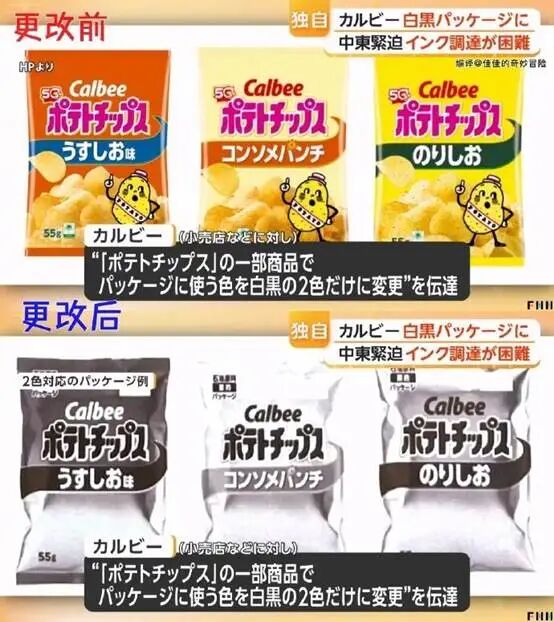
After that, many well-known Japanese food companies quickly followed suit. Leading companies Kagome and Nisshin Seifun simplified their product packaging colors, removing complex printed patterns and colorful logos; Nisshin Seifun went further by eliminating all printed designs and text on noodle bundles, minimizing ink usage as much as possible.
Soy product leader Taisho Foods announced that starting in June, it will fully simplify its packaging printing system, reducing color layers and the printed text area. In addition, Japan's major discount retail chains launched new private-label brands, covering 26 everyday foods and daily necessities like natto and boxed rice, all using uniform black-and-white packaging. By cutting colorful printing costs and reducing ink consumption, they aim to ensure normal product supply and stable prices.
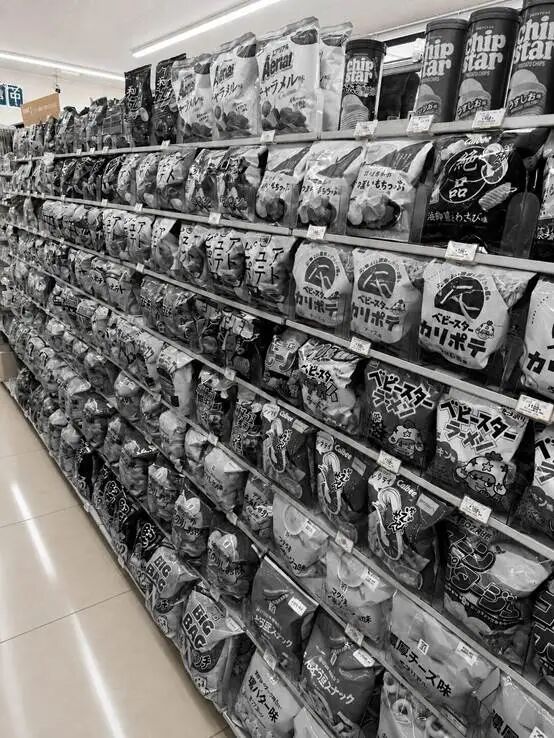
Currently, Japan's offline retail market is showing a clear 'fading' trend. Walking into supermarkets and convenience stores in cities like Tokyo and Osaka, the once colorful product displays have been disrupted, with a mix of black-and-white packaged products and traditional colorful ones creating a very noticeable visual contrast.
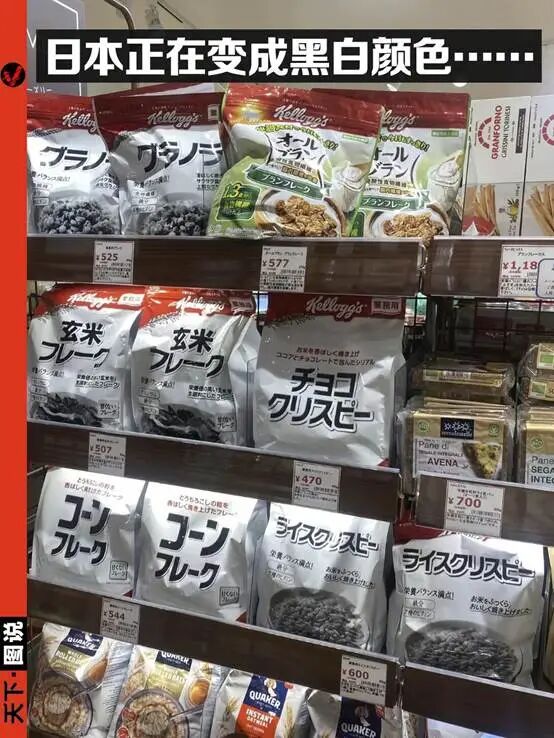
According to research data from the Japan Food Industry Association, over 70% of food companies have already started to lighten and simplify their packaging. More than 70% of companies also anticipate that raw material shortages may continue, and they might further simplify packaging or raise product prices in the future. The Japanese consumer goods industry has fully entered an emergency state of 'producing with limited ink.'
It's worth noting that while Japan's Ministry of Economy, Trade and Industry has publicly stated that domestic naphtha supply is sufficient, the adjustments by real market companies directly confirm the real challenges of supply chain shortages.
The deeper logic behind packaging 'fading away'
The collective move toward black-and-white packaging in Japan's products may seem like a minor change in the consumer goods sector, but it actually reflects a microcosm of deep shocks in global energy and chemical supply chains. Behind it lies complex international geopolitical tensions and structural flaws in regional supply chains, with the core trigger being the disruption of global raw material supply chains caused by geopolitical conflicts in the Middle East.
From the perspective of the industry chain transmission logic, the core raw materials for producing color packaging ink are toluene, synthetic resins, and other chemicals, all of which rely on naphtha processing and refinement. Naphtha is also known as the "base flour" in the industrial sector and is a core raw material for light industry, chemicals, and printing.
Since the beginning of this year, geopolitical tensions in the Middle East have persisted, with shipping in the Strait of Hormuz disrupted, global crude oil and naphtha trade and transportation obstructed, international naphtha prices surging, and supply tightening. As an island nation extremely resource-scarce, Japan's supply chain shortcomings have been greatly amplified. After shipping restrictions in the Strait of Hormuz, Japan's naphtha imports sharply declined. Core domestic petrochemical companies such as Mitsui Chemicals, Mitsubishi Chemicals, and ENEOS cut production and suspended naphtha import tenders, directly leading to a sharp reduction in downstream raw material capacity for toluene and ink resins, resulting in severe shortages.
This has created a complete chain of crisis transmission: Middle East geopolitical conflict→ disruptions in shipping across the Strait of Hormuz→ naphtha supply shortages and soaring prices→ cutoff of core ink raw materials→ insufficient color ink production capacity, soaring procurement costs→ forcing Japanese companies to simplify packaging and stop using color printing.
Supply chain insights brought by "oil shortage and ink shortage."
Japan's current industry difficulties are ultimately the inevitable result of a single raw material source, weak domestic support, and insufficient risk resistance. Essentially, this crisis is a case of survival of the fittest in supply chain capabilities.
Looking at the global ink supply chain, the current overall pattern is characterized by "raw materials relying on energy, production capacity concentration and differentiation, and high regional dependence." Geopolitical conflicts and international oil price fluctuations are global industry challenges. China's packaging and printing industry is also slightly affected by external factors. Raw material prices fluctuate in the short term, but the overall market operates steadily and risks are controllable, forming a sharp contrast to Japan's industry difficulties. The core stems from China's relatively complete full industry chain layout.
In terms of raw material supply, China has achieved a diversified layout, completely freeing itself from dependence on a single production area. Domestic self-sufficiency rate for core packaging raw materials such as BOPP and PET film exceeds half. The full set of auxiliary materials such as label surface materials, adhesives, and backing paper has ample production capacity and a complete supporting system, fully meeting the domestic market and export order demands. At the same time, domestic companies retain compliant high-end import channels, supplying through both domestic and international channels to effectively hedge the risks of international raw material price fluctuations.
For the printing and packaging industry, this round of crisis has also redefined the survival rules of enterprises: short-term cost advantages will eventually be eroded by external risks, while long-term full-chain adaptability, risk hedging, and technological innovation capabilities are the fundamental paths for companies to weather cycles, stabilize domestic and international markets, and achieve high-quality, sustainable development for the industry.