


Mexican media giant invests $150 million to enter corrugated packaging, Meiyingsen faces a strong competitor!
Amidst the sluggish growth of global traditional media and profound adjustments in industrial structures, the spectacular transformation of Mexico's publishing group (OEM) provides a textbook case of the integration of traditional industries with modern packaging.
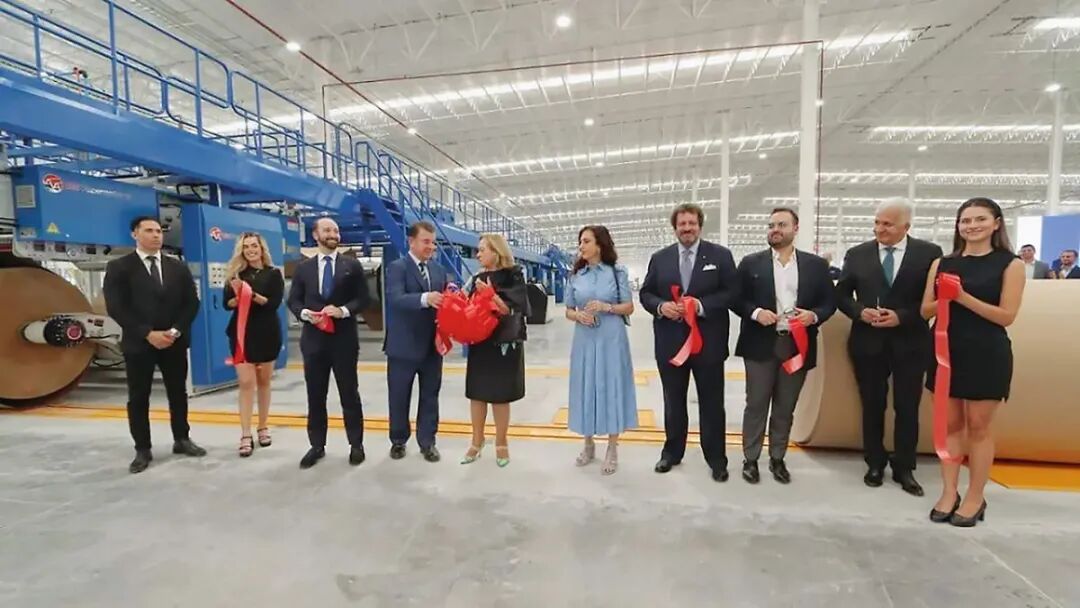
Recently, OEM's paper division announced that its PRONAL Corrugados plant, located near Monterrey, the capital of Nuevo León, Mexico, has officially started operations. This is not just the completion of a modern factory; it also marks that Mexico's most influential media and comprehensive paper industry giant has officially achieved the integration of a 'closed-loop full industry chain,' spanning from waste paper recycling and raw paper production to end-stage corrugated packaging services.
Monterrey's ambitions: the strategic implications behind the location
José Antonio Rodríguez de Menegui, CEO of the OEM Paper and Packaging Division, has high hopes for the new plant. The location of Monterrey is itself an accurate market game. Monterrey, the industrial heart of northern Mexico, is at the center of an unprecedented "corporate relocation wave". As global manufacturing shifts to Mexico, demand in the packaging industry has exploded.
Rodríguez de Meneghi pointed out that domestic demand for corrugated boxes in Mexico is soaring at a rate of 11% to 12% per year, and Monterrey's geographical advantage near the US-Mexico border makes it a preferred location for export-oriented companies.
PRONAL Corrugados was inaugurated to serve exporters looking for the ultimate in logistics efficiency and high-quality packaging solutions. The OEM's goal was clear: to become one of the top three in the production of paper and cartons in Mexico through this strategic position, making high-quality corrugated boxes an iconic business card of the company.
Closed-loop ecology: dimensionality reduction from "selling paper" to "selling packaging"
Before PRONAL Corrugados went into operation, the National Paper Mill of Mexico (PRONAL) in San Luis Potosí acted primarily as a base paper supplier. Although the production and sales volume is huge, it is often subject to the procurement of downstream cardboard factories. With the opening of the new Monterrey factory, this situation was completely broken. PRONAL will supply the base paper directly for its corrugated board line, which means that the OEM group has achieved a full integration from waste paper recycling to finished packaging production.
The competitive advantage that this integration brings is significant. Rodríguez de Meneghi emphasized that this vertical integration of "papermaking corrugated packaging" marks the beginning of a new era. It not only significantly reduces the cost of raw material procurement, but more importantly, the company can reverse customize the gram weight, strength and fiber ratio of the base paper according to the specific needs of the end packaging customer. In a market that only pursues high quality, this ability to control quality from the source is undoubtedly a "dimensionality reduction blow" to simple processing enterprises.
Hardcore Gear: Define Made in Mexico with the world's top technology
In order to become an instant hit in the Mexican market, OEMs have spared no expense in equipment investment. PRONAL Corrugados covers an area of 6 hectares and has a modern 28,000 square meter plant with a core production line using the top-of-the-line configuration of the American company.
The plant is equipped with the widest and most advanced 2.85-meter-wide Pioneer Series corrugated board production line currently in its kind in Mexico. The line operates at high speeds of up to 350 m/min, and its built-in VortX gluing system ensures uniform and smooth dispensing, ensuring that the strength indicators of each sheet of cardboard meet demanding industry standards.

General Manager José Saul Guzmán Espinosa further revealed the plant's technological evolution map. At present, the line is capable of producing three- and five-layer flushed cardboard for the food and cleaning industry. By 2026, the plant will have the capacity to produce seven layers of corrugated cardboard, making it the second machine in Mexico to have such a function. At that time, the plant will be able to produce heavy-duty packaging for heavy products such as auto parts and household appliances, completely filling the market gap in this field.
In the back-end processing department, two Magui's carton printing and processing lines ensure excellent visual effects. G-Grafix four-color printing, die-cutting and adhesive box linkage line and four-color printing slotting die-cutting machine make packaging no longer just a protective case, but also a carrier of brand communication. High-definition printing results and precise die-cutting processes are directly aimed at the increasingly demanding e-commerce and high-end consumer goods markets.
Daughter buys bones: $150 million to open the expansion of the national territory
The first plant in Monterrey was just the "appetizer" of the OEM's huge expansion plans. The total investment budget for the PRONAL Corrugados project is up to $150 million. According to the company's disclosed development plan, the OEM will build a second factory in 2026 and a third factory in early 2027. The three factories in major industrial centers will be at odds with each other to cover the entire Mexican production capacity.
Behind this ambitious investment plan is a huge dividend for the Mexican packaging market. According to the latest report from Grupo IMARC, the Mexican corrugated box market has reached $2.5 billion in 2024 and will maintain steady growth over the next decade. The booming trend of retail, industry, agriculture, and cross-border e-commerce is calling for more sustainable, lighter, and more economical packaging alternatives. In particular, the global consensus of "paper instead of plastic" has brought unprecedented alternative growth space for corrugated packaging.
Circular economy: the green responsibility of media giants
As one of Mexico's most influential media organizations, the OEM has not neglected social responsibility and environmental protection in this transformation. The PRONAL Corrugados project is strategically embedded in the Group's circular economy system.
At present, the OEM Paper and Packaging Division has an annual production capacity of more than 600,000 tons of recycled paper and paperboard. This closed-loop network includes Ecofibras Ponderosa, which is responsible for waste paper recycling, Cartones Ponderosa and PRONAL, which are responsible for base paper production, and specialized companies responsible for logistics and transportation.
The life cycle of each carton, starting from the recycled waste newspaper, to the transformation into new corrugated packaging, and then to the recycling after use, the whole process flows in the green ecological chain of the OEM. This closed-loop model not only brings environmental benefits, but also greatly improves resilience to raw material price fluctuations and supply chain risks.
In addition, the establishment of new factories has injected a boost into the local economy. The first factory directly created 250 high-quality jobs. To date, the OEM paper division has created more than 1,550 direct jobs and more than 3,000 indirect jobs throughout Mexico, fully demonstrating the driving effect of large-scale industrial projects on local prosperity.
A sample of the "packaging" of traditional media transformation
This big move by the Mexican Publishing Group shows a profound truth to the industry: traditional industries do not mean backwardness, as long as the combination of the industrial chain can be found, even the seemingly traditional packaging paper industry can burst out with amazing vitality.
By integrating Maguire's state-of-the-art equipment, PRONAL's paper production capacity and Monterrey's location, OEMs are defining a new benchmark in Mexico's packaging industry. They are not only aiming at the packaging carton market, but also a new consumption era that values quality, pursues efficiency, and advocates green. For domestic packaging and paper companies that are in the midst of transformation anxiety, the Mexican solution of "whole industry chain integration + regional center layout + circular economy closed loop" may bring a lot of inspiration and thinking about "breaking the game".