


Low production efficiency and difficult inventory management? Look at the 73 year old newspaper printing company's breakthrough move!

Printing enterprises play the role of producers of information carriers and promoters of cultural diversity development in the process of social development, assisting the Party and the state in the positive dissemination of political and economic information, and are an indispensable industrial chain for social development in the new era.
By 2027, we aim to promote the formation of a digital connectivity system for the printing industry, where backbone characteristic enterprises take the lead in iteration, large-scale enterprises stabilize and upgrade, and small and medium-sized enterprises progress step by step. Breakthroughs have been made in key core printing technologies, and digital application scenarios such as process digital design, intelligent workshop scheduling, and online intelligent detection are constantly expanding. The digital management service system is more complete, and an industry level data resource information platform has been established to better meet the needs of industry development.
The printing industry belongs to the traditional industry category, and the enterprises in the industry are practitioners of iterative upgrading of printing technology, such as the transition from saying goodbye to "lead and fire" to achieving "light and electricity", CTP replacing film, and the rapid development of digital printing machines. In the rapidly changing technological innovation, hardware facilities are being updated and iterated at a high speed, which requires the printing industry to catch up with the improvement of internal management software.
With the rapid development of information technology, newspaper printing enterprises such as Chongqing Chongbao Printing Co., Ltd. (hereinafter referred to as "Chongbao Printing") are facing increasingly fierce market competition and constantly changing customer demands. In order to stand out in the competition, enterprises need to continuously improve their internal management level, enhance operational efficiency and quality. ERP and WMS software, as advanced management tools, can provide effective solutions for newspaper printing enterprises.
Challenges faced by internal management of printing enterprises
01/Complex production process
Printing involves multiple stages, from manuscript editing, typesetting and plate making to printing, oiling, hot stamping, binding, etc. Each stage requires precise coordination and efficient operation, so precise and efficient process instructions are even more necessary, otherwise delays and quality problems are prone to occur.
02/Difficulty in inventory management
Whether it's newspapers, books, or packaging printing, precise control is required for the receipt, shipment, and storage of raw materials such as paper, ink, printing plates, and adhesives. There are various types and specifications of raw and auxiliary materials. If the management of the raw material warehouse is not in place, it will lead to problems such as inaccurate classification, material issuance errors, and inventory errors. In terms of finished product inventory, newspapers are basically "zero inventory", while inventory of books, magazines, and packaging products is a key management content, which not only meets production needs but also avoids occupying funds and space due to inventory backlog.
03/Poor communication of information
The lack of timely and accurate information transmission between various departments and links within the enterprise (such as marketing, technology, procurement, production, shipping, etc.) can easily lead to delayed adjustments in production plans, a disconnect between procurement and actual demand, resulting in material shortages, shortages or overages, and even high-frequency replenishment production. This not only affects production efficiency, but also increases the investment in comprehensive costs.
04/High cost control pressure
Fluctuations in raw material prices and low production efficiency can all lead to increased costs, and companies need effective cost control measures to improve profitability. For example, based on the current production situation (production progress, material reserves, etc.), communicate and coordinate with customers in a timely manner to carry out stocking production; According to the batch delivery plan of business products, timely purchase raw materials when the market price of raw materials is low. For enterprises that produce newspapers and purchase them independently, fully grasping the trend of paper prices and finding the right timing for procurement is one of the effective measures to reduce production costs.
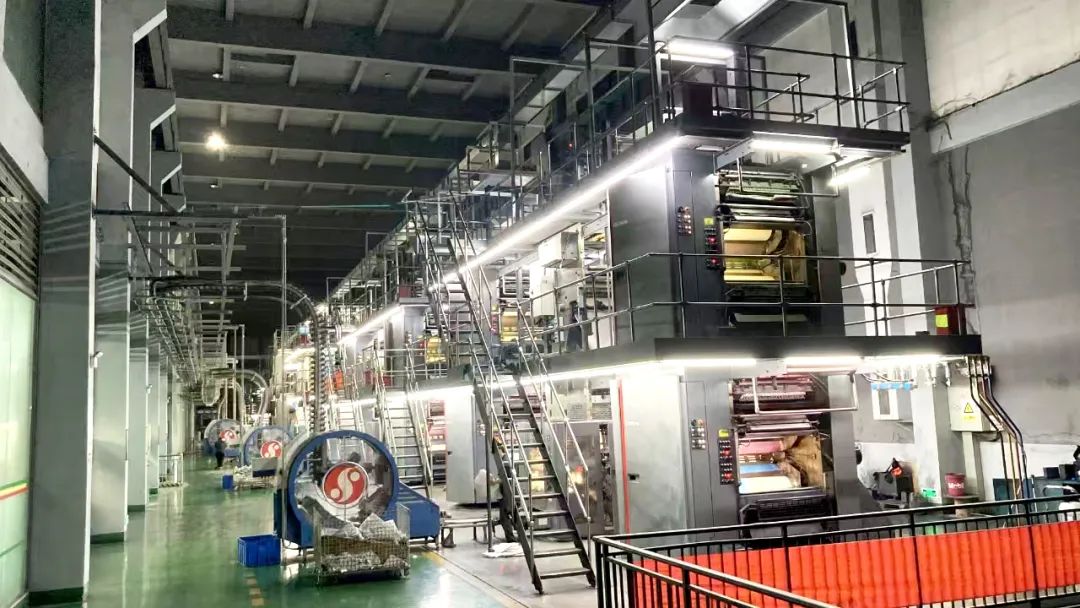 Re reporting the printing factory scene
ERP and WMS software
Application and advantages in newspaper printing enterprises
01/Application and advantages of ERP software
(1) Optimize production process
Through an integrated system, comprehensive management of production planning, scheduling, execution, and other aspects is achieved to visualize and automate the production process. For example, automatically generate production tasks based on order requirements and arrange equipment and personnel reasonably; Real time monitoring of production progress, timely detection and resolution of problems in production, such as equipment failures, raw material shortages, etc., to reduce production delays.
(2) Strengthen supply chain management
Establish close information connections with suppliers, timely obtain supply information of raw materials, and ensure timely delivery; Optimize procurement plan, arrange procurement quantity and time reasonably based on production demand and inventory situation, and reduce procurement costs.
(3) Improve financial management level
Accurately calculate production costs, including raw material costs, labor costs, equipment depreciation, etc., to provide accurate data support for cost control; Real time synchronization of financial data and business data facilitates financial analysis and decision-making for enterprises.
02/Application and advantages of WMS software
(1) Accurate inventory management
Detailed classification and positioning management of raw materials, semi-finished products, and finished products in the warehouse to improve inventory accuracy and minimize discrepancies. Establish an inventory warning mechanism to promptly remind management personnel to replenish or handle backlogged inventory, and optimize capital utilization; Generate various inventory, inbound and outbound, and performance reports to provide data support and trend analysis for enterprise decision-making, and provide accurate procurement strategy references for enterprise management.
(2) Improve storage efficiency
Optimize warehouse layout, plan storage space reasonably, and improve warehouse utilization. By using barcode or RFID technology, goods can be quickly and accurately received, inspected, and shelved, reducing manual errors.
Based on precise inventory management and the first in, first out (FIFO) principle, effectively reduce the risk of material expiration or damage; According to order requirements, the system intelligently plans the optimal picking path, reduces picking time, and avoids repetitive labor.
(3) Implement traceability management
Trace each batch of raw materials and products, record their source, destination, and quality information, in order to quickly locate and solve problems when they arise.
Precautions for Printing Enterprises to Apply ERP, WMS and Other Software
01/
system selection
When choosing software such as ERP and WMS, printing companies should fully consider factors such as their own scale, business characteristics, and development strategies, and prioritize products with complete functions, strong scalability, and high industry adaptability. At the same time, a comprehensive evaluation of the software supplier's strength, service quality, implementation experience, etc. should be conducted to ensure the smooth implementation and long-term stable operation of the system. Based on current experience, it is recommended to prioritize selecting software suppliers that have been "polished" by multiple different types of enterprises in the industry, such as state-owned enterprises, private enterprises, joint ventures, etc.
02/Business Process Optimization
Before introducing software, enterprises should comprehensively streamline and optimize existing business processes, remove unreasonable links, and make business processes more concise and efficient. The implementation of software systems should be closely integrated with business process optimization to ensure that the system can fully support the business operations of enterprises and maximize efficiency.
03/Data Quality and Security
The operation of ERP, WMS and other software relies on accurate data, and enterprises need to establish a sound data management system to ensure the accuracy, completeness and timeliness of data. At the same time, we must attach great importance to data security issues and take effective measures such as data encryption, backup, and access control (such as creating enterprise owned servers, implementing multi factor authentication, clarifying permission boundaries and implementing minimization principles, restricting unauthorized access to data and the use of external devices, etc.), to prevent data leakage and loss, and protect the enterprise's trade secrets and customer information.
04/Employee Training and Support
The successful implementation of software systems relies on the support and cooperation of employees. Enterprises should develop detailed training plans and provide systematic training to employees to enable them to master the operating methods and business processes of the system; During the implementation process, it is necessary to provide technical support and assistance to employees in a timely manner, solve problems encountered by employees, and improve their acceptance and enthusiasm for using the system.
Case study on the application of re reporting printing services
Chongbao Printing is a large-scale printing enterprise with a history of 73 years. It is a high-tech enterprise, specialized and innovative enterprise in Chongqing, a leading enterprise in the printing industry in Chongqing, an honest enterprise in the printing industry in Chongqing, an executive vice chairman unit of the Chongqing Printing Association, a director unit of the Chongqing Packaging Association, and the only publishing and printing enterprise in Chongqing to have won the "Top 100 Printing Enterprises in China" for 8 consecutive years. Its annual sales revenue is nearly 200 million yuan. Our main business covers newspaper printing, commercial book printing, and corrugated packaging printing, as well as graphic design, confidential printing, paper sales, and academic research services.
01/Problems before application
Before applying software, the company's business was complex and production plans frequently changed, which could lead to the following problems: low production efficiency and long product delivery cycles; Inventory management is chaotic, with alternating occurrences of inventory backlog and stockouts, large capital occupation and long cycles, and low site utilization; The difficulty of information communication and coordination among various departments is high, and the communication cost is high. It mainly relies on face-to-face communication or platforms such as WeChat and QQ to transmit information, resulting in non-standard and inconsistent process terminology and parameter settings.
02/Effect after application
The accuracy and stability of the company's production plan have significantly improved, and standardization has been achieved in all aspects from customer files, business sources, process guidance, production allocation, material supply to finished product destinations; The clear work instructions for marketing, technology, production, quality inspection, and warehouse ports greatly reduce the time for manual information transmission, and the information sharing between departments is more timely and accurate, resulting in smoother work coordination; Production efficiency has increased by more than 10%, and the delivery cycle of products with large task volumes has been shortened by at least one day; The turnover rate of raw material and finished product warehouses has also significantly improved, with inventory turnover rate increasing by more than 5%, reducing inventory backlog funds, and basically eliminating stock shortages; With the normal use of the software, employees' work efficiency and satisfaction have significantly improved.