


How can digital printing expand into diversified applications? Companies like Henan Shengda and Liantu Express Print share their views...
Recently, the 21st 'Digital Printing in China' Technology Development Forum 2025 was successfully held in Zhengzhou, Henan. The conference specially featured a 'High-end Dialogue' session, where guests discussed the theme 'With Intensifying Market Competition, How Can Digital Printing Expand Diversified Applications?' They explored how digital printing companies can develop diverse product applications and open up new business avenues. Here, we share some of the highlights from the discussion.
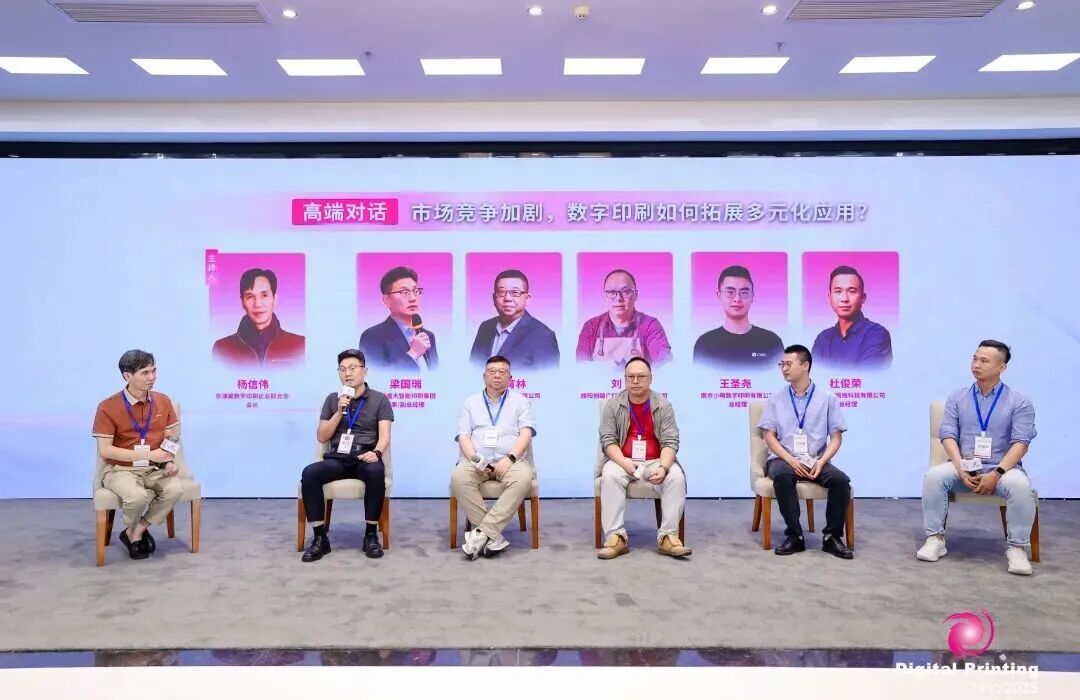 Scene view
Henan Shanda Intelligent Printing Group
Director and Deputy General Manager Liang Guorui
How to expand diversified applications should be combined with the positioning of the enterprise, the market environment and the stage of the enterprise should be clear. In the early days of Shanda, from the simple laminated printing business such as business cards and single pages, gradually expanded to business products, and now through the blessing of digital printing equipment, extending to cultural and creative, two-dimensional and other small-batch products, our brand equipment models are relatively extensive, basically covering all models of top digital printing and post-press equipment brands at home and abroad. With the advantages and diversification of equipment, we can also provide small batch printing and production services for labels, tote bags, albums and other products.
Regarding diversified services, I believe that the fundamental starting point of enterprise promotion is to closely combine its own advantages, better meet customer needs, and continuously improve customer experience and satisfaction. Shanda Printing launched the "free of error" service commitment in the early stage, establishing customers' trust in our delivery, and through the membership policy, customers can enjoy more competitive prices and exclusive service rights, as well as logistics services for delivery; Relying on the logistics network to launch supply chain services to help customers realize the procurement problem of small batches of materials, in terms of software, Shanda Printing has realized the whole process from the front end to the back end, and in the future, through the official website or online design tools, to help customers self-help to achieve lightweight customization. At the same time, Shanda Printing continues to strengthen internal control, resolutely put an end to the phenomenon of grabbing direct customers, and ensures business compliance and customer fairness.
If it receives 10 million yuan of funds, Shanda Printing will continue to increase investment in hardware equipment, the whole supply chain chain, and customer soft services, provide customers with more efficient solutions, and further consolidate and expand diversified application scenarios.
Beijing Liangtu Advertising Co., Ltd
General Manager Zhang Yulin
Diversification, I would rather call it "integration". Since 2018, Liangtu has gradually expanded its product scope, and its current business covers gift packaging, personalized customization and other fields. We have noticed a trend in the printing industry where the boundaries between service and production are increasingly blurred. On the one hand, with the help of modern equipment and artificial intelligence technology, printing companies can still show a high degree of professionalism in cross-border operations, such as some companies that originally focused on packaging business have successfully expanded new businesses such as gift boxes; On the other hand, the boundaries between customers for different products and services are gradually blurring, taking the fast printing store as an example, whether it is digital printing, packaging or gift needs, customers may choose the same service provider. Therefore, the current development of the printing industry is not so much diversification as integration.
I myself am an advertising planner, and I have been involved in the field of short video since 2020, and I have always attached great importance to marketing diversification, which is one of the important reasons why Liangtu has been able to maintain an annual growth rate of 30% so far. The fast printing industry often says that "the fragrance of wine is also afraid of deep alleys", and keeping a low profile means losing opportunities. In the past, the fast printing industry tended to "race horses" and seize excellent stores in the market, thinking that the door itself was an advertisement, but in fact, excessive pursuit of advantages may cause waste of social resources. Of course, products are always the core carrier of marketing, and we rely on a wealth of innovative products to carry out marketing and convey brand stories, and win the widespread attention of more customers through innovative products.
Quick printing stores should be aware of the importance of marketing, and at the same time, they need to take decisive action, and only in practice can they reap results.
Mianyang Chuangyue Guangyin Network Technology Co., Ltd
General Manager Liu Yang
I have a different perspective on diversity. First of all, from the perspective of enterprise form, large enterprises can provide "large and comprehensive" one-stop services, while small enterprises have limited capabilities, and their diversification should focus on screening independent products, positioning their own characteristic products in diversity, and giving full play to their advantages through single point breakthroughs; The second is customer diversification, taking the digital printing business as an example, there is seasonal demand such as graduation season and Spring Festival season, and the business volume will decline during the non-peak season, but the customer group is not repeated. When we transformed from digital printing to digital packaging, we initially took tea packaging as the main line, and found that there was an obvious off-peak season, and later adopted the "three festivals" strategy of Dragon Boat Festival, Mid-Autumn Festival and Spring Festival, which effectively balanced the business volume, which also allowed us to experience the different values brought by different customer groups. Therefore, I think diversification is to achieve two-way drive through customer diversification and product diversification from small store independent products to products.
Mianyang Chuangyue took 3 years to complete the transformation from digital printing to digital packaging, during which we have been looking for product commonalities. We think that packaging gift boxes, anything can be contained in them, this is the diversified part, but we must find commonalities, so our current gift boxes are modular, which can not only focus on a product, but also diversify to serve different customer groups. While meeting customer needs, consider your own production capacity. We have defined the development goal of "de-factory, de-specialization, and de-logistics" for ourselves, and have achieved the first two, and are working hard for "de-logistics".
The core pain point of "de-logistics" is the high cost of cross-regional packaging and transportation. Under the "de-factory" strategy, we have explored the "clever power" path that is more suitable for the small-scale digital printing industry. Compared with "hard power" and "soft power", "clever power" emphasizes the replacement of scale expansion with flexible strategies. In specific practice, we have built a "flexible production capacity" system, taking small equipment as an example, the daily production capacity can be flexibly expanded from 1,000 gift boxes to 5,000 gift boxes, and the production capacity can be matched by adjusting the manpower allocation rather than expanding the scale of the equipment, so as to truly achieve "production capacity according to orders" rather than "equipment determines production capacity". If we receive an investment of 10 million yuan, we will replicate this flexible production capacity model to the whole country, realize "de-logistics" through distributed production nodes, and fundamentally solve the problem of high cost of cross-regional packaging and transportation.
Nanjing Xiaomeng Digital Printing Co., Ltd
General Manager Wang Shengyao
As a start-up enterprise, we only have 3 newly introduced inkjet rotary printing machines, which are not as advanced as the advanced equipment or technology owned by leading companies in the industry, but through practice, we have also formed a unique understanding of diversification. When the company was first established, we could only undertake the teaching aid printing business, which could achieve 24-hour continuous rotation during the peak season of school, and in the off-season, it would cause problems such as clogging of printheads due to idle equipment, and at the same time bear the daily fixed costs of machines, rent and other related costs. In the face of various challenges, we take the initiative to explore diversified paths, and realize the diversified value of one machine serving multiple customers, multiple products, and multiple application fields by undertaking orders from different categories such as industrial manuals, pharmaceutical instructions, and publications.
The inkjet rotary printing machine we use is updated and iterated extremely quickly, and the technology upgrade of the third high-definition color inkjet rotary printing machine introduced from double adhesive paper to coated paper has actually only gone through two and a half years. This rapid update nature dictates that devices must be used frequently to maximize value. Therefore, our strategy is to keep the machines running at full capacity and dilute the cost of the sheet through large-scale production. Based on the total cost of equipment of 10,000 yuan per day, if it is operated continuously for 24 hours, the hourly cost can drop to about 500 yuan, and if it is only operated for 10 hours, the hourly cost will soar to 1,000 yuan. This significant difference in cost structure allows us to reduce printing costs by making "full machines" our primary goal.
If we receive an investment of 10 million yuan, we will adopt a gradual investment strategy. This fund can leverage nearly 100 million yuan of equipment assets through financial leverage, and can purchase 15~20 domestic inkjet rotary printing machines at market prices. However, the current demand scale of the domestic printing market is limited, and it is difficult to support such a large-scale equipment production capacity in the short term. As one of the first companies in East China to introduce high-definition color rotary printing machines, we have experienced a long period of equipment running-in. At the beginning, we treated the company as a quick printing shop, customers needed hundreds of books, we followed the thinking mode of the quick printing shop, no matter what kind of paper was used, all made on the same day, and later we found that this method was wrong. In the process of slowly exploring, we found that these orders can be aggregated, unified paper, unified production, thus reducing production costs a lot and greatly improving overall efficiency. In addition, this year we have unified all production standards and made many software upgrades to the machines. Last year, the speed of the machine could only be driven to 80m/min, and this year it can reach 120m/min.
Guangzhou Dopu Network Technology Co., Ltd
General Manager Du Junrong
In the fierce market competition, most printing companies will understand diversification from the perspective of product dimension or process design, such as whether to introduce new equipment, develop new processes, etc. However, as a software practitioner, my understanding of diversification focuses more on the diversification of service dimensions, not only positioning myself as a production and processing provider, but also a supplier that can provide overall services, and carry out in-depth system docking with customers through software services to better provide system solutions for customers.
For the pain points encountered in the process of software promotion, I think it still depends on what problems this software solves. There are many types of software, and tool-based software such as PhotoShop and AI have been standardized. If software applications in the printing industry are also standardized, costs will be reduced. We offer different solutions for different segments of the printing industry, focusing on the whole process rather than a single link, covering the complete link from order taking, quotation, imposition to delivery. In fact, you can also choose only one field, but in order to build your own moat and industry popularity, we choose to provide enterprises with full-process system solutions, but it is also difficult to form a completely standardized thing, and it is still necessary to customize specific solutions according to the actual needs of enterprises, which is a difficult point in the process of software promotion.
If we have 10 million yuan, we will focus on specific system solutions and provide value-added services to customers as an enabler. To give a real case of our customer, a leading domestic e-commerce procurement business card used to approve the printing authority of employees at different levels through a complex OA system. After the customer opens the port to us, the approval results will be automatically transmitted to the system, and after approval, the business card will be directly synthesized, printed and distributed, and the cost will hardly increase. This solution allowed our client to win the bid and successfully win the business. This focused solution empowers customers, rather than simply producing and competing for price, which not only enhances the added value of services, but also avoids homogeneous competition.