


From 2007 to 2025, the European book market's revenue will shrink by over 30% in 18 years
According to the UK magazine The Bookseller, the Federation of European Publishers (FEP) recently released the 'Annual Data and Trends Report on the EU Book Market.'
In 2025, the nominal revenue of the European book market (note: 'nominal revenue' refers to total revenue measured in current currency units, without adjusting for price changes) reached €24.6 billion (about 182.8 billion RMB). The federation revealed some alarming data-after adjusting for inflation, the real revenue of the European book market in 2025 was only €15.2 billion, down more than 30% from €22.9 billion in 2007. At the same time, the federation warned that the decline in the number of readers is the main issue facing the European book industry today.
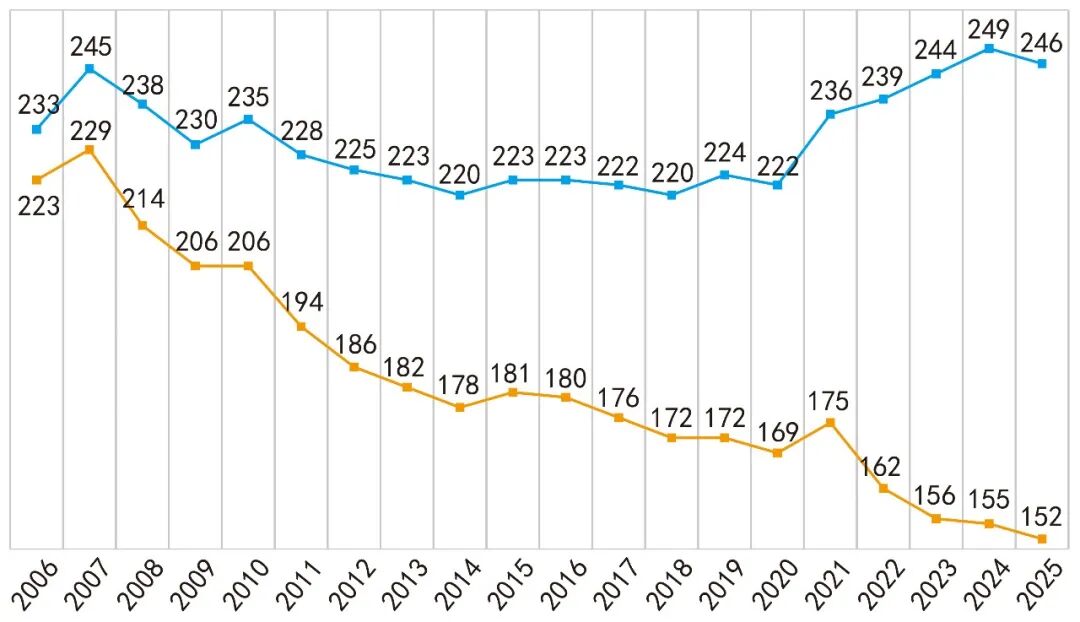 2006–2025, European Book Market Nominal Revenue (Blue) VS Inflation-Adjusted Real Revenue (Orange) (Unit: 100 million euros)
Federation President Sonia Draga admitted while presenting the key findings of the report: "Unfortunately, not all the numbers paint an encouraging picture." Federation Vice President Enrico Turrin also pointed out that the market data revealed in this report are not ideal.
Turrin noted that the European book market is "shrinking." Although it achieved slight growth for three consecutive years previously, that growth was "driven by rising book prices rather than an increase in book sales."
In 2025, the European book market's nominal revenue fell by 1.2% year-on-year, and the federation admitted that "the current market situation is not optimistic." Moreover, inflation is putting the European publishing industry in a "real dilemma." Turrin pointed out that while the nominal revenue of the European book market in 2025 reached €24.6 billion, roughly the same as €24.5 billion in 2007, real revenue adjusted for inflation has dropped sharply. "By this measure, we are indeed facing serious issues." Turrin admitted that although the European publishing industry still appears lively and "not like an industry whose overall scale has shrunk by 30%," there are certainly quite a few underlying problems.
In recent years, book sales in Europe have continued to decline, and the range of new titles has contracted. The report shows that in 2025, about 2.4 billion copies of printed books were sold in Europe, down 6% from 2020. The number of new book categories decreased from 595,000 in 2020 to 570,000 in 2025. Turrin said, "We still sell more than 2 billion books each year, but sales have been declining for several consecutive years. In recent years, we've lost quite a few readers."
 Sonia Draga, President of the European Federation of Publishers
The profitability of the European publishing industry needs improvement. Data shows that over the past 25 years, European book prices have risen by an average of 43.8%, while overall prices have increased by 75%. By 2025, Europe's inflation rate is expected to be about 2.5%, while book prices will rise by only 1.9%. Tulin analyzed that for years, revenue in the European book market has stagnated, but the variety of books continues to grow, meaning "the revenue per book is declining." Meanwhile, the industry faces other pressures. For example, publishers are shifting to audiobook services, with subscription models completely different from print publishing, "which may not be as profitable"; The European second-hand book market continues to expand, leaving publishers and authors in a survival crisis; "original reading," represented by original English books, is popular among readers in many countries, squeezing the market for books in smaller languages...... All of these factors continue to put pressure on the industry.
How to increase the appeal of books is an important issue that European publishers need to consider. Turin said there are signs that book reading in Europe is declining-the number of readers is continuously declining, and the quality of reading has significantly declined. He cited data released by Eurostat in 2022, showing that 47.2% of Europeans say they usually don't read, "which is a terrible thing." He pointed out that today's 15-year-old reading ability in Europe is only at the level of 14-year-olds ten years ago. Poor people read even less, but only about 2% of Europeans cite "economic reasons" as a reason for not reading. Turin also admitted that "measuring data is a difficult thing"-the Eurostat reading survey is conducted only once every few years, with the latest release in 2022. Turin admitted, "European books aren't that expensive, at least book prices aren't a reason people don't read." We don't have to make books cheaper and cheaper; instead, we want to make them more attractive. "
The audiobook market continues to expand, reshaping the landscape of the book market. Data shows that print book revenue accounts for about 81.6% of the European book market, followed by e-books (13.1%) and audiobooks (5.3%). Notably, the audiobook market share has grown rapidly, more than doubling from 2.5% in 2021. By 2025, the Spanish audiobook market size is expected to grow by 53.3% year-on-year, and Italy's by 13.3%. The federation believes that traditional publishing "has already lagged behind audiobook development."
But Tulin reminds us that with the rapid development of artificial intelligence (AI), readers are finding it increasingly difficult to distinguish "which books are produced by professional publishers." Tulin said, "We are gradually losing the ability to trace the source of content." The federation emphasized that in recent years, the European publishing industry has lacked "exciting news," but the industry has always faced challenges and continues to impact the book market ecosystem. "We need to provide references for industry development by publishing industry data, so as to find effective solutions."