


Guangxi: Striving to Reach 45 Million Tons of Paper and Paperboard Capacity by the End of the 15th Five-Year Plan
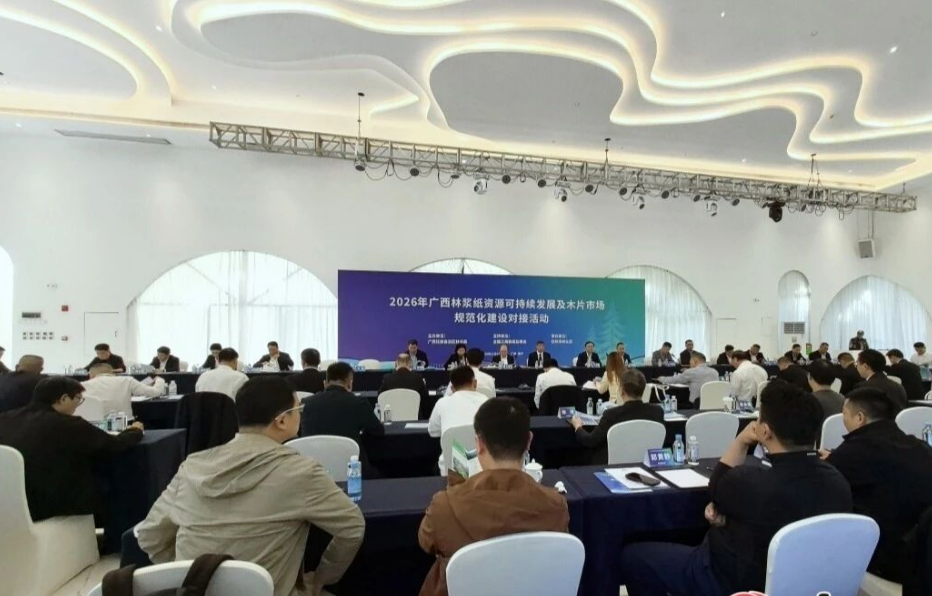
On November 21, 2026, an event focused on the sustainable development of Guangxi's forest pulp and paper resources and the standardized construction of the wood chip market was held in Nanning. The event invited academicians and experts in the forest pulp and paper field, as well as representatives from relevant district and municipal government departments, local state-owned forests, major domestic pulp and paper companies, and wood chip production and supply chain trading companies, with a total of 110 participants.
The meeting revealed that wood processing and the paper industry are among the top ten modern pillar industries in Guangxi's manufacturing sector. Leveraging abundant plantation forest resources and the combined advantages of the Pinglu Canal's river-sea transport and the Beibu Gulf's coastal opening, Guangxi's paper industry has achieved rapid growth in recent years. By 2025, the region's production of paper and paperboard is expected to reach 11.9846 million tons, ranking fifth in the country, with virgin wood pulp production ranking first nationwide.
According to the 15th Five-Year Plan, Guangxi aims to build two major paper industry clusters along the Xijiang River and the Beibu Gulf coast. By the end of the plan, it intends to achieve a pulp capacity of 30 million tons and paper and paperboard capacity of 45 million tons, establishing a large-scale, technologically advanced, modern full-industrial base for forestry, pulp, paper, and fiber.
Wang Shuangfei, academician of the Chinese Academy of Engineering and professor at Guangxi University, delivered the keynote report analyzing the development trends of the national and Guangxi paper industries. He pointed out that Guangxi's pulping and papermaking equipment and green, low-carbon transformation levels are among the best in the country. However, it also faces raw material challenges such as a lack of dedicated papermaking tree species, low per-hectare forest yield, insufficient supply of coniferous wood, and poor compatibility of bamboo resources for pulping. He suggested accelerating the cultivation of high-quality eucalyptus, acacia, Masson pine, and timber bamboo; optimizing forest management techniques; and building a diversified raw material supply system of 'local cultivation, regional adjustment, ASEAN imports' to solidify the raw material foundation for industrial development.
"The navigability of the Pinglu Canal further unleashes Guangxi's advantage of connecting rivers and seas, creating favorable conditions for the paper industry to align with RCEP rules and deepen China-ASEAN industrial chain cooperation," said Gu Baohua, Party Secretary and Director of the Guangxi Forestry Bureau. Guangxi will continue to promote the construction of industrial raw material forests and high-yield bamboo bases, improve the 'forest-industry combination' supply stabilization mechanism, enhance cooperation between state-owned forest farms, wood chip suppliers, and leading paper enterprises, accelerate the establishment of bulk timber trading markets, and open up multiple raw material supply channels.
During the special seminar, participants discussed two main topics: 'Supply Mechanism of Forests for Pulp and Paper in Guangxi' and 'Quality Improvement and Market Standardization of the Wood Chip Processing Industry.' They proposed practical measures on high-quality seed cultivation, long-term cooperation between farms and enterprises, wood chip quality control, construction of digital bulk trading platforms, and improvement of import supporting facilities.