


Digital printing demand is rising in Eastern Europe, and an Austrian printing company is introducing the Heidelberg Jetfire 50
In recent years, the global trend of small-batch, personalized commercial printing has gradually extended to the Eastern European market, where local demand for digital printing continues to rise, and the market attention toward industrial-grade digital printing solutions is increasing. Heidelberg, with its Jetfire 50 industrial inkjet system and a complete digital ecosystem, has gained growing recognition from printing companies in Eastern Europe.
Steady Growth of Digital Printing in Eastern Europe
According to Heidelberg's market analysis, by 2030, digital printing output in Eastern Europe is expected to account for about 44% of total commercial printing production. The key factor supporting this growth is the ongoing deepening of the short-run printing trend in the region.
In terms of regional layout, Poland, Austria, and the Czech Republic, with their well-established printing industry bases, are among the fastest-growing markets for digital printing in Eastern Europe. Roland Spatt, Heidelberg's Regional Head for Eastern Europe, said, "The Jetfire 50 has received very positive feedback in the Eastern European market. With this industrial inkjet printing system, Heidelberg has reached a new level of productivity in digital printing, helping commercial print businesses combine their existing offset operations to build differentiated competitiveness for the future."
For most printing companies in Eastern Europe, digital printing transformation is not about replacing offset printing but achieving a complementary synergy between offset and digital printing. The Heidelberg Jetfire 50 focuses on industrial-grade production efficiency and offset-level output quality, perfectly meeting the needs of companies upgrading to a hybrid production model and optimizing overall capacity. Heidelberg's Chief Sales Officer, Dr. David Schmedding, stated that the implementation of the Jetfire 50 is a typical example of a hybrid printing solution matching customer needs, helping companies operate more flexibly and efficiently in the market, thereby enhancing profitability and competitiveness. Next, Heidelberg plans to launch the Jetfire 75 to expand its B2-format digital product lineup, further improving productivity and covering a wider range of business scenarios.
Austrian Printing Company Implements Jetfire 50
Klampfer Druck, located in Sankt Ruprecht, Austria, is a highly representative full-service printing company and a long-term partner of Heidelberg. The company currently has about 100 employees and operates five production sites, offering high-quality commercial printing and folding carton production, making it one of Austria's larger local printing enterprises.
Faced with the market's increasing demand for production flexibility and short lead times, Klampfer Druck completed the installation and commissioning of the Jetfire 50 at the end of August this year, officially expanding its digital printing capacity. General Manager Daniela Klampfer noted that the trend of small-batch and personalized products in the current printing market continues. For Klampfer Druck, which covers both commercial printing and creative packaging, the Jetfire 50 can respond to these emerging market demands cost-effectively while ensuring high quality.
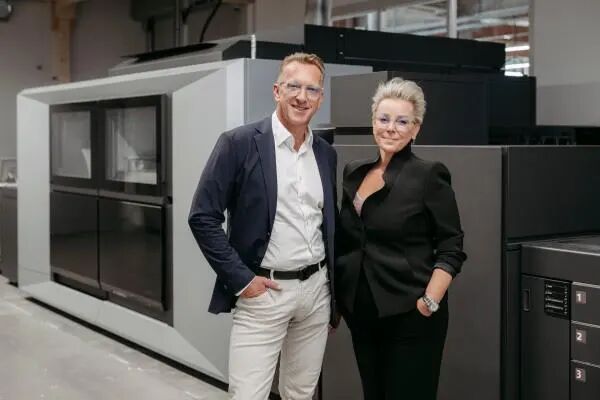
After putting the Jetfire 50 into production, Klampfer Druck further deepened its hybrid production layout, allowing offset printing and digital printing to each play to their strengths. This industrial digital printing system can print double-sided at a speed of up to 4,560 SAR3 sheets per hour, with production efficiency far exceeding the toner-based digital presses the company has used for years, making it capable of handling short-run jobs in higher volume ranges.
At the workflow integration level, the Jetfire 50 can seamlessly connect to the company's existing production workflow via the Heidelberg Prinect system. At Klampfer Druck, the device has been successfully integrated into the existing production system built by a third-party supplier, while the company also retains the option to later upgrade to the AI-driven Prinect Touch Free workflow to achieve full-process automation and ensure seamless integration of offset and digital printing, reducing manual intervention while continuously optimizing production processes.
Currently, Klampfer Druck's offset operations are equipped with two Heidelberg Speedmaster XL 106 and Speedmaster CX 104 presses, running three shifts, and are supported by Heidelberg Subscription Smart service contracts for maintenance and consumables. Company General Manager Robert Klampfer said: "With our order structure, short-run jobs of 1,000–2,000 copies aren't economically viable on either toner-based digital presses or offset presses. The Jetfire 50 can quickly and high-quality handle all kinds of short-run jobs, optimizing the entire production infrastructure utilization and ensuring every order is produced on the most suitable equipment."
In terms of quality, the output from the Jetfire 50 is visually indistinguishable from offset print, and its stable color management provides core support for hybrid production. Early small-batch orders of the same product can be printed digitally, and when demand increases, production can switch to offset; personalized gift vouchers, direct mail, and other products that used to require a two-step process can now be printed in a single pass, and calendar production efficiency has also been significantly improved.
For Klampfer Druck, the decision to invest in the Jetfire 50 was not just about a single machine but the complete digital ecosystem Heidelberg built around it. Its ease of operation helps address the industry-wide shortage of skilled workers, and the intuitive Prinect Production interface lowers the learning curve, allowing prepress staff to be quickly trained and reassigned to production. The machine currently has an availability rate of around 90%. Based on experience with their offset business, Klampfer Druck also opted for Vendor Managed Inventory (VMI) services for the Jetfire 50, with Heidelberg managing and replenishing consumables like ink.
On the finishing side, as a systems integrator, Heidelberg can provide inline and near-line finishing solutions for the Jetfire 50, integrating C.P. Bourg and Tecnau finishing equipment, as well as its own Stahlfolder Fireline folding solution, covering folding, perfect binding, saddle stitching, and more, enabling production of brochures, catalogs, and books in one pass. Klampfer Druck has already implemented Heidelberg finishing systems like Stahlfolder folding technology, StackStar-P robots, MK Masterwork die-cutting and hot-stamping systems, and Diana Go gluing machines, achieving control over most production steps and forming a coordinated production chain with the Jetfire 50. Daniela Klampfer emphasized: "Thanks to these measures and continued investment, we are able to hold our ground and achieve steady growth despite a challenging market environment."
The growth of the digital printing market in Eastern Europe reflects the broader global shift in printing industry demand. In markets with a strong offset printing foundation, pure digital substitution is not suitable for most companies' business realities, and hybrid "offset + digital" production is emerging as a more viable transformation path.